The future is analogue
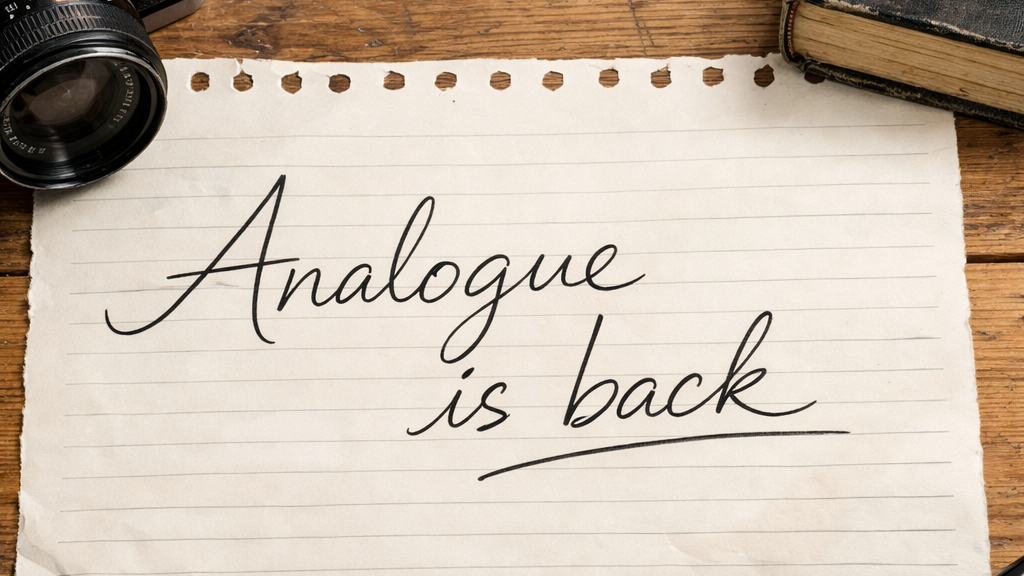
We misread what “better” means
For decades, “better” has been treated as “put it on a screen”. Meetings, dating, shopping, thinking – all repackaged as apps, feeds, dashboards.
Yet look at where people spend money and energy now:
Trips to places with bad reception.
Workshops where you write on real paper, standing next to real people.
Printed magazines for audiences who could read the same words on a phone for free.
If digital really solved everything, these things would look like relics.
They don’t. They look like oxygen.
Analogue is deliberate friction
Analogue tools slow you down in ways that are hard to fake:
A notebook forces you to choose what goes on the page.
A conversation in person forces you to listen and to connect and stop multi-tasking.
A small room forces you to decide: who needs to be here badly enough to take a chair.
AI can handle anything repeatable. It thrives on volume.
That pushes value to the few places that resist being sped up and scaled.
Deliberate friction becomes a design choice.
When everything is fluent, rough edges signal “real”
AI content is getting smoother by the week. That smoothness is starting to backfire. People are learning to distrust anything that sounds like it has passed through the same invisible template.
What cuts through now:
An unedited voice note from a leader instead of a polished email.
Slides with handwriting over screenshots instead of flawless corporate templates.
Policy positions that show real thinking.
These details don't just show authenticity (a word people are tired of). It shows that someone cared enough to do this the slow way.
Analogue as a power move
For organizations, “the future is analogue” is a set of hard choices about where you refuse to outsource your judgment.
That can look like:
Defining a few moments in your workflows where AI is banned: crisis response, final approvals, delicate negotiations.
Making certain meetings pen-and-paper only, to force attention.
Sending fewer mass emails and hosting more small rooms where people can ask uncomfortable questions.
Design campaigns that earn attention in the room, not just in the feed – workshops, townhalls, tangible artefacts people can hold and keep.
Treat analog touch points (print, events, handwritten notes, physical mailers) as premium media, not nostalgic extras. Use AI and platforms to find and understand your stakeholders, then deliver the message in the format their overloaded brains actually trust.
The message underneath: “We use machines as sparring partners to think with and to amplify, not to think instead of us.”
The edge belongs to the ones who can switch off
The organizations and leaders who thrive in the next decade will be fluent in AI – and very clear on when to close the laptop.
They will:
Use LLMs for research, analysis, drafting and simulations.
Keep the human work for sense-making, ethics, relationships, empathy, and taste.
Treat analogue not as nostalgia, but as infrastructure for trust.
The future is full of AI. The advantage goes to the people who can still stand in a room, with nothing but a pen and a point of view, and move other humans.
👋 We're The Think Room. Want to stay visible, credible and human in the age of algorithms? We find your unique DNA so you stand out in a tsunami of sameness. We do this for organizations and the people that make these organizations what they are.