Why are your LinkedIn impressions down?
Why are your LinkedIn impressions down?
The algorithm changed... again
Everyone is complaining to me: "My impressions are sooooo low."
I know. it's frustrating. But there is good news. For the first time LinkedIn's engineers have given insight into the algorithm and how it works.
It's quite a technical article, which I will link below, so I will unpack it for you.
It comes down to this:
LinkedIn has changed how the Feed works and it now cares much more about professional substance, topic clarity and behavioural patterns over time.
It is a different way of deciding who sees what in the main Feed.
What LinkedIn changed in 2026
On 11 March 2026, LinkedIn published a technical explanation of how it rebuilt its Feed using AI and new ranking infrastructure.
The goal is to show more relevant, timely and professionally useful content to more than one billion members and to reduce low value engagement bait.
In practice this means three big shifts for you:
LinkedIn reads posts and profiles in a more detailed way, so it can tell the difference between “EU policy” as a buzzword and concrete files like CBAM or the AI Act.
It uses a new ranking approach that looks at your engagement history as an ordered sequence, not a pile of random likes, so it can understand where your interests are heading.
It updates its understanding of content and members within minutes, so feeds react more quickly when topics break or when someone changes focus.
If your impressions are down, there is a high chance you need to adapt to these new rules.
BUT these are not bad for EU professionals who care about substance.
How the Feed “sees” EU Bubble professionals now
Think about what LinkedIn knows about a typical Brussels professional.
It has your profile data: Headline, About, roles, sectors, locations, skills, languages, institutional links.
It has your engagement history: The speeches you watch, the press releases you share, the think tank notes you save, the MEP posts you comment on. But also everything else you do on LinkedIn that might not be meant for public consumption...
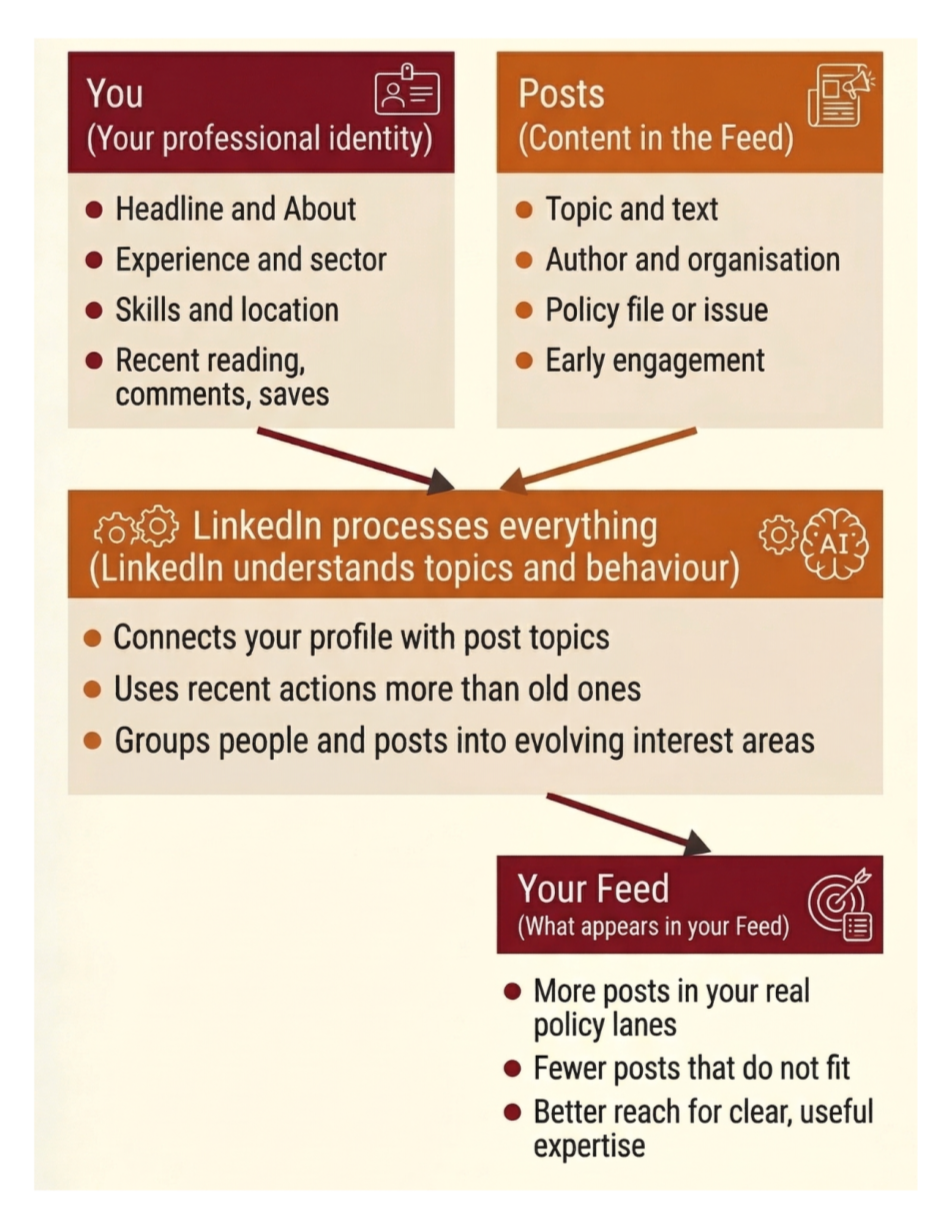
LinkedIn now combines these into a single, rich description for each member and each post.
It feeds those descriptions into an AI system that can understand topics and relationships at scale.
For example, if you:
Regularly read and comment on AI Act, DSA and DMA content
Occasionally engage with competition and industrial policy
Rarely interact with generic “leadership” posts
LinkedIn will:
Bring you more analysis on digital regulation and adjacent policy themes
Reduce generic productivity content that does not match your behaviour
Treat your own posts on digital files as more relevant for other people with similar patterns
Your Feed becomes a reflection of what you actually follow, not what you pretend to like. :-)
What is the purpose of this?
LinkedIn has been moving in this direction for a while.
In 2025 many practitioners noticed that quality and topic relevance were beating generic posts more often.
In March 2026 LinkedIn confirmed that it has replaced older, fragmented systems with a unified, language based retrieval and ranking architecture, powered by large language systems and GPUs.
At the same time, LinkedIn publicly committed to:
Down ranking engagement pods, automated comments and low value viral formats
Prioritising content that shows expertise and aligns with “emerging professional conversations”
Making feeds adapt faster when someone shifts topic or role
For the EU Bubble, this is exactly your turf: emerging conversations, complex files and constant shifts in focus.
What this means for your EU Bubble visibility
Let us translate this into concrete consequences for policy and public affairs work.
You cannot hide behind generic language . LinkedIn understands topics more deeply now.
If your profile and posts say:
“EU affairs,” “policy,” “stakeholders,” “innovation,” “sustainability”
but never mention:
- CBAM, ESRS, Net Zero Industry Act, Mobility Package, EHDS, enlargement, ETS, DSA, DMA
then you are sending a weak signal.
LinkedIn will struggle to place you in specific professional conversations.
You will blend into a generic comms category, where reach is more competitive and less relevant.
What to do:
Name the actual files and instruments you work on.
Use the same language that your colleagues, clients and the Official Journal use.
Make sure your headline and About mention your policy lanes, not only your corporate role.
Your profiles and posts are one system
Under the new architecture, your profile is not a static CV, it's active information.
This means:
If your headline says “EU health policy,” but your posts are mostly generic leadership quotes, LinkedIn sees a mismatch and your impressions go down
If your experience, skills and featured section are all aligned with a policy area, and your posts consistently reflect that, LinkedIn has a very clear story of who you are.
Clear story equals easier matching with the right people and higher odds that your content goes far.
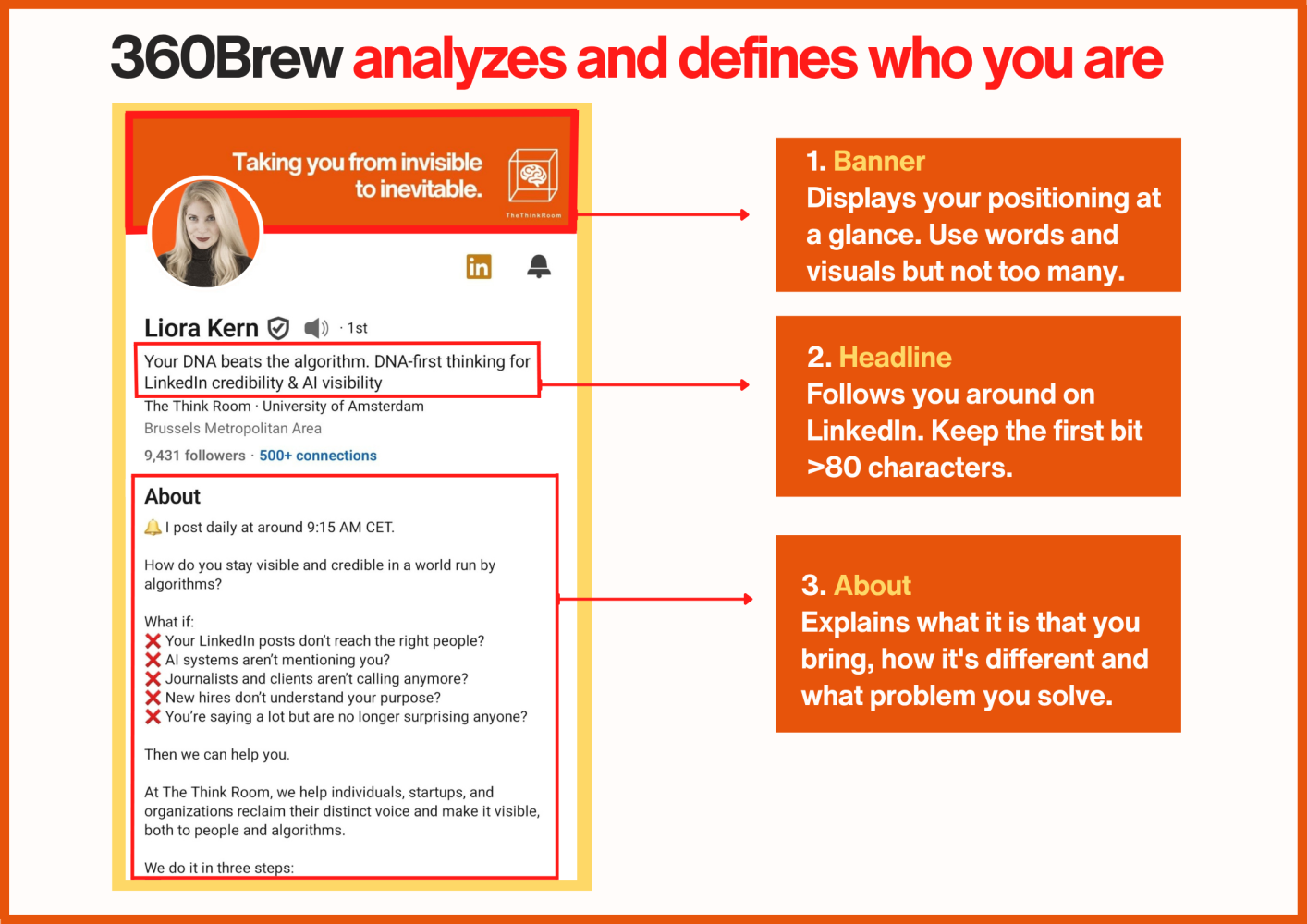
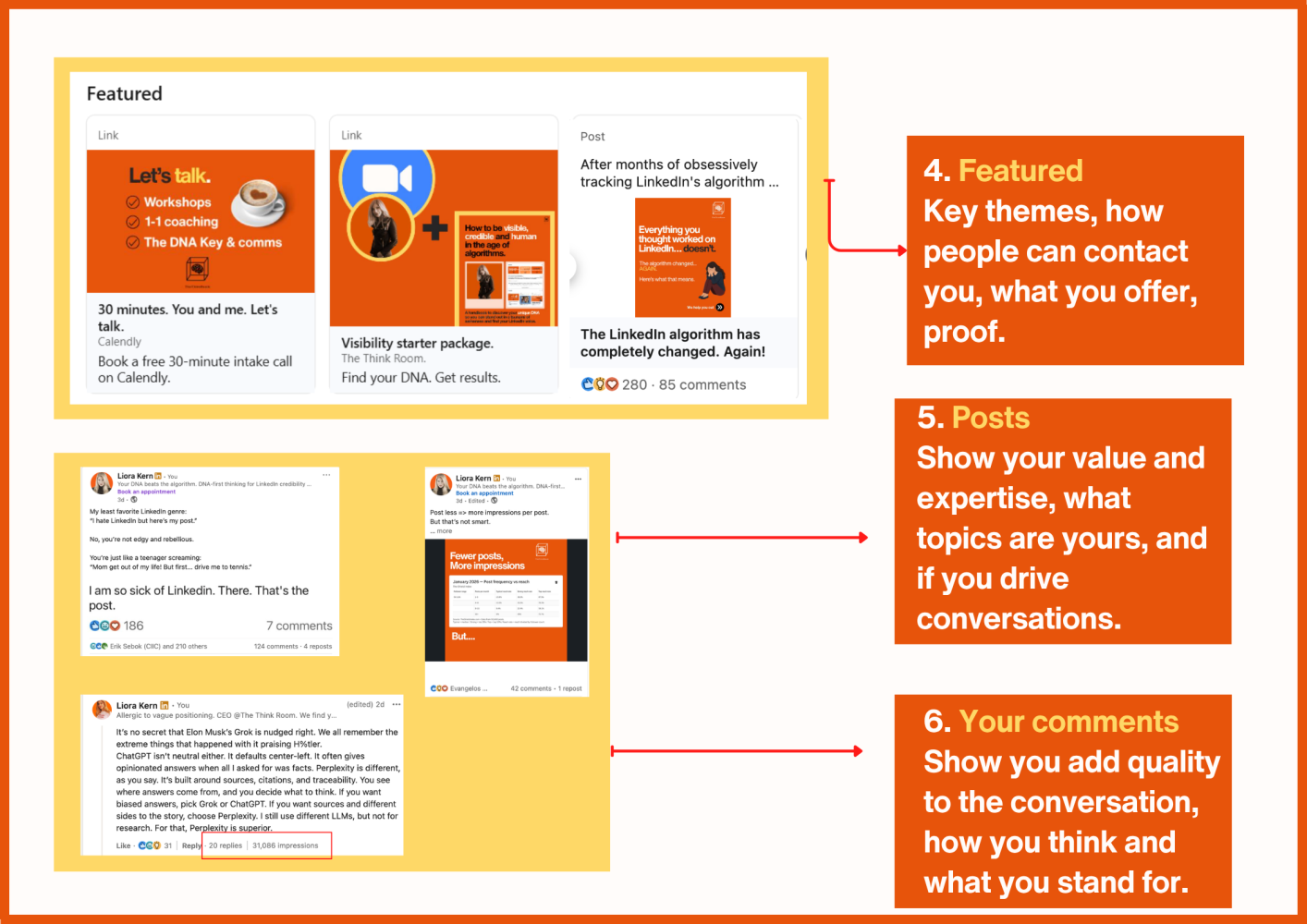
The elements LinkedIn's algorithm looks at
Featured, posts and comments are taken into consideration and should be aligned
Useful context beats polished announcements
LinkedIn says it wants “genuinely valuable” and “professionally relevant” content.
For Brussels, that should be easy peasy.
Content that the new Feed favours:
Short explainers of what a new legislative proposal does for a specific sector
Trilogues and comitology updates written in plain language
“What this means for” posts aimed at specific audiences: SMEs, local authorities, NGOs, industry, regions
Visuals or carousels that walk through timelines and decision points
Content that the Feed is more skeptical about:
Generic event invitations without context
Copy pasted press releases
Posts that only list speakers without explaining why it matters
If you want impressions that matter, focus on saving people time and helping them prepare for their real world conversations.
Sequence and timing matter
LinkedIn now looks at your interactions as a sequence that evolves.
This matters for creators in the EU Bubble because your topics often move with the legislative calendar.
You can work with that:
Build series around key files: from proposal to trilogue to implementation
Create recurring formats: “This week in digital policy,” “Green Deal watch,” “Plenary preview”
Align your posts with predictable milestones: Commission work program, Council presidencies, key ENVI, ITRE and IMCO votes
Over time, the Feed will recognize that your account tells a coherent story around certain processes and will be more likely to suggest you to people who follow those processes.
Your engagement is just as important as your posts
Your own behaviour now has more weight.
Analyses of the 2026 update confirm that LinkedIn reduces overall low quality engagement and treats the remaining interactions as higher intent signals.
For EU Bubble professionals this means:
Whose content you support and discuss helps define your own topic footprint
Thoughtful comments on key institutional and stakeholder posts can extend your reach into relevant networks
Random likes on whatever crosses your Feed do not help your positioning and can confuse the system
Think of engagement as an extension of your advocacy, not as a chore.
The new algorithm watches you
Why impressions are down
If your impressions are down in 2026, a few explanations are likely:
LinkedIn is deliberately reducing noisy engagement and inflated numbers
Your topics and language are too generic for the new, more semantic Feed
Your profile does not match your posting behavior
You are posting announcements, not adding context and interpretation
You are not building sequences that the system can recognize over time
The solution is to be clearer, more specific and more consistent about what you are here to do.
How to adapt
Here is a short checklist you can use this month.
Profile
Rewrite your headline to include your role, your core policy lanes and your audience
Update your About to describe the files and issues you actually work on, in plain language
Refresh your featured section with content that reflects your current focus, not only past press releases
Content
Commit to three to five consistent themes that match your files and responsibilities
Share fewer corporate visuals and more contextual posts that explain why something matters
Create at least one recurring series linked to the legislative or political calendar
Engagement
Spend ten to fifteen minutes a day engaging in your real policy lane
Comment with substance on institutional, NGO, association and expert posts that relate to your work. Do you disagree? Explain why, but always be respectful and kind.
Save high quality explainers and refer back to them in your own posts
The new LinkedIn Feed is moving closer to how Brussels actually works.
It rewards people and organizations that can make sense of complex issues for specific audiences over time.
Sources:
Engineering the next generation of LinkedIn’s Feed:
https://www.linkedin.com/blog/engineering/feed/engineering-the-next-generation-of-linkedins-feed
LinkedIn Newsroom: How LinkedIn is improving the feed to show more relevant content:
https://news.linkedin.com/2026/ImprovingTheFeed
6 elements that tell LinkedIn who you are:
LinkedIn updates feed algorithm with LLM powered ranking and retrieval
https://searchengineland.com/linkedin-updates-feed-algorithm-llm-ranking-retrieval-471708
--
👋 I'm Liora Kern. With my startup The Think Room we help organizations and individuals be visible, credible and human in the age of algorithms.
Contact me for workshops, strategy and identity mappings.