Don’t improve your prompting. Use these 3 documents instead
You don’t need to improve your prompting. What you need is these 3 documents.
Everyone is suddenly excited about teaching AI their DNA.
We’ve been doing exactly that for the past year.
The technology improved but the underlying problem did not: AI without identity creates generic output.
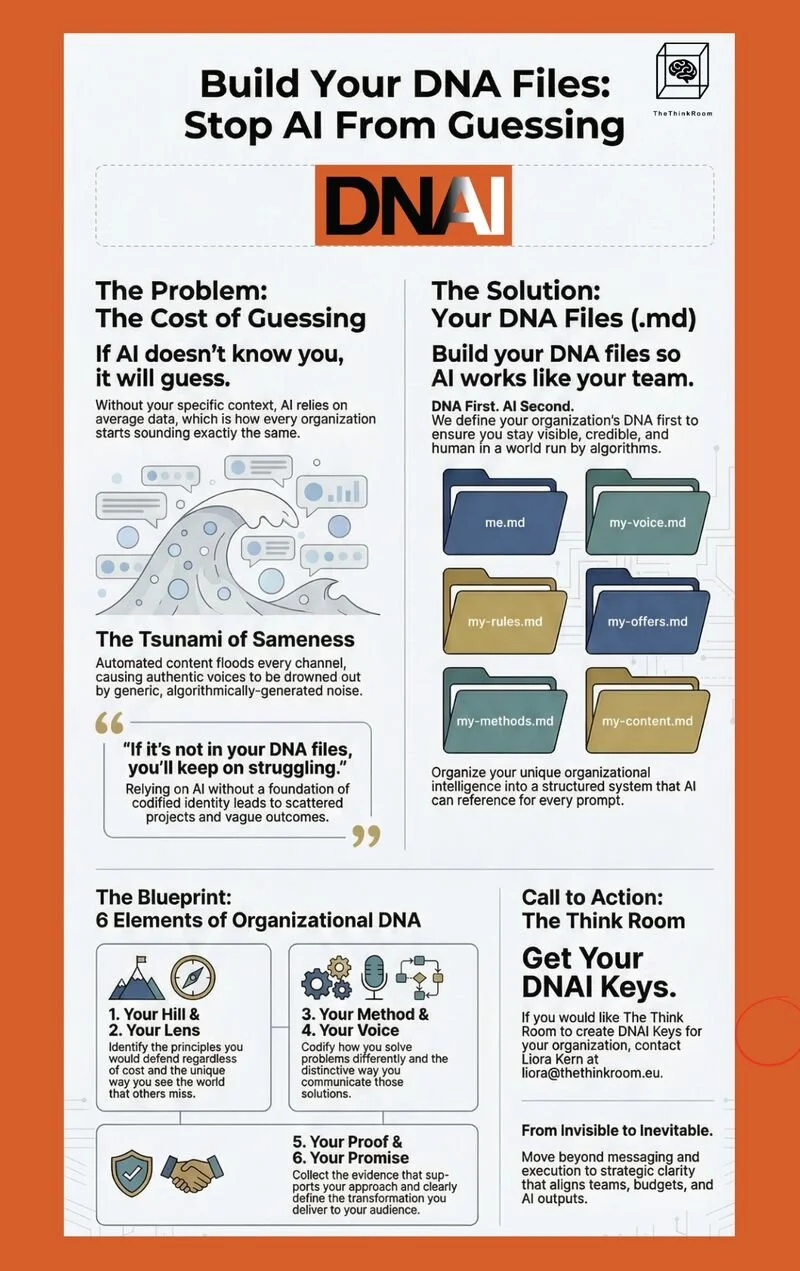
AI is a new team member. And team members need onboarding.
If AI doesn’t know who you are, what you do, what you believe, how you write, how you think, how you want it to work with you
…it will guess and be random.
And when has random ever worked?
That’s how we got into this tsunami of sameness, and how you end up being frustrated with your AI of choice.
So here is a simple way to structure your DNA files.
Only 3 files to start with!
1️⃣ me.md
This file explains who you are and what you do.
Include:
- Short bio
- What you do professionally
- Who you help
- Your expertise areas
- Your point of view
- Your frameworks and methodologies
- Topics you often talk about
- Questions people ask you often
- Questions you want to be known for answering
- Your differentiators
- Your mission/vision
- Your story and experience
2️⃣ my-voice.md
Include:
- Tone of voice
- Words you like
- Words you dislike
- Sentence style
- Formatting preferences
- American or British English (or another language)
- Examples of LinkedIn posts, emails, articles, speeches
- Phrases you often use
- How formal or informal you are
3️⃣ my-rules.md
This file explains how AI should work with you.
Include:
- Ask me questions before answering
- Challenge my thinking
- Act as strategist / editor / advisor
- Show a structure before writing
- Give options and examples
- Avoid certain words or styles
- Preferred formats
- What a good answer looks like for you
You can then add things like:
- my-offers.md
- my-methods.md
- my-content.md
- my-clients.md
- my-positioning.md
The important part is that you are building a structured brain about you, your voice, your work, and your rules.
That is essentially what a real DNAI Key is.
You can keep a master “DNAI Key” folder in Claude’s global instructions on desktop with these sub‑files. In other LLMs you can upload them in relevant Projects and GPTs.
But these documents are not just for AI, you can use them for new hires agencies, partners, and internal alignment.
If you’re an individual, you can probably create them yourself.
If you’re part of an organization, this exercise forces you to define who you really are, what you stand for, and how you want to communicate.
And that is much harder than writing prompts.
