Did your 40k followers just become useless?
Indeed, how do you get your impressions back. And more importantly, real-life results?
The Think Room | Put Us in the Hot Seat
Hard to imagine now in this heatwave, but this particular Friday it was raining cats and dogs. Brussels had decided summer was optional this week, and Liora Kern and Sebastián Rodríguez showed up anyway - for the third LinkedIn Live in a row - because apparently no amount of grey sky is going to stop us talking about LinkedIn.
Good thing, because the platform had a week.
What's going on with my posts?
A post went viral. It talked about something that a lot of people have been feeling: your follower count stopped mattering.
Not "matters less." Stopped mattering. People with lots of followers were seeing no engagement. And people with very few followers were going viral. What is LinkedIn doing?
Liora explained.
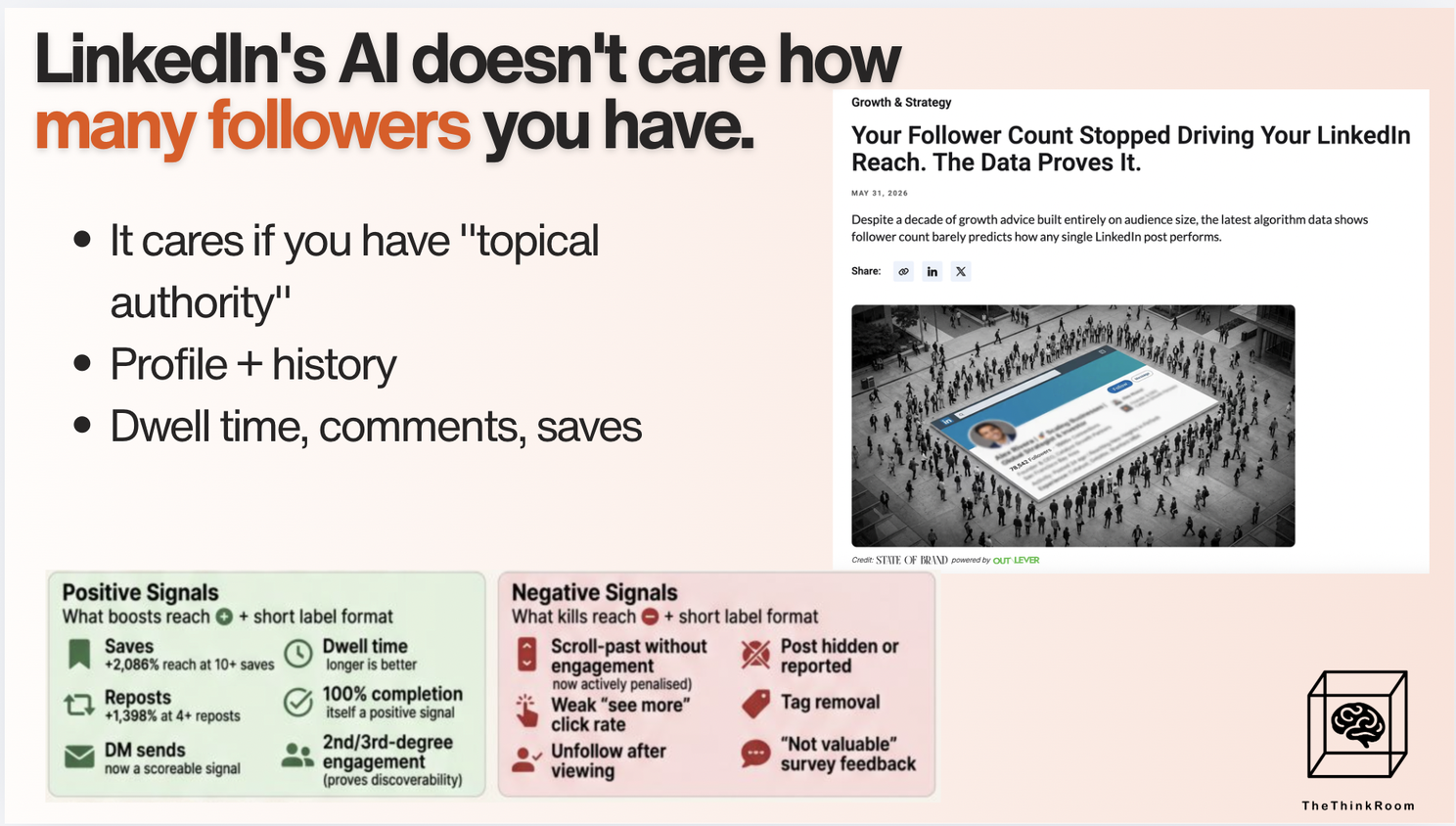
LinkedIn moved from a relationship graph - where your reach came from who you were connected to - to an interest graph. The platform now shows content based on topic relevance. Richard van der Blom, the person behind the LinkedIn Algorithm Insights Report, built from 1.8 million posts, put data behind that: organic reach is down 47%, engagement down 39%, follower growth down 59%. The people who feel that the most are those who built big followings posting across too many topics.
"There are people with 20, 30, 40,000 followers, and they have zero likes," Liora said on the show. "Zero. Because they post about different things every day."
The algorithm now asks one question about your content: Does this person have topical authority? Do they post on one subject, consistently, in a way that's useful.
Source: The Think Room
That's it. That's the whole game now.
What LinkedIn is measuring now
A few things drive reach right now that most people ignore, because they happen invisibly.
Saves. When someone saves your post, LinkedIn treats it as a strong indicator that your content is worth keeping. An 80% chance their next post from you appears in the feed, according to van der Blom's data.
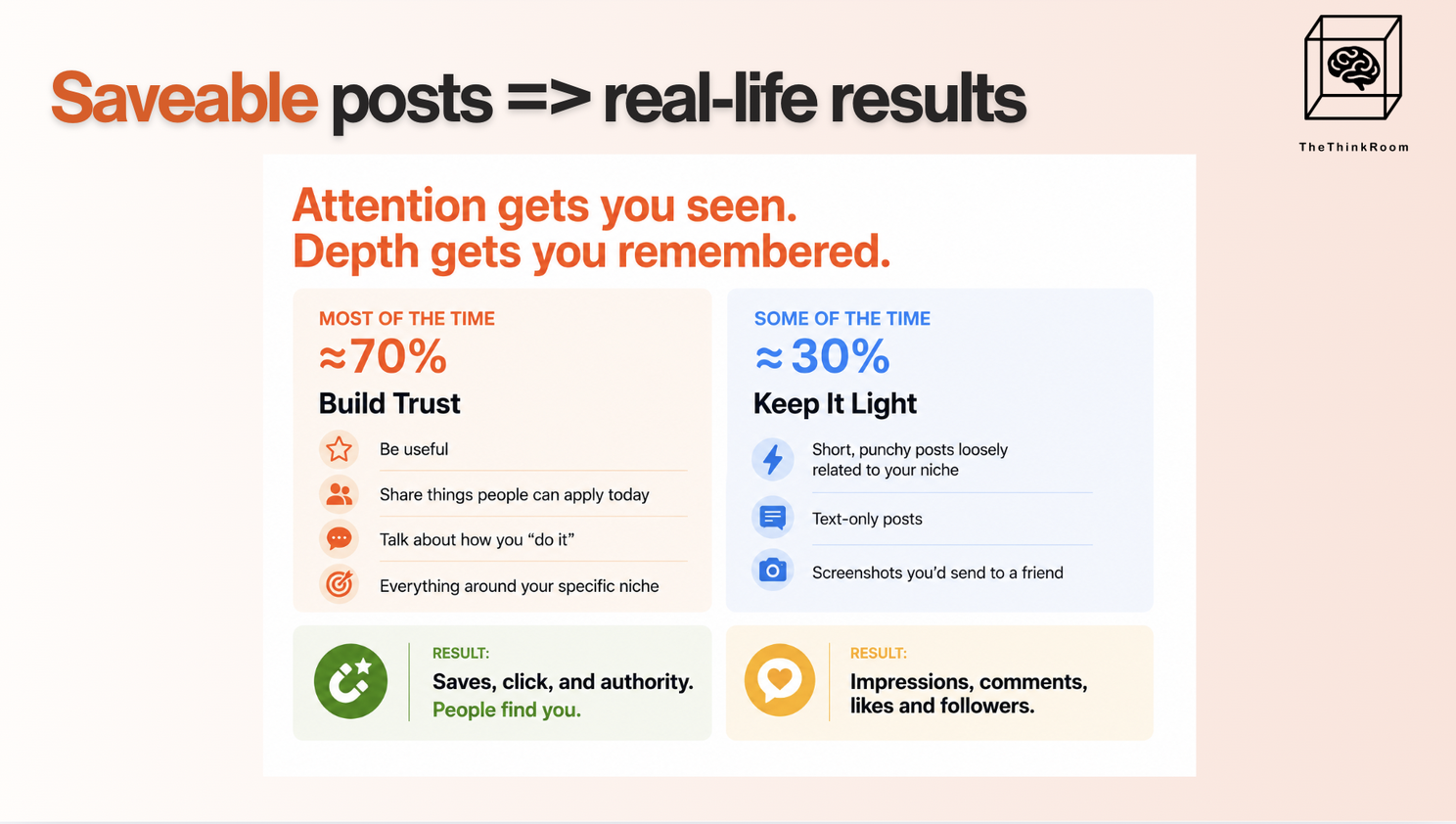
Image Source: The Think Room
DMs. If someone forwards your post to a colleague, that's a data point nobody else can fake or game.
Dwell time. How long do people stay on your post? Do they read to the end?
Outside-network engagement. People who aren't your connections or followers commenting and engaging - that tells LinkedIn the content has legs beyond your existing circle.
What kills reach makes sense: immediate scrolling, people clicking "hide post," or unfollowing right after you publish. People blocking you, of course.
The lifespan of a post (it's longer than you think)
Something that changed too. "If your post doesn't gain traction in the first 90 minutes, it's dead." Someone posted that, very recently. But it's not accurate anymore.
Richard van der Blom's data shows four distinct post patterns now:
The Rocket: big engagement fast, from large accounts, early. High peak, shorter lifespan.
The Builder: little engagement at first, then a comment from an active account reactivates it a few days later.
The Grower: steady, slow build over time.
The Afterburner: goes slowly, then something reignites it weeks out.
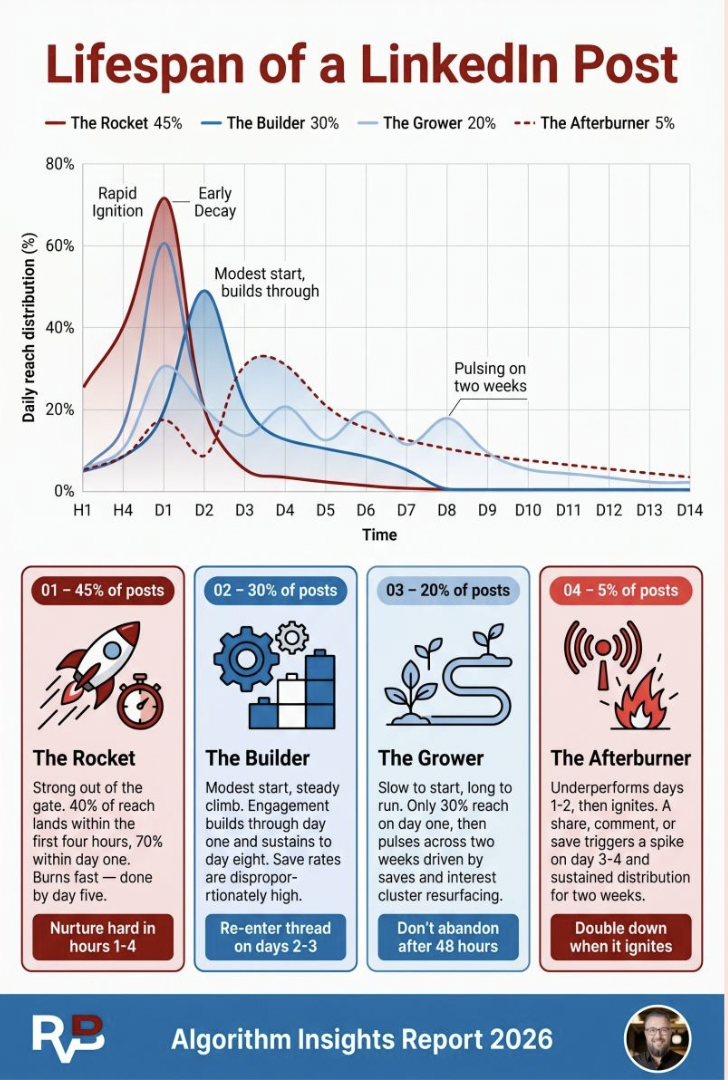
Source: Algorithm Insights Report 2026 by Richard van der Blom
This is why you're seeing posts from three weeks ago in your feed. Stop deleting posts that don't immediately perform - the algorithm is still deciding what to do with them.
Reposts: they help less than you think
Luiz Carlos de Oliveira Junior, joining us from Brazil (and always asking the best questions), said: what about people who keep reposting other people's content?
The answer is that reposts get very few impressions. They don't help your account, and they don't do much for the account you're reposting either. If you want to support someone's post, comment on it. Save it. React to it meaningfully. Be like Luiz.
LinkedIn keeps the repost function. We're not entirely sure why.
AI labeling: where does the line go?
This is where the conversation got really interesting - and where Sebastian brought the Brussels policy angle in.
He submitted a proposal to the European Commission's public consultation on AI labeling (the deadline was June 3rd). His point: the line between "AI-generated" and "human-created" is already impossible to draw cleanly, and the legislation needs to account for that.
"The subtitles on the clips we take from this show are generated using AI to transcribe the audio," Sebastian said. "Do we label that as AI?"
His position, and ours: label when the AI content could genuinely mislead. If Liora generates an image of Ursula von der Leyen dancing in the European Parliament, that gets a label. If she uses Canva's AI feature to clean up a diagram she built herself, the question of what counts as "AI-generated" becomes almost meaningless.
Sebastian put it this way: "Now we are in the phase of - okay, how do we handle all these issues in a practical way?"
His submission is visible on the consultation page, under his name, if you want to follow the thread.
Tools we use
For visuals and content:
Canva - still the starting point for LinkedIn visuals. The Magic Layers feature lets you take an AI-generated image and edit specific elements directly within Canva, which gives you meaningful human input on top of the AI base.
ChatGPT image generation - for contextual images where consistency across variations matters. Sebastian's workflow: generate in ChatGPT, then use the output as a base for animation.
Gamma - for proposals and presentations.
For AI video:
Starting from a text prompt to generate a video is inefficient. The change-one-element problem is nearly impossible to solve mid-generation. The approach is to generate many strong, consistent images first - then animate them. The tool we’re using for that:
Higgsfield - for animating images into video, with strong control over consistency across frames.
Magnific (formerly Freepik, based in Malaga) - for scaling image and video generation. Worth noting: in the ongoing debate about European tech sovereignty, this is a Spanish company competing directly with the large US platforms, Sebastian explained.
The AI-label workaround Sebastian mentioned - and the tension it creates
Sebastian admitted it on air: if he generates an image in ChatGPT, he sometimes takes a screenshot before uploading, which removes the automatic AI tag. He's transparent about the trade-off - he does it only when the content isn't deceptive, and when he's added enough of his own editing that the "AI-generated" tag feels imprecise.
Liora's take: the label matters most when the image could mislead someone not paying close attention. Everything else is a judgment call - and right now, we're all making it without legislation that holds up in practice.
The email question
Sebastian said that what's keeping him visible right now, in a period where LinkedIn reach has dropped hard, is his email list.
"Two out of three new members in the community I run came from my email list," he said. "That is what is saving me."
This fits what the data shows. Beehiiv's State of Newsletters 2026 report shows subscriber numbers and open rates trending upward, even as social platforms tighten their algorithms. Email lists are the one audience channel you own completely - you control when you send, who receives it, how you segment.
Source: Beehiv
The voices in your head (we named ours)
The last section of the show went somewhere unexpected. Liora walked through research by researcher Dr. Shadé Zahrai regarding four inner voices of self-doubt. Liora applied this research to LinkedIn and explain how we have four different inner voices that may hold us back from posting (or taking part in panel debates, for example).
These are voices from the past that are meant to keep us safe, but are now keeping us silent.
The Judge: "Who do you think you are? What if they laugh at you?"
The Protector: "Better to stay quiet. Don't attract attention. Don't take up space."
The Police: "You need more experience before you post. Take another course first. You're not an expert yet."
The Neglecter: The one that has you posting for everyone else - your CEO, your clients, your colleagues - and never for yourself.
Liora calls hers Fred. Specifically a small man with a mustache. When Fred shows up, she tells him to be quiet “I am not listening to you Fred”.

Source: The Think Room
Sebastian brought in the other side: the confidence that comes with doing none of this work. He got a message once from someone calling his content "so basic, common sense, I don't even know why you write about it." That person has a real name and surname, lives in Sebastian's head at specific moments, and is now permanently blocked on LinkedIn.
Charlotte Kan, a conversation architect who organized an event with Liora, said it well: "If people are confident, they don't need to put you down."
You won't remember all the positive feedback, but you'll obsess over that one negative message. Screenshot the good ones. Build a folder. Look at it on the hard days.
Post of the month
Robert van Tongeren"The Mother, The Dickhead, and the Massive Power of Tiny Impacts"- was our post of the month. It got a lot of engagement. Liora said she was not crying. She was. Read it.
The one-paragraph summary Sebastian asked for
Post on one topic, consistently. Make it useful to a specific audience. Care about saves more than likes. Give your posts time - they live longer than the old algorithm allowed. Build your email list in parallel; it's the only audience that belongs to you. And silence Fred.
Questions? Drop them in the comments on LinkedIn or tune in live next Friday.
The Think Room Team
We make you visible, credible and human in the age of algorithms
