
The short version: Your LinkedIn profile should tell people what you do unusually well, give them a reason to believe you and make the next step easy. Your posts should keep reinforcing the same message. That also gives AI search more information about you and your expertise.
Some very experienced people are hard to understand on LinkedIn.
Their (your?) profile has 20 years of experience, a variety of job titles, dozens of skills and several impressive organizations.
It doesn't help us at all. IIt’s giving: "Here is everything I have ever done, you figure it out."
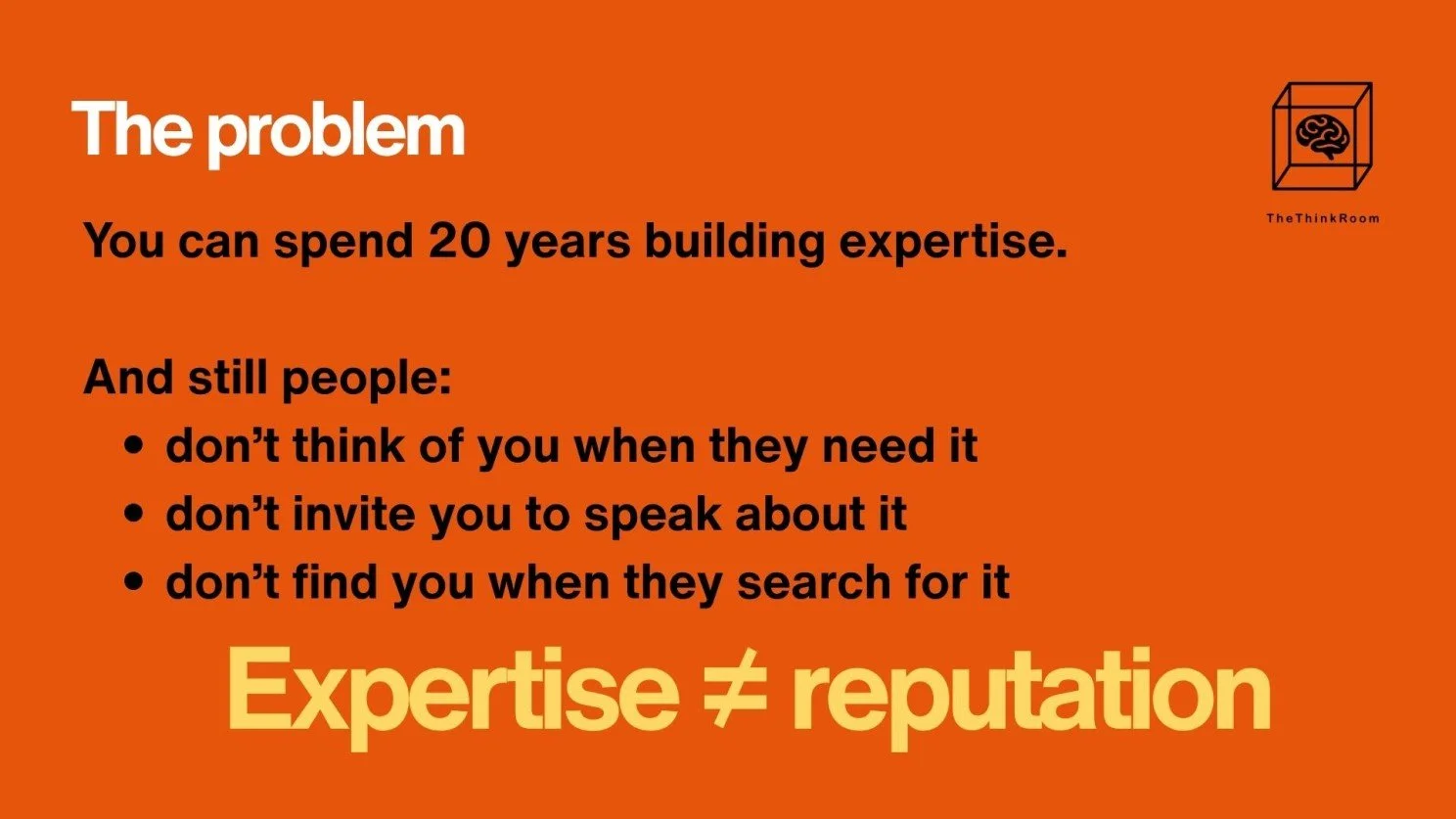
Expertise does not equal a good reputation
When we review LinkedIn profiles, we look at five things:
Distinctiveness: What could only belong to you?
Positioning: What should people know you for? Is the goal of the profile clear?
Proof: Where is the evidence?
Next steps: What should someone do after visiting your profile?
Connection: Do we get a sense of the person behind the expertise? Do we like you?
Let's look at all five.
But first, what are you even here for?
The most important thing about your LinkedIn, and generally your communication, is defining your goals.
Why are you on LinkedIn? What do you hope to get out of it? Put those goals on paper and be specific.
Examples:
I would like to be approached by event organizers to be in their panels and give keynotes => 5 requests per month
I would like to be approached to give paid workshops and trainings => 5 enquiries per month
I am a freelancer and would like potential clients to understand what I do and contact me with assignments => 10 calls per month
I would like recruiters to contact me with job offers so that I have a new job in 6 months
I am happy with my job but would like to build my LinkedIn visibility for general influence and the future => grow my LinkedIn followers by (percentage or number at <specific date>) and grow engagement/impression by (percentage by <specific date>)
Then let's optimize 5 sections of your profile toward that goal.
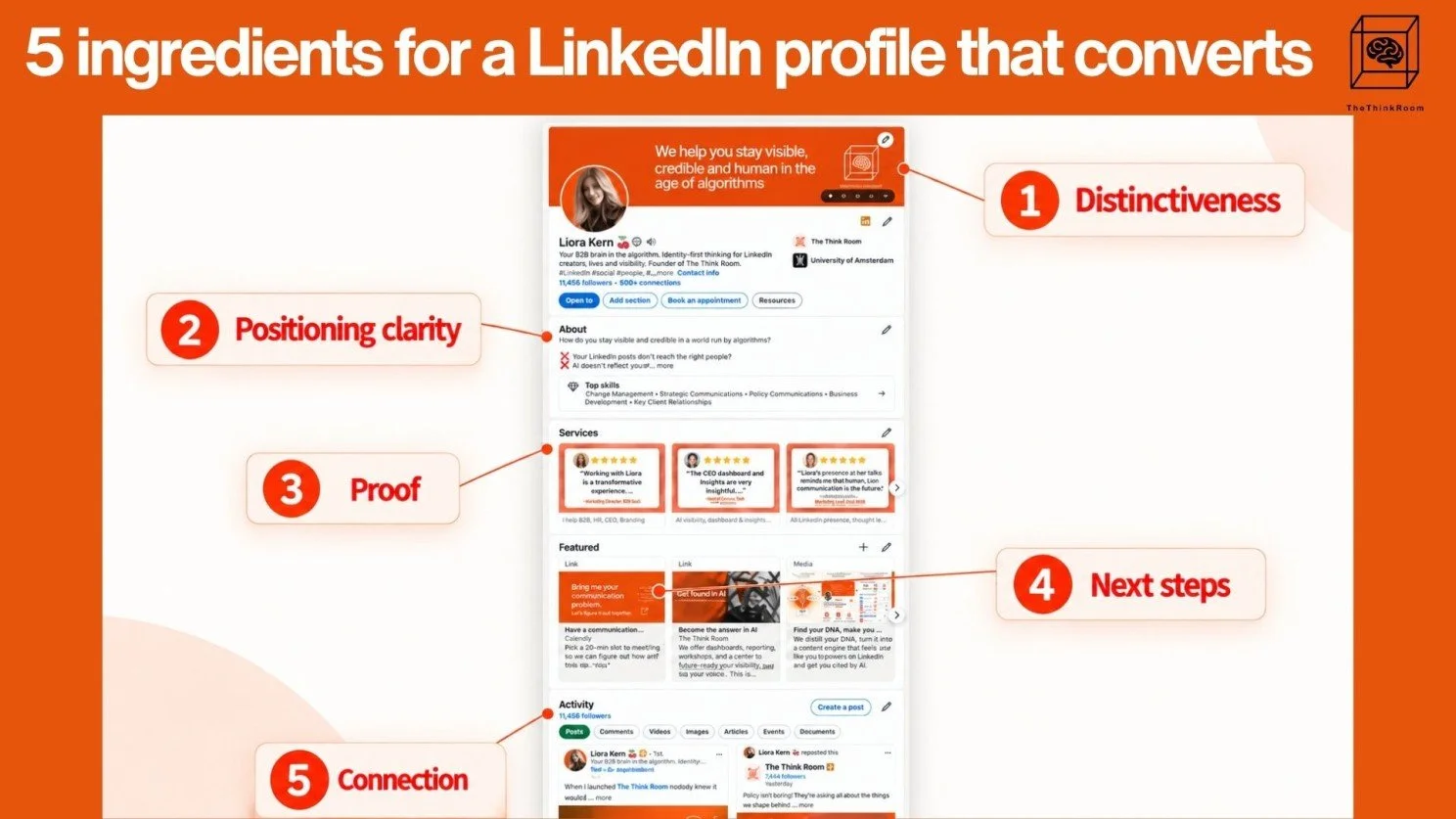
Source: The Think Room
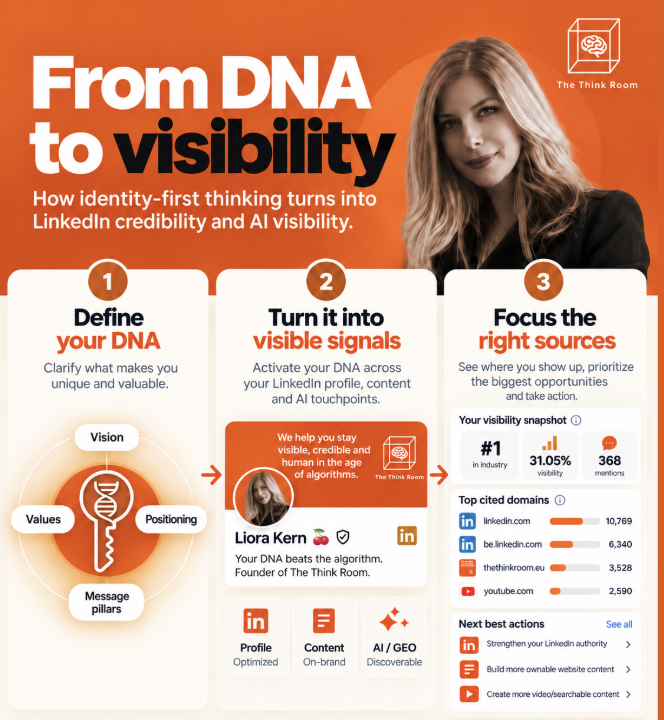
1. Distinctiveness: Your unique combination of skills, values, and experience
Find your unique DNA. Miglė Blusevičiūtė had us map out her DNA Key in great detail.
You may have worked across five sectors and still have one recognizable strength running through all of them: making complexity understandable, spotting patterns early, getting difficult people to agree, or turning ideas into decisions. That is far easier to remember than ten areas of expertise. And it tells you something about what you should probably focus on in your career.
What have people repeatedly relied on you for?
What do you notice that others miss?
What comes unusually easily to you?
What do people keep asking your advice about?
Liora Kern 🍒 explains how to map out your own DNA in this article.
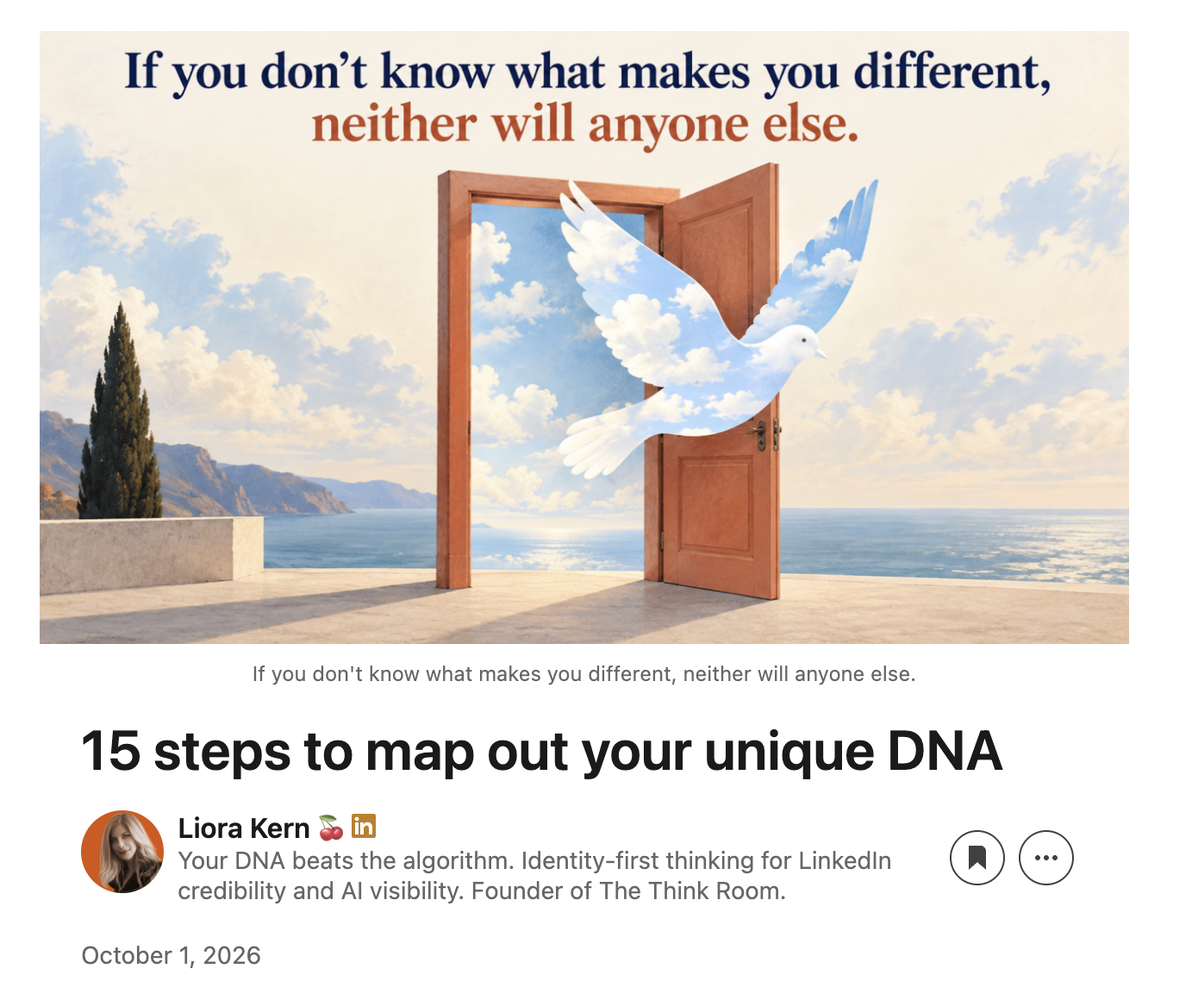
Article: 15 steps to map out your unique DNA
2. Positioning clarity
Going back to your goals and what you want to be found for, make sure that your profile makes that 100% clear.
Within 10–15 seconds, we should be able to work out:
what you specialize in
what problems you solve
whom it is relevant to
what we might call you for
You can clarify this in your About section and in your headline.
Below is what we focus on. Is that all we do? No, we offer many more communication services. But a LinkedIn profile should always be specific.
The Think Room's core services
Give your positioning its own language
Dr. Madeleine de Hauke is a leadership trainer and coach who is a trained medical doctor. She says: "Show me your meetings, and I will show you your culture". The Financial Times called her “The Meeting Doctor.” That opens up a whole vocabulary around her work: "diagnosing" dysfunctional meetings, spotting recurring "symptoms", "prescribing" changes. It is also 100% accurate as her medical background defines how she approaches dysfunctional teams and organizational problems, and it's probably why she is so d*mn good at treating them. “This positioning makes Dr. Madeleine distinctively different from the thousands of other coaches and trainers in the space.
We use the DNA language. Yes we know what we do is not biology. But it sticks, and people remember it and contact us with it, and connect it to us.
What does that mean for you? Listen to the words you use about your own work. Pay attention when clients describe you, look for phrases that keep coming back. Find your own language, then carry that language through your headline, banner, About section and, of course, your posts and comments.
3. Where is the proof?
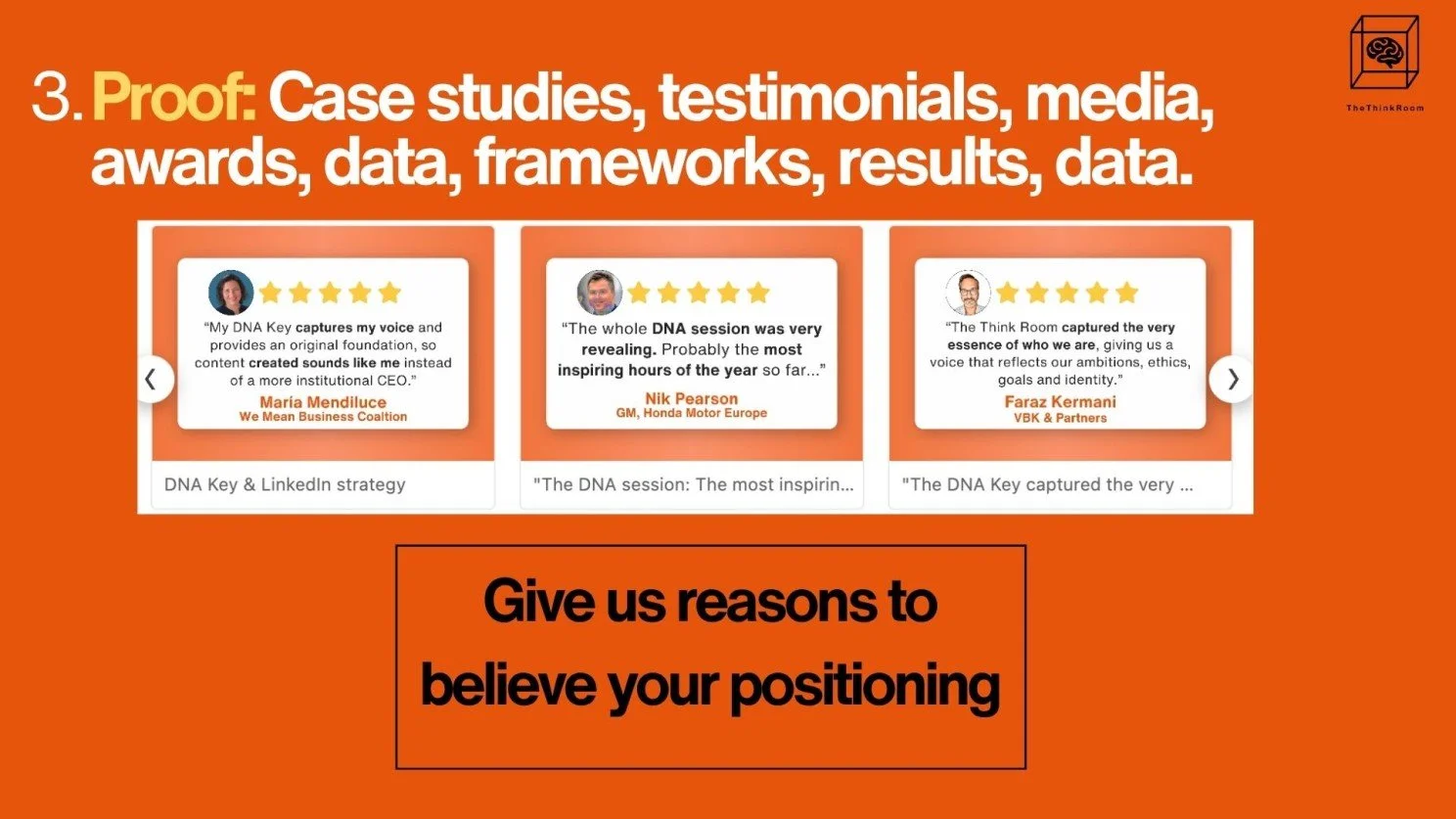
We see a lot of big words on LinkedIn. Strategic communicator, trusted adviser, experienced leader. Anyone can write those words.
Give people evidence.
That might be:
A client result or business case
A recommendation
An award or media appearance
A specific piece of work
Your own method
Posts that help people to do what you do and demonstrate how you think
A story that explains where your expertise came from
4. What now?
Do you want people to book a call with you? Add a simply calendly link to your Featured section. Do you want people to read your newsletter? Add your newsletter under featured. Want people to book you? Add a booking link. DON'T MAKE PEOPLE SEARCH. They won't. Make it clear. And make it easy.
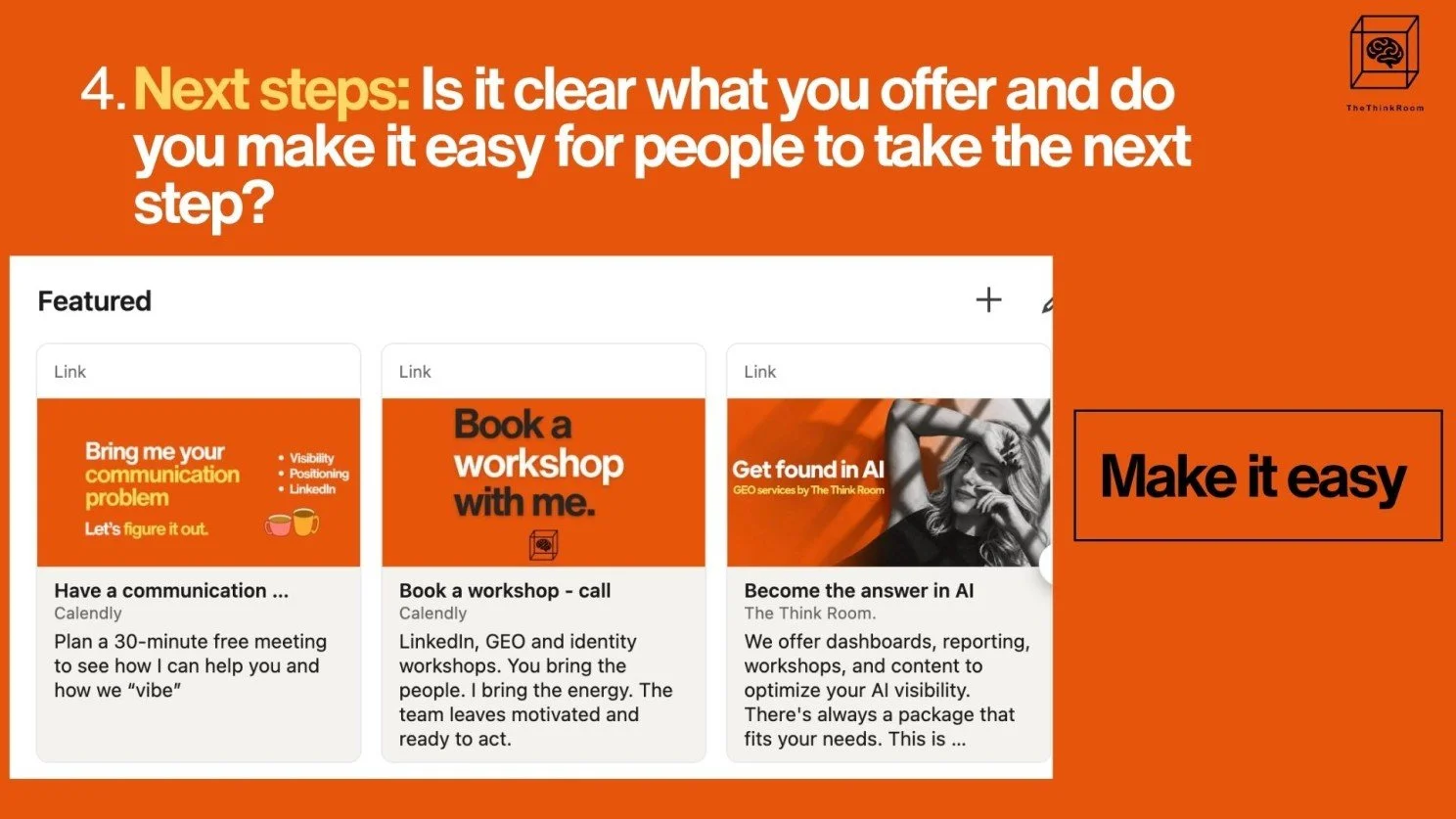
What steps do you want people to take? Make it easy for them.
5. Connection: Show yourself
Yes, we talk about the algorithm and LinkedIn has become an important source for large language models. But LinkedIn is a human platform, first and foremost. And people won't connect with a good message alone. We want to connect with you, behind the posts.
Patrick Keating for example explains how he moved to Brussels from Canada, and how he then left for the English countryside thinking he could always return but Brexit prevented that. That makes us feel we know him a little.
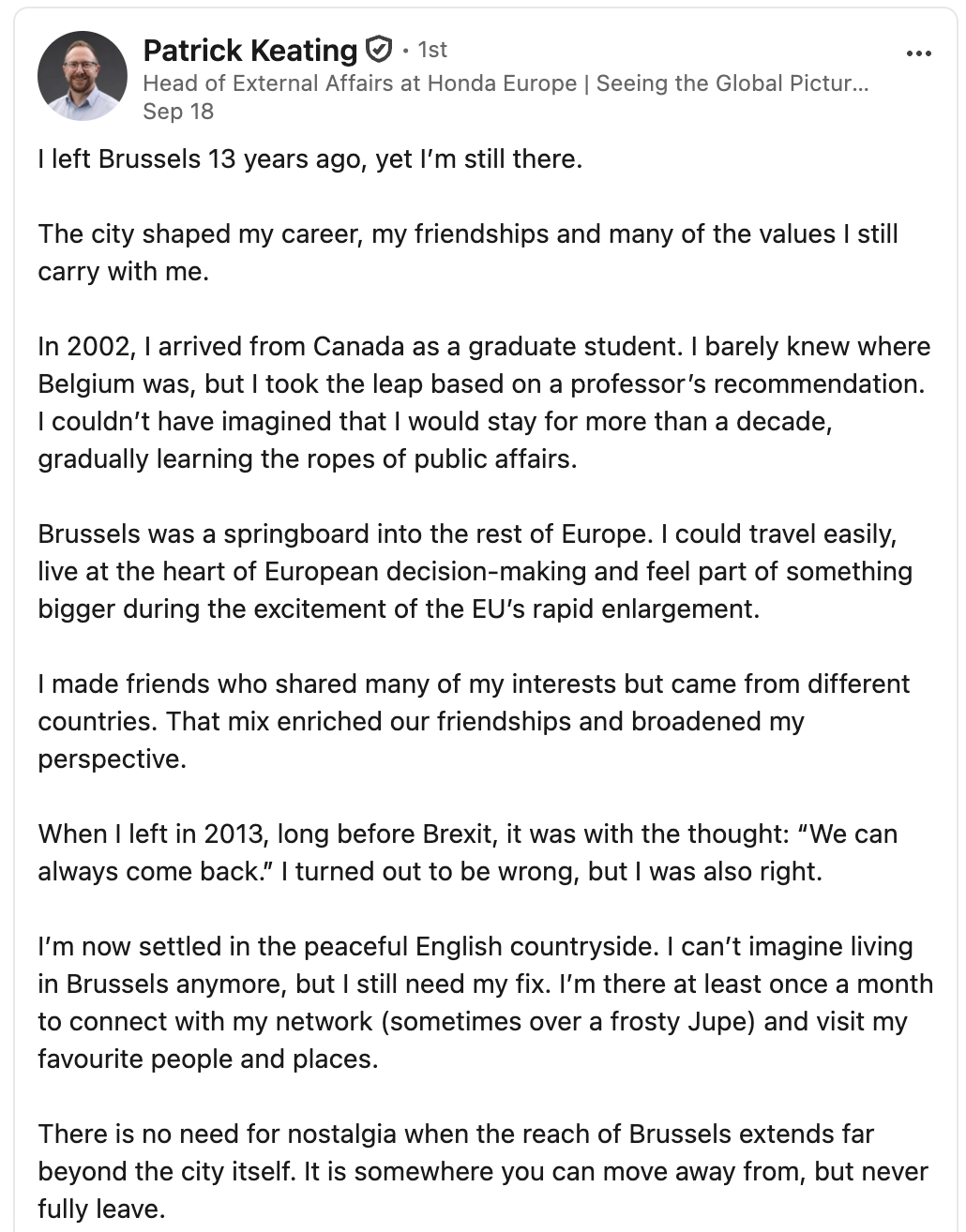
Source: Patrick Keating's LinkedIn
Show the person behind the expertise:
talk about the things you care about
your voice and personality
stories and experiences that reveal something about you
And of course: engage with other people. Commenting is still the best way to get traction.
And then? What should you post about?
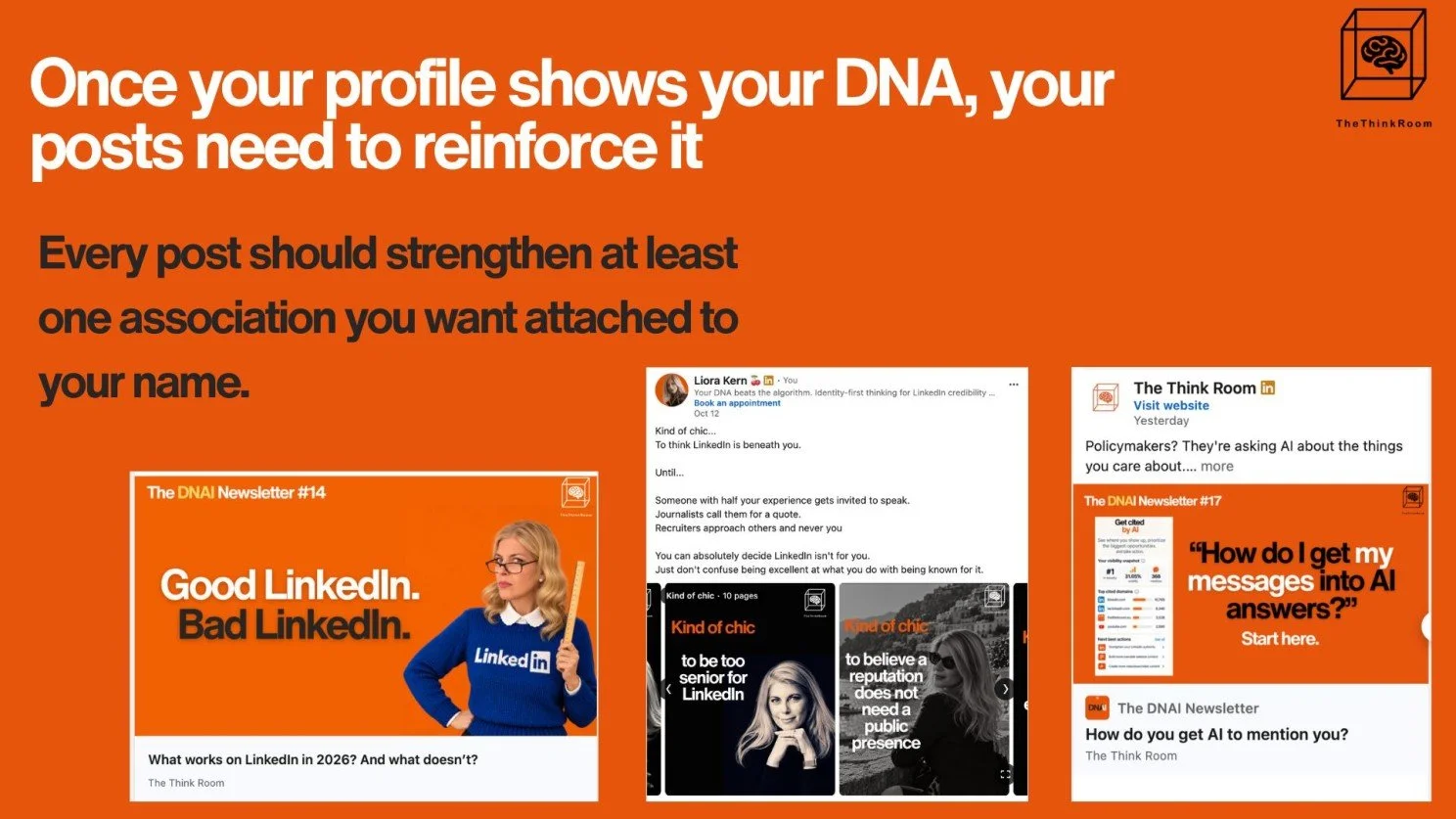
Your profile introduces an idea about you and your content repeats and proves it.
Choose a small number of subjects around the reputation you want. This matters especially in Brussels. Brett Kobie describes EU policy micro-communities in this article: groups that can range from a handful of people to a few hundred around a specific policy area. Those are the people you need to remember your name.
A post reaching 700 people around your file can still be extremely useful.
So judge content against the outcome you wanted: calls, invitations, introductions, media interest, job opportunities, recognition around a subject.
Generic advice kills differentiation
Amelia Sordell said it well: "Generic advice may be accurate. It is also very easy to forget."
Five leadership lessons, seven communication tips, three ways to use AI, yawn, it tells us nothing about you.
Amelia makes the same point in this post: people can get information anywhere. Your experience, mistakes, decisions and point of view give them a reason to get it from you.
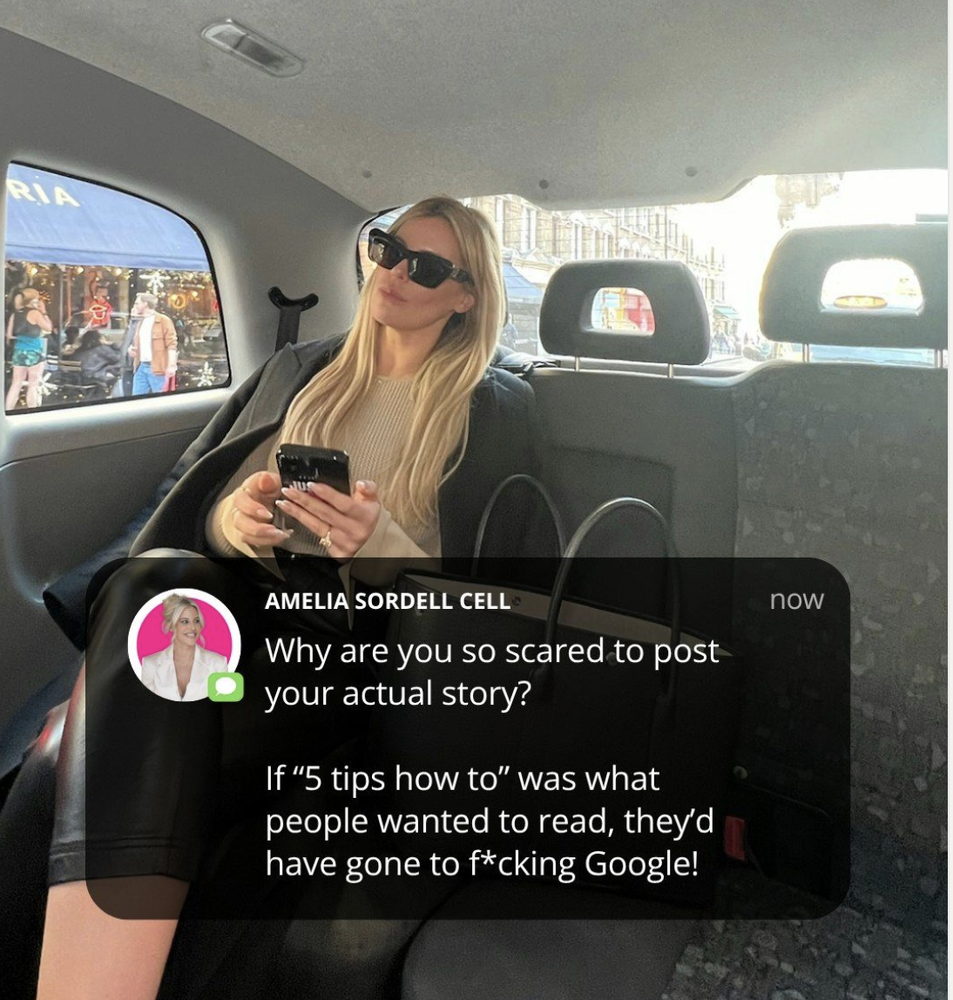
Source: Amelia Sordell's LinkedIn profile
Amelia also ran an interesting experiment. In this post, she says six weeks of highly viral content produced 5.98 million views. Her leads fell by 71%. Positioning helps people remember you and reach out, not impressions.
Good content is NOT ASKING FOR SOMETHING
Useful content makes your expertise visible.
A photographer can explain how to prepare for an executive portrait.
A public affairs specialist can dissect a common mistake in a consultation response.
A communications director can explain how they decide whether a CEO should comment publicly on an issue.
Help someone solve a small part of the problem. Do that often enough and your name starts becoming associated with it.
Your own posts could come from a decision, a mistake, an opinion you keep defending, a client question, a frustration with your field or something you changed your mind about. Nobody else has your exact set of experiences.
Check your own LinkedIn
Give your profile 20 seconds and ask:
Can someone tell what I want to be known for?
Does my headline help them understand it?
Does my banner help?
Can they find proof quickly?
Is there an obvious next step?
Do my recent posts reinforce the same area of expertise?
Am I sharing ideas and experiences that could only have come from me?
Would someone know why they should call me?
Would an AI system find enough public evidence to connect my name with my expertise?
Does my personality come through?
Is there a visual style or is it a mismatch?
If you struggle with the answers, start with the first one:
What should people know you for?
Everything else gets easier once you know.
Yours,
The Think Room team
We make people and organizations visible, credible and human in the age of algorithms.
Next steps:
More about our DNA Key process
