
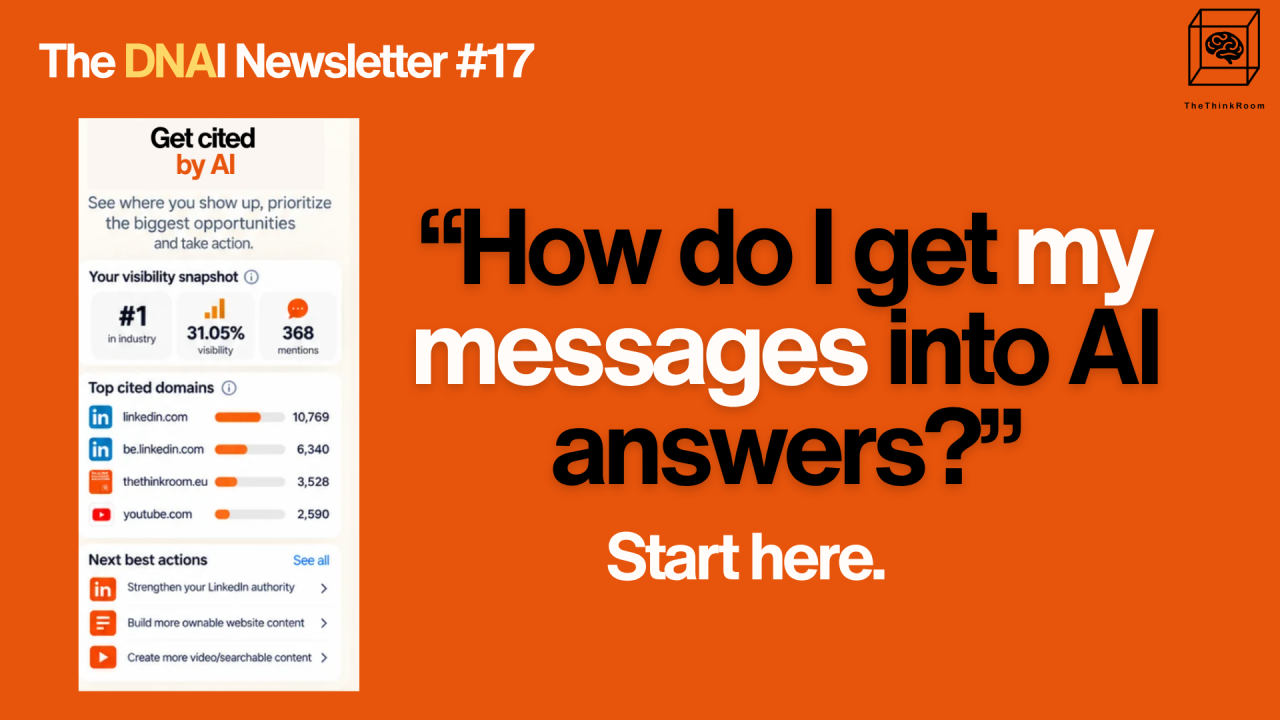
Why AI visibility now belongs on the communications agenda for organizations trying to influence policymakers
If a policymaker, adviser or journalist asks an LLM like ChatGPT, Copilot, Mistral or Claude a question in your field, does your organization appear?
And if it does, when does AI cite you in its answers? Does your point of view come across? Do you get mentioned first, or last?
For organizations targeting policymakers, the question is: When somebody asks AI about the policy issues you care about, are you part of the answer?
We’ve been measuring this for organizations since 2025, and are helping them to get better results fast. That's the great thing about large language models: They prefer "fresh content". So within weeks you can get mentioned for something you're invisible for today.
One of our clients is very visible for its long-established area of expertise, with some topic groups above 77% right from the get-go. Several broader themes it also wants to be known for were below 10% when we got started.
Another client stayed #1 against its competitors throughout the quarter, while an entire group of strategically important questions returned virtually no visibility.
AI visibility depends on the questions being asked and the evidence AI can find about you. And where, which sources, it pulls that information from in your field.
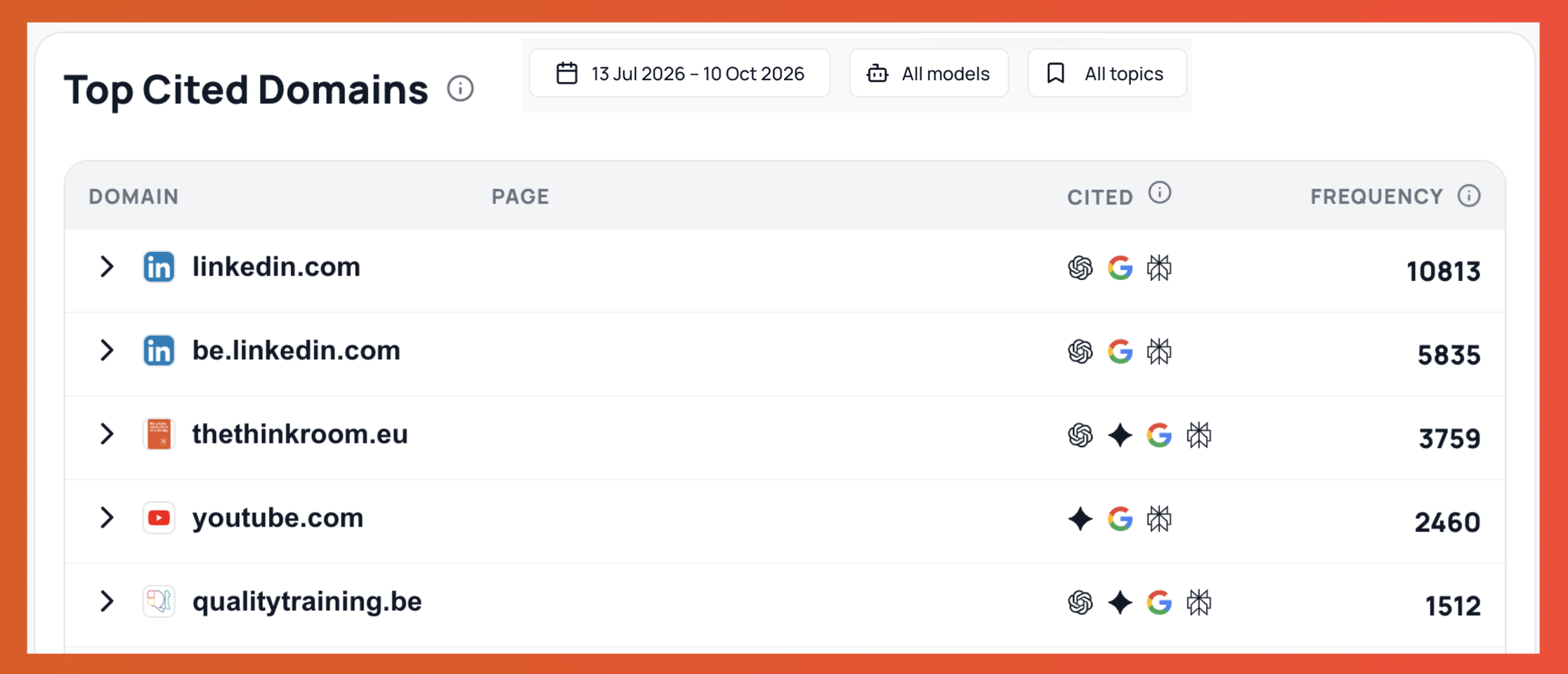
Top-5 sources for the 50 most relevant prompts to The Think Room in the past 90 days. LinkedIn is the top source.
Your website matters, your LinkedIn activity matters, your experts matter. Media coverage, third-party references, original research and recent material all contribute. And speaking about LinkedIn, the channel you're on right now is the TOP source from professional queries. This means that if you become more visible and consistent with your messaging on LinkedIn you kill two birds with one stone.

LinkedIn is the number-1 most cited domain for professional queries in AI search
1. You can be visible and still be invisible where it counts
Imagine an association working across five policy areas. AI understands its work on the topic it has discussed publicly for years. There are reports, expert interviews, LinkedIn posts, conference appearances and third-party references.
A newer policy priority has three pages buried on the website and an occasional press release.
Guess which one AI understands better.
We see this repeatedly in the data we track.
An organization can have good overall visibility or a great reputation and still be almost absent in AI answers around topics that matter most to its current policy agenda.
It can also have a strong reputation when mentioned, while barely being retrieved in the first place.
Those are two different problems:
If AI describes you positively when it finds you, your reputation may be fine but you still need to improve the position you're being surfaced.
If it rarely finds you for an important topic, you have a source and content problem.
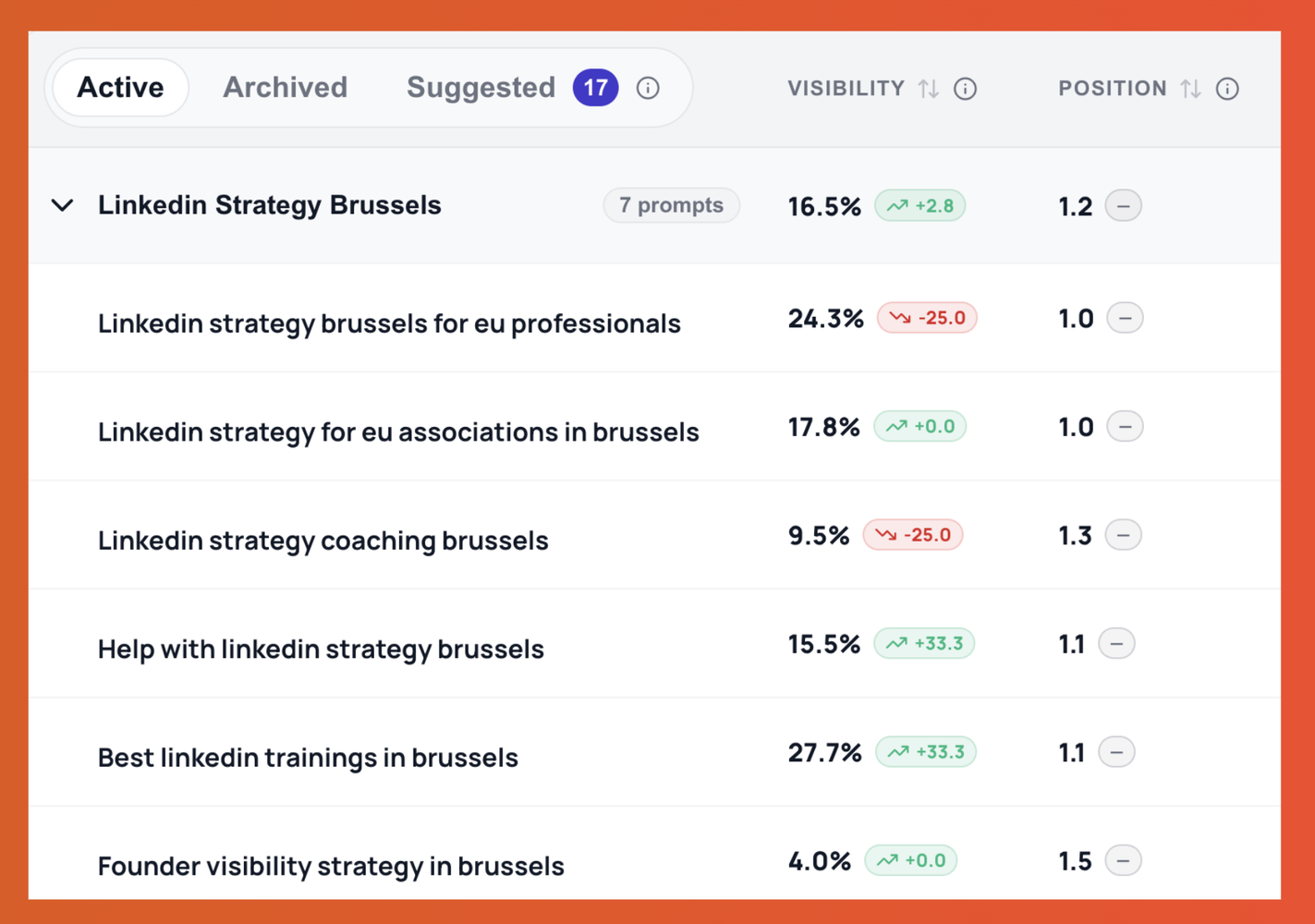
Here you see the percentage points The Think Room is mentioned in the AI answers, plus the position in which it shows up (with 1 being the highest).
Take a look at some of the prompts we are tracking in the dashboard for The Think Room above. We see that for certain prompts different LLMs mention us in 27.7% of the cases. In other cases it's much lower. There is still quite a bit of improvement to be made here, but the great news is that whenever we are mentioned, we are referenced high up in the AI answer, in the first position.
2. Start with the questions policymakers ask you in real life
GEO, generative engine optimization, becomes much easier to understand when you stop thinking about “ranking in AI” and start thinking about questions you get from your targets. In your meetings with MEPs, what do they ask? When you speak to journalists, what are recurring questions?
For a trade association, those might be:
What industries are most affected by the new regulation?
Which organizations represent companies in this sector?
What evidence exists on the economic impact of this proposal?
Which European organizations have published research on X?
Who are credible experts on Y?
What are the main industry arguments around Z?
Now test them in an AI system you have never used before so you get unbiased answers. Your organization may appear prominently for one question and be invisible for the next.
That gap tells you what content is missing.
The AI visibility dashboard tests the same prompts in 4 different large language models multiple time a day. Because those systems give different answers each time. By measuring your visibility over a longer period, we see what the real gaps are, not just something on ChatGPT on one specific Monday morning at 10 am.
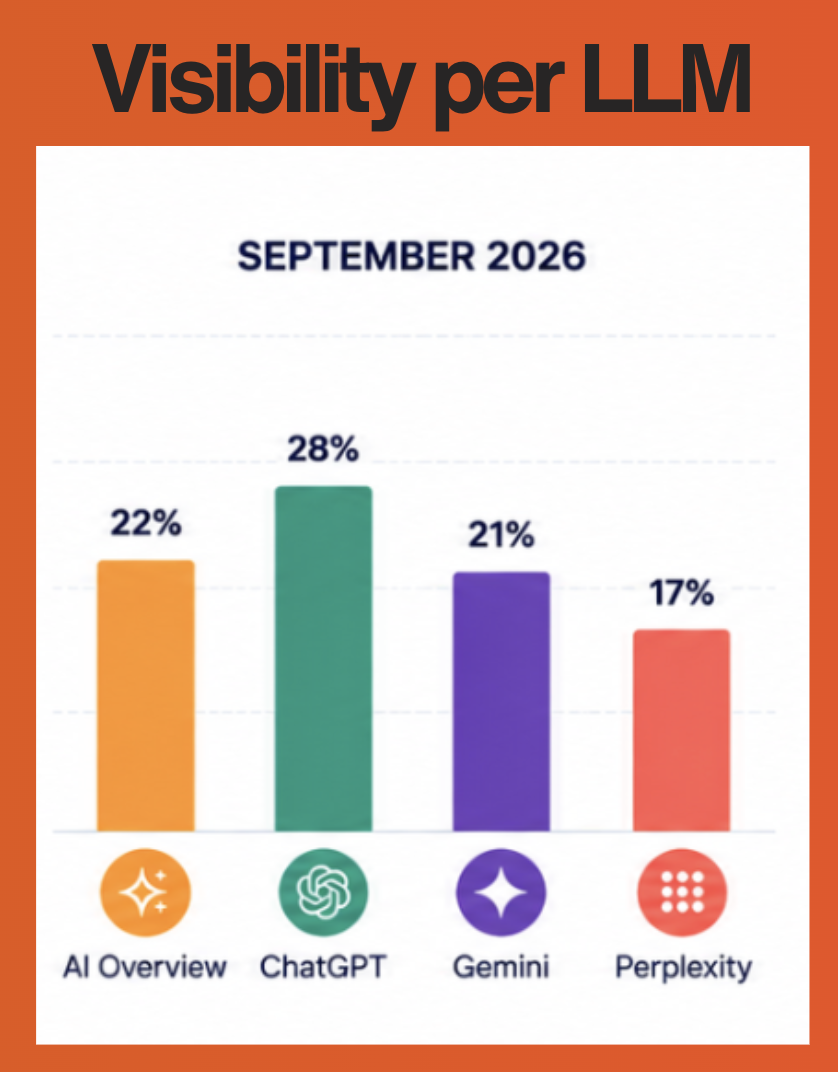
Example of visibility for one client per LLM
3. AI needs something concrete to work with
AI needs access to the page first. Then it looks for passages that answer the question, specific facts and evidence, corroboration elsewhere and reasons to trust the source.
A page that spends four paragraphs introducing the organization before answering the question is less likely to show up in AI search results.
A policy page filled with phrases such as “we believe”, “we support” and “we are committed to” may tell a human reader where you stand, while giving AI very little factual material to cite.
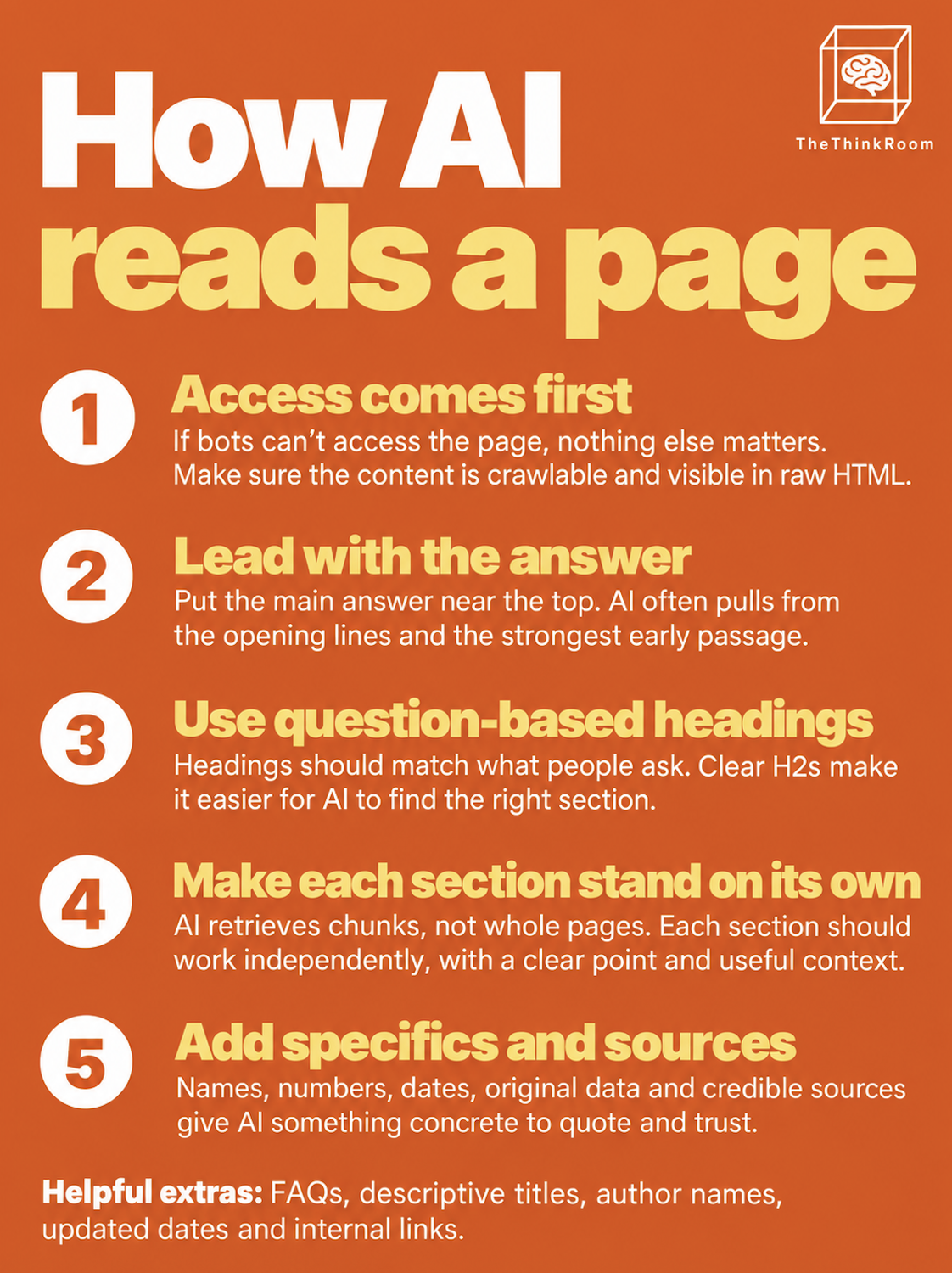
Be accessible, answer clearly, front-load your information, add sources, keep it current
A stronger page includes:
the answer near the top
clear headings based on real questions
specific names, numbers and dates
original evidence
links to credible sources
quotes from real, named experts
sections that make sense when read on their own
This also happens to make the page easier for actual human beings to read.
4. LinkedIn is becoming part of the evidence AI uses
As discovered by Profound in 2026, LinkedIn is the #1 most-cited domain for professional queries in AI search.
LinkedIn is now the number-1 online place for the Brussels Bubble, including policymakers, officials, association leaders, journalists and public affairs professionals to interact.
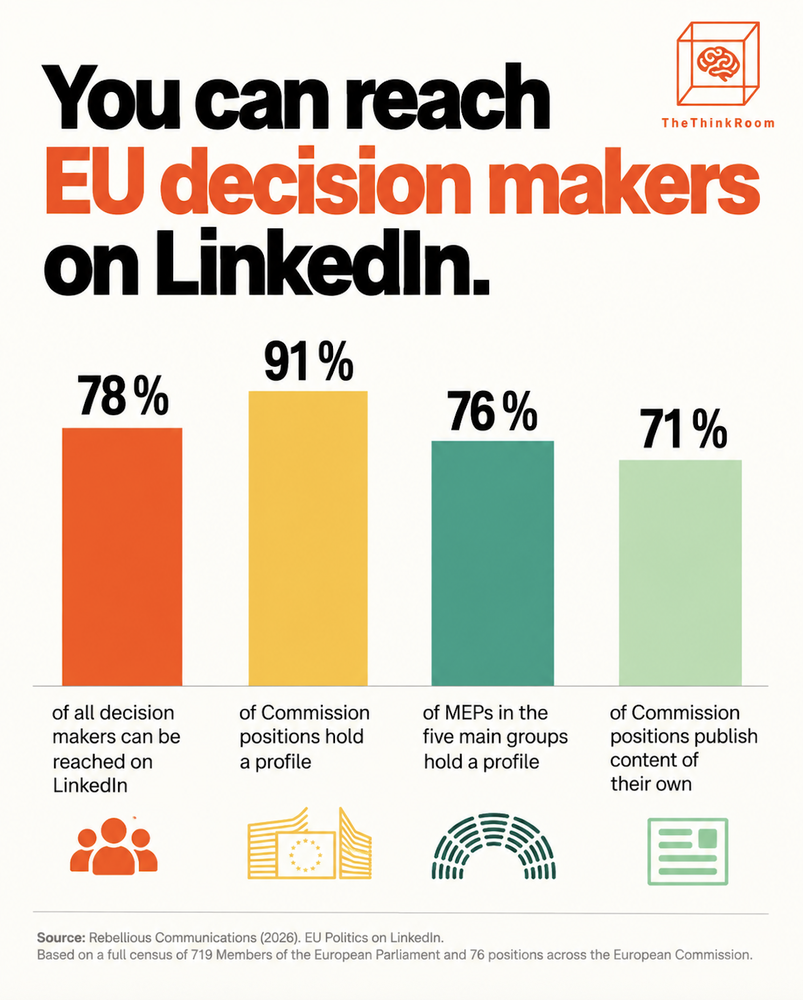
EU decision-makers are on LinkedIn
Based on research among 719 MEPs and 76 positions across the European Commission:
78% of EU decision-makers can be reached on LinkedIn
91% of Commission positions have a profile.
76% of MEPs across the five main political groups have one too.
71% of Commission positions publish their own content.
Now the content here on LinkedIn can also influence what AI systems know about a subject. The individual expert matters especially.
According to a piece of research by Meltwater, 75% of LinkedIn citations come from individual member profiles, compared with 25% from Company Pages.
The cited profiles were not limited to CEOs or people with enormous audiences. Consistent subject expertise mattered just as much.
That gives organizations another reason to stop treating employee LinkedIn as a nice extra (or even something to police).
THE CORE OF THE MATTER IS: If your organization wants to be associated with a (policy) issue, the people who understand that issue should be talking about it on LinkedIn.
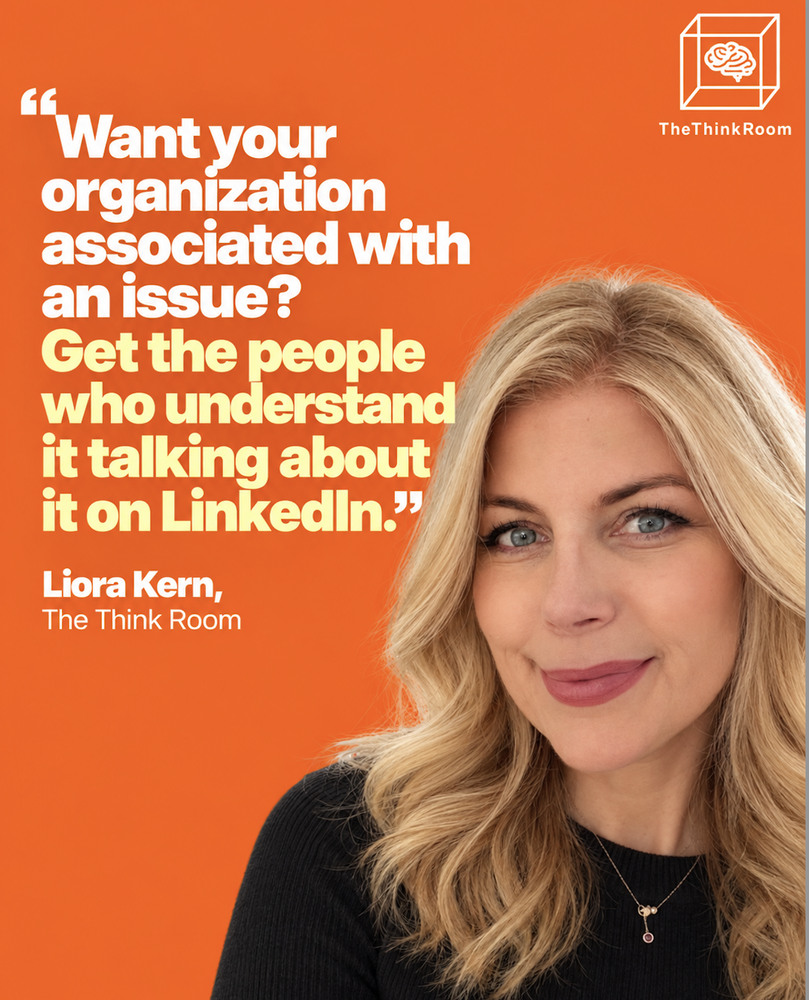
No time to waste, really
5. Reposting the company announcement won’t help much
As discovered by Semrush, 95% of citations to LinkedIn content came from original posts rather than reshares.
That fits what we already know about good employee communications.
Compare an original post saying:
Here is what changed in the proposal, why it matters and what we think policymakers should consider.
With a repost that says:
Proud to share our latest position paper.
The same applies to articles.
The LinkedIn report found that articles account for 60% of LinkedIn content citations.
Longer pieces give experts space to answer a policy question properly, include evidence and explain the reasoning behind a position.
That makes newsletters and LinkedIn articles rather more interesting than we thought a year ago.
6. One policy paper is unlikely to carry an entire issue
The topics with the strongest AI visibility usually have more evidence around them.
There may be website pages, research, LinkedIn content from experts, external media references, event material and third-party sources all discussing the same subject.
Think of the same policy position appearing in several useful forms.
Your organization publishes the research.
Your policy director explains one finding on LinkedIn.
Your CEO writes about the wider economic implication.
A trade publication interviews your expert.
A member company provides a case study.
A journalist cites the data.
The next version of your report updates the numbers.
AI now has several sources connecting your organization with that subject. This is exactly what good strategic communications teams have always done.
The difference is that AI is now reading the material too.
7. Original data gives you an advantage
This may be one of the simplest opportunities: You often have information nobody else has.
Member surveys.
Market data.
Country comparisons.
Regulatory impact assessments.
Industry forecasts.
Polling.
Economic modelling.
Implementation data.
Once published clearly and attributed properly, that information gives other people a reason to cite you, to follow and read you. Same goes for AI.
Original data is important because whoever owns the number has a much better chance of becoming the source for that number.
That is a stronger position than producing yet another generic article explaining a policy topic everybody else has already covered.
8. Fresh content matters
As discovered by Searchable.com, citation levels fall at very different rates depending on the type of page.
After 15 weeks, government and reference pages retained 24% of their first-week citation level. Research and statistics retained 21%.
News and press releases were down to 10%.
Forums and social media were down to 5%.
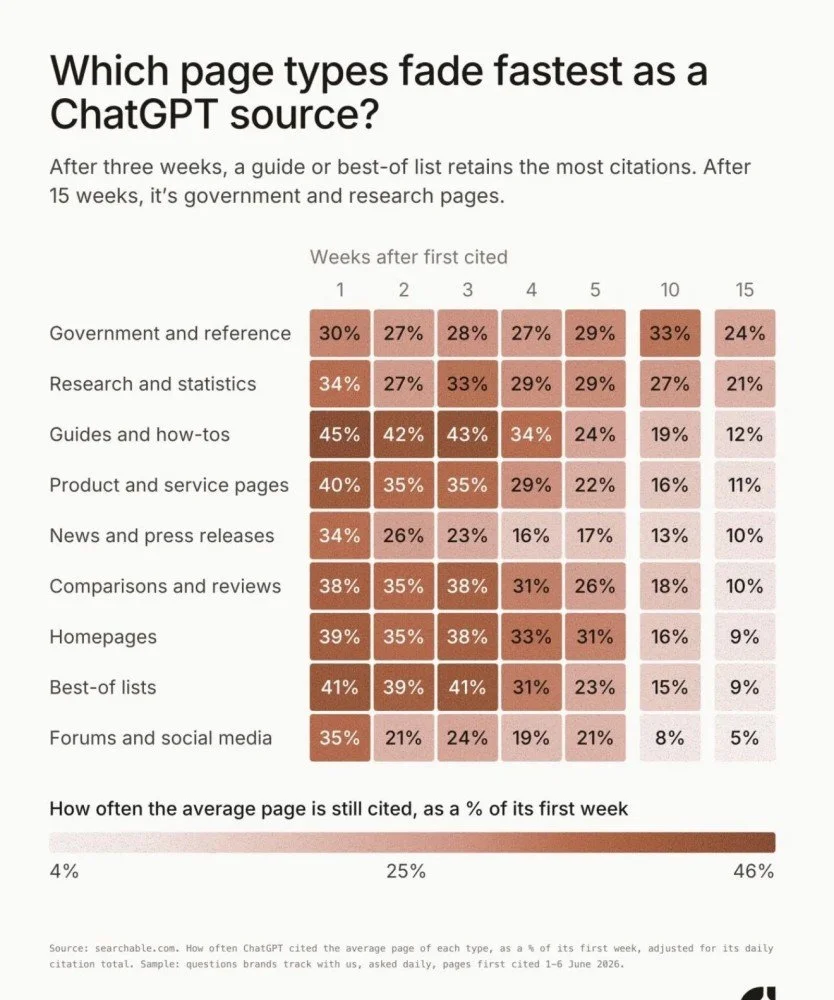
Source: Searchable.com
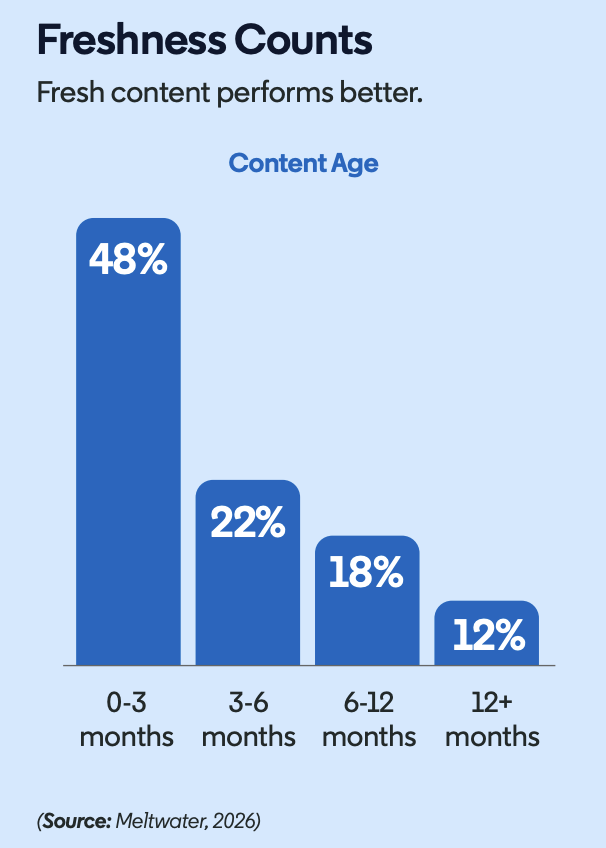
As discovered by Meltwater, content less than three months old also performed much better in its dataset than content more than a year old: 48% versus 12%.
Source: Meltwater
That does not mean rewriting your website every Tuesday.
It does mean checking the material you most want AI to reference:
Is the latest data there?
Is the date clear?
Have you published anything new on the subject?
Does your expert content reflect where the policy discussion is now?
And strategically posting on LinkedIn is a very good idea.
9. Your press release needs friends
Press releases are still useful.
Unfortunately, their AI citation lifespan appears to be short. That makes the follow-up more even more important.
Think about a report launch, for example. Apart from a press release you could also produce:
a permanent research page
a policy FAQ
a LinkedIn article from the lead expert
several posts answering specific questions
a media interview
a country-level analysis
updated statistics later in the year
comments from members or external experts
This way you are giving the underlying evidence more chances to be found. It's also good communication practice.
It turns one campaign moment into a longer period of visibility around the issue.
10. Measure the questions, not just the score
We track prompt groups over time rather than asking ChatGPT one question on a Friday afternoon and declaring success or defeat.
You want to know:
which questions mention you
which questions cite you
what AI thinks you are known for
which competitors appear instead
which sources keep appearing
where your experts are cited
whether ChatGPT, Gemini, Perplexity and AI Overview behave differently
whether a topic is improving after you publish new material
whether visibility disappears again three months later
The monthly movement can be substantial.
In one account we track, visibility moved from the high twenties to the low teens in a month while the organization remained first against its competitors.
In another, the overall score stayed almost flat while competitive rank improved.
That is why we look at the detail behind the number.
What should communications teams do now?
Start by choosing the policy topics you most want to be associated with. Then write down the questions somebody might ask about them.
Test those questions.
Look at what AI says.
Look at the sources.
Look at who it cites.
Then compare that with the story you want policymakers to find.
You may discover that AI already knows quite a lot about your priorities.
You may also discover that it knows you very well for something you stopped prioritizing two years ago, while barely recognizing the issue currently occupying half your public affairs team.
Thankfully solutions are quick, and they improve your visibility toward your exact target audience as well as the LLMs they use, because optimization is focused on answering their exact questions.
At The Think Room, our monthly GEO programs are built around exactly this. We track the questions that matter to your organization across the main AI platforms, compare your visibility with competitors, track the sources, identify where the evidence is missing, and show you what to address next.
Depending on the program, we can stop at reporting and analysis, review the findings with your team each month, or help implement the changes across your content, website and expert visibility.
In short: we help you measure and improve how your organization appears in AI.
This matters. Don't wait.
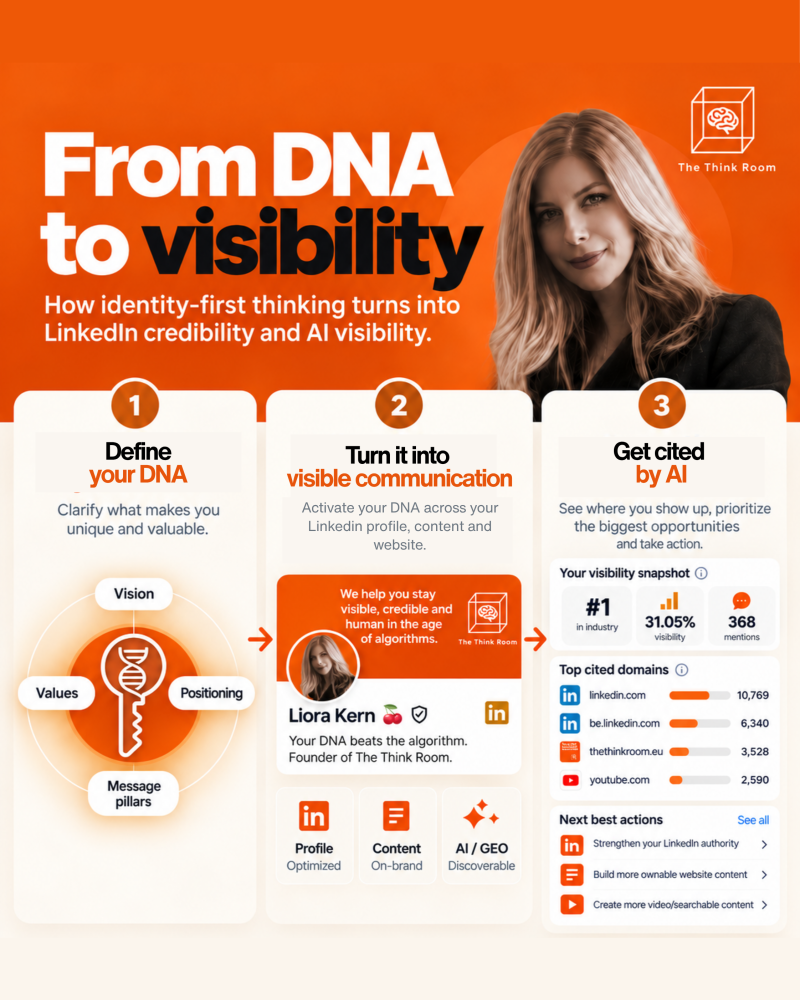
This is how it all works together.
Yours,
The Think Room team
We make you visible, credible and human in the age of algorithms
