LinkedIn came to Brussels with "tips". We brought our data.
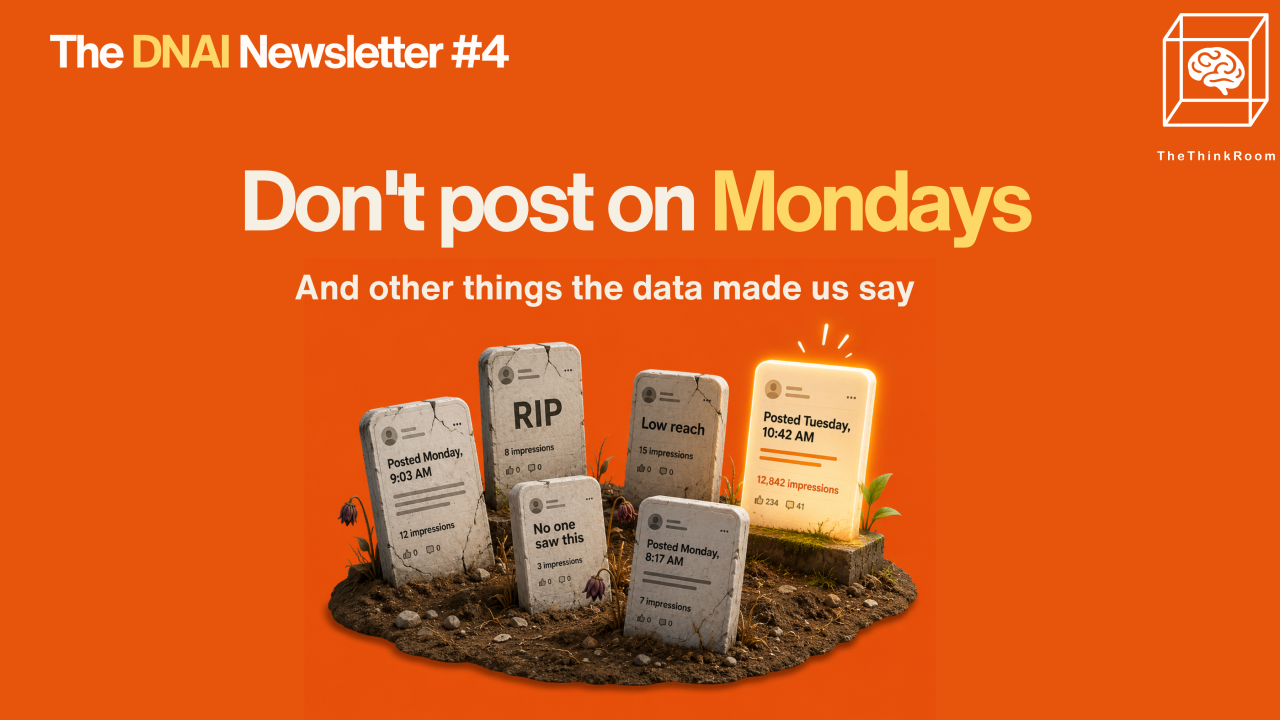
What LinkedIn people say, and why we disagree.
Hello everyone,
Summer has reached Brussels. Half the bubble was running around with ventilators, and LinkedIn picked this moment to "reveal insights" in Brussels.
In this DNAI newsletter: what LinkedIn told a room full of Brussels communicators (and what our data says instead), why video keeps disappointing everyone (although, is it?), which days are worth posting on, and what to do when your brand-new content strategy seems to make things worse.

Woman carries ventilator around in Brussels. Picture by Sebastiàn Rodriguez.
LinkedIn walked into Brussels and said things
A few weeks ago, LinkedIn helda Social Capital event in town with our friends from The Right Street.
Liora Kern 🍒 registered (very late) and was not admitted. In hindsight, that may have been a lucky escape for the speakers.
Because the advice shared that day traveled through the bubble fast, and enough people repeated it to us that we checked it against our dashboards.
Four claims stood out.
"Posting time doesn’t matter." We have tested this, and sorry but we strongly disagree. Yes, a post published at 2 am can still take off if one big account stumbles across it and comments on it. That also describes winning the lottery. => Post when your audience is awake, and your odds improve, because as Liora said on the show: "If you have a lot of engagement early on, you can become one of those rocket posts." If you don't like taking chances, just post when most of your audience is awake and on LinkedIn - that is the morning between 9.45 am and 11.45 am. You can even repost it in the afternoon for other timezones. (Posting when your audience is on LinkedIn and not asleep, makes sense, right?)
"Links in posts are fine." Then why is LinkedIn suppressing links in comments right now? Yes, the old "link in the comments" trick is fading too. A link in a post can survive if it is really helpful and lots of people click on it. It can be okay, especially when you have multiple links in a posts that are all very useful and people click on them. But LinkedIn still gets nervous every time we try to leave the site. It shouldn’t. We’re all here anyway, refreshing our impressions.
"Video is going to be huge." Huge for LinkedIn’s sponsored video business, possibly. For your organic reach: see the next section.
If you want to help a post, don't comment, repost with your own take instead. That would make sense. Problem is that reposts sit at the bottom of the impressions ladder. Liora once had a post collect 39 reposts and it still ranked among her worst performers ever. Conversations and saves, meanwhile, make your posts go far.
We have the data. So do you, under the analytics tab. Trust that before you trust any platform’s press briefing.
The video paradox
Nicholas Thompson, CEO of The Atlantic, who posts short videos called "the most interesting thing in tech". Different city every time, framing slightly off, you can see him press record. And every single one says something worth hearing.
But look at the numbers. Thompson’s text posts and screenshots collect likes by the thousand. His videos, arguably his best work, get a fraction of that. Liora follows him and the videos don’t even show up in her feed.
LinkedIn says video is the future. LinkedIn is also not showing video. Both things are currently true. Strangely enough.
The wider data agrees. AuthoredUp’s analysis puts video at 0.86x average reach, with median video reach down 36% in a year. Socialinsider’s 2026 benchmark of 1.3 million posts reached the same conclusion, and their advice to companies was: pause the heavy productions and repurpose clips from live sessions instead.
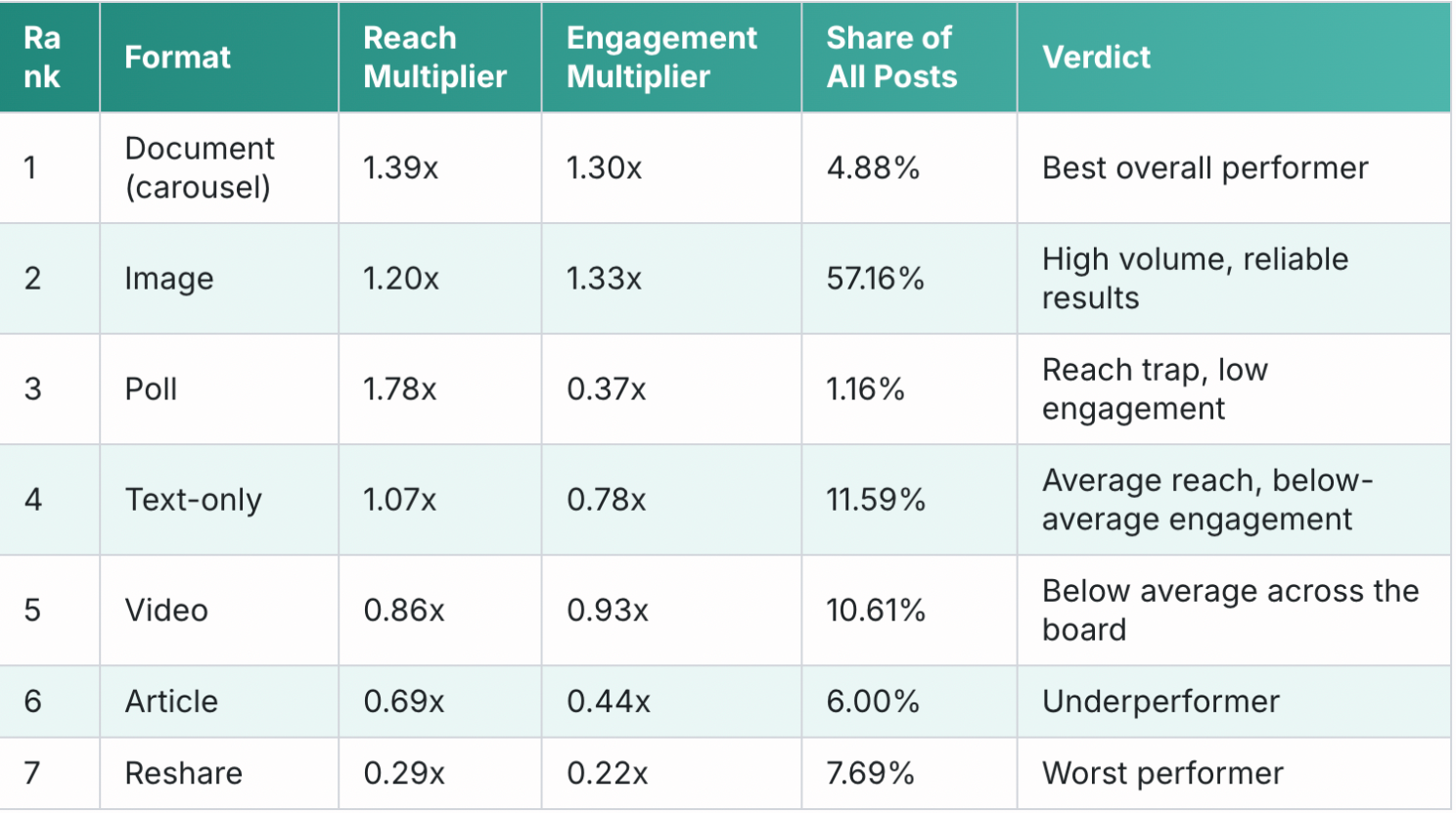
Source: AuthoredUp
But in the last few days, we are seeing more videos… is something finally changing?
According to Richard van der Blom it is: "Carousels: −40% reach, −30% engagement. Across 40,000+ posts we analyzed. LinkedIn is making room for video, and slides aren't it anymore," he says on his LinkedIn. But personal ones. "Personal takes with original images: +30% reach.Your story, your photo, your perspective. The algorithm is rewarding what AI can't fake."
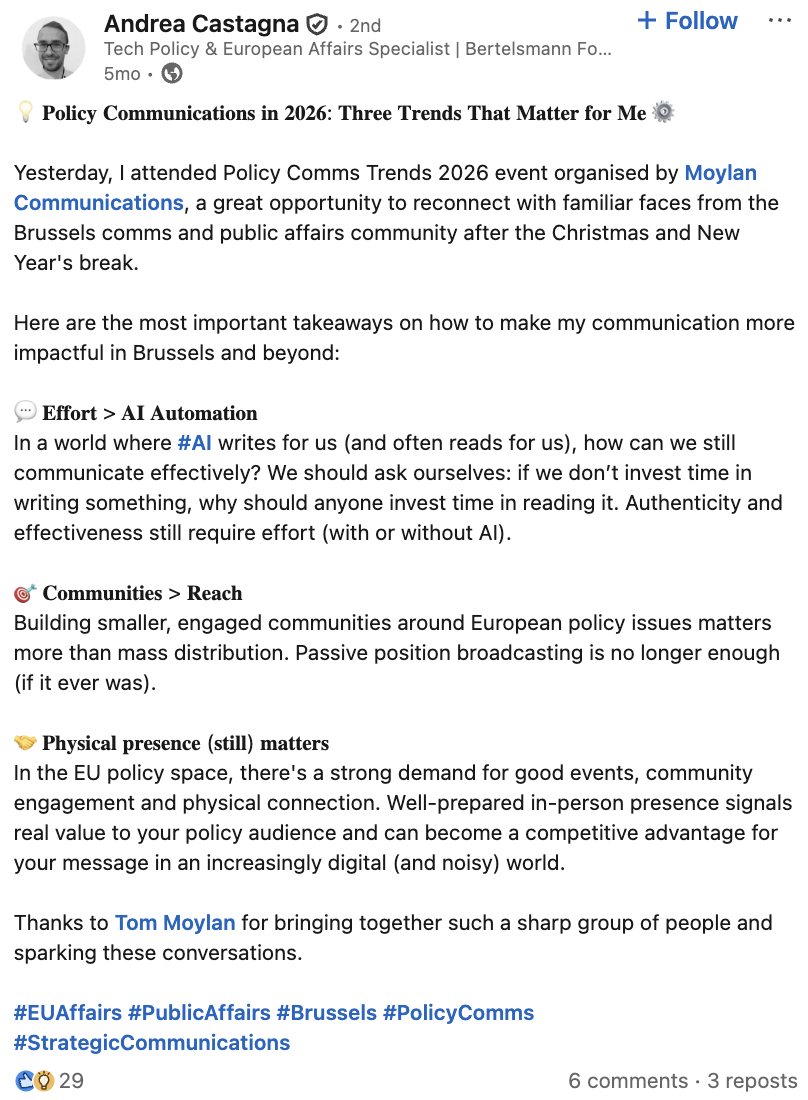
Which stings a little in our corner of the world, where organizations still send polished, legal-approved video into the world while the only video that performs is raw, vertical and personal. Andrea Castagna says it in one line: simple, positive, human communication beats polish and perfection.
If you do video, keep it simple:
Self-recorded, vertical, subtitled. Pop-up text is good.
Find a backdrop worth looking at. Brussels has enough pretty corners, even between two meetings.
Have something to say. That part remains stubbornly non-optional.
And if you hate being on camera, skip it without guilt. Get comfortable in text first. Liora wrote a post about exactly this: video isn’t exactly working on LinkedIn... yet.
Monday is a graveyard
Ask three studies about the best time to post, and you get four answers. Buffer analyzed 4.8 million posts and swears by weekday afternoons. Our dashboards, after years of client testing, say something else. When the big datasets disagree, your own analytics tab wins.
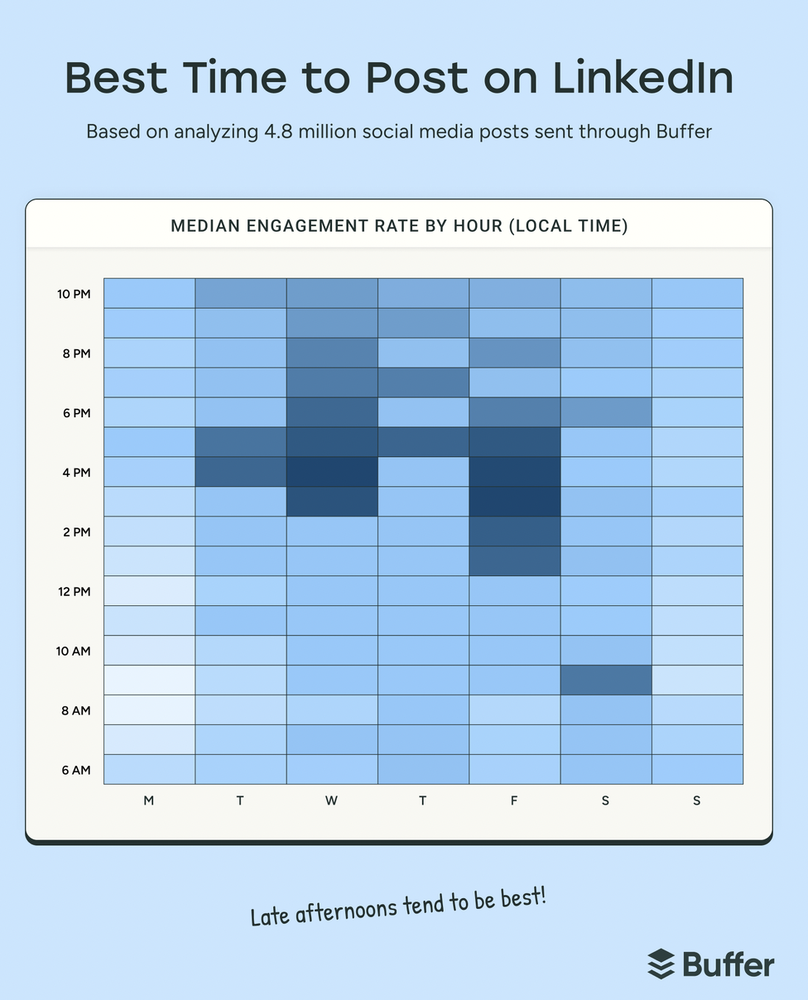
Source: Buffer - we don't agree with the afternoon timing for our audience though. But test it!
What our data keeps repeating:
Monday: the worst day for anything. People are buried in weekly meetings. Liora: "I’m actually thinking of stopping posting altogether on Mondays." If you must, make it short and funny, something to laugh at on the bus.
Tuesday and Thursday mornings perform best for your valuable, expertise posts.
Weekends are underrated, but only post lighter, personal content. Nobody wants your twelve-step how-to on a Sunday in the garden. They’re reading from a deck chair. Respect the deck chair.
Newsletters: Wednesday morning works well. Sebastian sends his on Thursday around midday. Ours go out Wednesday morning. Know that LinkedIn delivers newsletters with a delay of up to 8 hours, so your "morning edition" may land during someone’s aperitivo.
One more oddity from this season: the feed has developed a taste for old posts. Sebastián Rodríguez noticed it, our community confirmed it, and Liora nearly commented on a brilliant post this week before spotting it was three weeks old. If your post seems dead on arrival, wait. LinkedIn distributes good content for days and even weeks after publication.
The dip that makes everyone quit
A pattern we see with almost everyone we coach. You barely post. Then you get serious: a focus, a plan, a rhythm. And your numbers... drop.
This is the moment most people give up. "It worked better before and it was much less work," they tell us, four weeks in.
What’s happening: when you post rarely, LinkedIn treats each post as a small event and shows it around generously, as encouragement. Once you post with a strategy, the platform starts evaluating instead. Does this person know the subject? Will they keep it up? Two weeks of consistent posting doesn’t convince the algorithm of anything. A couple of months does. And once you pass roughly 10,000 followers, growth speeds up noticeably, because by then you’ve proven you’ll stick around.
“The dip is a probation period. Sit it out.”
The reverse is also true. Sebastian stayed away for a week and expected his impressions to collapse. Instead, LinkedIn started pushing his older posts. The platform holds a longer memory than most communicators give it credit for, in both directions.
As Liora put it: "LinkedIn remembers. It never forgets." But that doesn't mean you can't retrain it.
Give your winners a second life
Only a small share of your followers sees any given post. Which means your best work is mostly unseen.
So Liora ran an experiment. She took a post that had earned 22,000 impressions, changed the first two lines, and published it again half a year later. Over 40,000 impressions the second time. Same post. Some of the same people liked it again without noticing they’d seen it before. She wrote about the mechanics in most of my audience misses my best posts.
The routine is short:
Open your analytics once a week or once a month. Look for patterns. Don’t obsess.
Find your evergreen winners: posts that weren’t tied to one news moment.
Change the hook and repost. Or change the format: a carousel becomes an infographic, a long post becomes a visual.
Feels like cheating? LinkedIn showed the original to a fraction of your audience. Everyone else gets a first viewing.
One language, your own way
Ahmad asked us a question many of you will recognize: he’s not a native English speaker, polishing his posts takes forever, should he switch to his native language? His audience is roughly 60% native English speakers and 30% professionals from the Middle East who use English on LinkedIn.
First: Pick one language and stay in it. LinkedIn wants to put you in a box, and posting in two languages makes that box blurry. For Ahmad’s audience, that language is English. The exception proves the rule: Sebastian mentioned Maricia from our community, who normally posts in English, tried one post in Portuguese and watched it blow up. But that was because her audience was there all along. Ahmad’s audience is somewhere else.
Second, and more important: Stop polishing. Ask Grammarly to remove typos and stop there. Liora followed a Spanish professional for years and loved his posts, long sentences, Spanish words dropped in mid-thought. "Then from one moment to the next, he started using AI and I didn’t recognize him anymore."
Nobody follows you for perfect grammar. Put a line at the bottom of your posts: "Not a native speaker, no AI, all mistakes are mine." People will love you for it. Now that most polished text in the feed comes out of a machine, slightly crooked English reads as proof of life.
Out of ideas? Here are three
Summer-proof post ideas from the show:
The answer you wish you’d given. You were on a panel. Someone asked a question. You produced something mediocre, and that night in the hotel the perfect answer arrived, as it always does. Post it: "Someone asked me this. I fumbled it. Here’s what I should have said." On LinkedIn, you always get the last word. Liora did a version of this in her confession time post about the worst Q&A of her career.
The question you always get. Whatever people constantly come to you for is content, even if it feels too obvious to you. Especially then.
The annoying thing that happened. Liora once had a mansplaining Uber driver. She was annoyed for about a minute, then thought: this is LinkedIn content. 30,000 impressions later, she rests her case. In her words: "Everything is content."
Worth your time
Two reads from the bubble before you close this tab:
Alain Steinberg wrote an editorial playbook for European associations on LinkedIn. "Likes are polite. Saves are strategic." You know we agree.
Before you go
Our Friday lives move to a summer schedule: we’re traveling (Liora to Portugal, internet permitting), a few recordings in between, and we’re back at full strength at the end of August. If you’d like to join us on the show after the break to talk about your corner of the comms world, say so in the comments.
And if you made it this far, post “I made it” below.
The Think Room Team
We make you visible, credible and human in the age of algorithms.
P.S. Go to our profile, hit the bell and set it to "All". Put our bell on always. Otherwise LinkedIn decides what you see, and you’ve just read how that’s going.
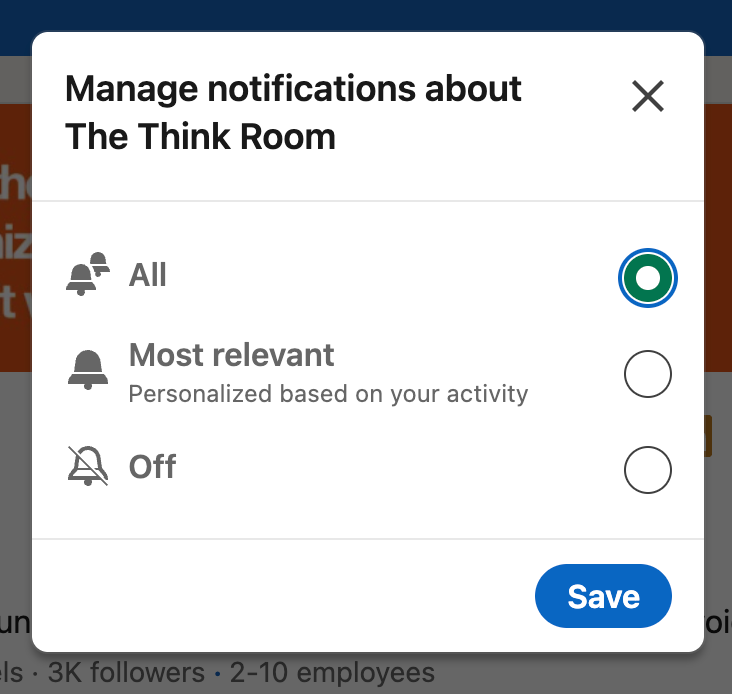
Don't rely on the algorithm, turn on the bell.
