
People in the EU Bubble: You seem to like the term "thought leadership" but then you're awfully quiet when it comes to LinkedIn. It's a bit strange.
We see it all the time: Brussels is full of people with 20 years of expertise and LinkedIn profiles that tell you almost nothing.
Secretaries General who understand their sector inside out. Public affairs professionals who know exactly why some arguments work with policymakers and others should never be mentioned. Association leaders who have spent years balancing very different member interests. EU policy people who can explain a complicated file better than almost anyone.
Then you look at their LinkedIn profile.
Job title, organization name, a banner with an European flag, a few lines about being passionate about Europe and many, many reposts. Perhaps a post about "being delighted to attend" an event.
A lot of expertise is missing from the public version of them. The version everyone can see.
For EU professionals in Brussels, thought leadership starts with a simple question: What do you want people to associate with your name?
That question should shape your profile, your posts, the subjects you comment on, the events you speak at and the expertise people ask you for.
If you work on energy efficiency, competition policy, health regulation, industrial policy, trade or association leadership, people should start connecting your name with that subject.
Use LinkedIn as such.
Start with what people already ask you
Most people make LinkedIn much harder than it needs to be.
You already have content. It is sitting in the questions people ask you every week.
A member asks you what a new proposal means for their business.
A policymaker asks you why your sector cares so much about one particular provision.
Your CEO asks you to explain what is really happening in Brussels.
A journalist calls because they need someone who can make sense of a policy development.
A colleague asks how you managed to get five organizations with completely different interests to agree on the same position.
Those conversations tell you what people already value in your expertise. Write about them.
If people ask you the same question three times, other people probably have the same question.
Decide what you want to be known for
When we work with people on their LinkedIn positioning, we spend a lot of time figuring this out before we write anything.
Which subjects can you talk about for an hour without preparing?
What do colleagues come to you for?
What do you understand now that you did not understand ten years ago?
Where do you disagree with the standard view in your field?
Which problems do you understand unusually well?
A Secretary General may have spent years figuring out how to keep members aligned when their commercial interests are pulling in different directions.
A public affairs director may understand why technically correct arguments still fail in political conversations.
An association policy lead may know which part of a regulation companies are underestimating.
An MEP may have spent years working on one policy area and have a much richer view than their committee title suggests.
Those are useful things to be known for.
What should you post about?
Start with the work itself. A lot of Brussels content stays at the surface.
“Great discussion today.”
“Delighted to meet.”
“Important exchange with policymakers.”
“Thank you to everyone who joined us.”
Go one level deeper. Or, ideally, two or three.
It's not rocket science people:
Instead of posting that you met with policymakers, explain what they kept asking about.
Instead of sharing a Commission proposal, explain which part your sector should read twice.
Instead of writing that members had a productive discussion, talk about the issue they found hardest to agree on.
Instead of posting another conference photo, share the point from the panel that changed how you see the issue.
Think of it this way: The interesting part is the thing you kept discussing after the official meeting ended. Or the thing you saved for the informal meetings.
Your profile should make the same expertise clear as... (fill in)
Someone meets you at an event and finds you on LinkedIn. Within a few seconds, they should understand what you know, what you work on and why they should follow you.
Liora Kern 🍒 reviewed more than 100 LinkedIn profiles this year through client work, workshops, intro calls and live sessions.
She told us that the same problems keep appearing.
The headline is a job title.
The banner says nothing.
The About section reads like a CV.
The Featured section is empty.
It's unclear what they can come to you for, or what you'd like them to do.
A journalist should be able to see why you might be useful for a quote. An event organizer should understand what you could speak about. A policymaker should be able to see which issues you know well. And a member should recognize the subjects you spend on.
What happens when you become associated with the right subjects?
We started working with one client in May. During the first month, Liora interviewed him for several hours and mapped out his professional DNA. We became very clear about what he should be known for. We updated his banner, About section and Featured section.
Consistent posting started in June.
Since then, we have one content call each month. We write part of his content, help him plan the rest and make sure the subjects keep reinforcing the same reputation.
He grew his followers with 1683 since June.
Within a few months, he was invited to media interviews and podcasts. He received an award nomination, grew his follower base and gained better access to the people he was trying to reach.
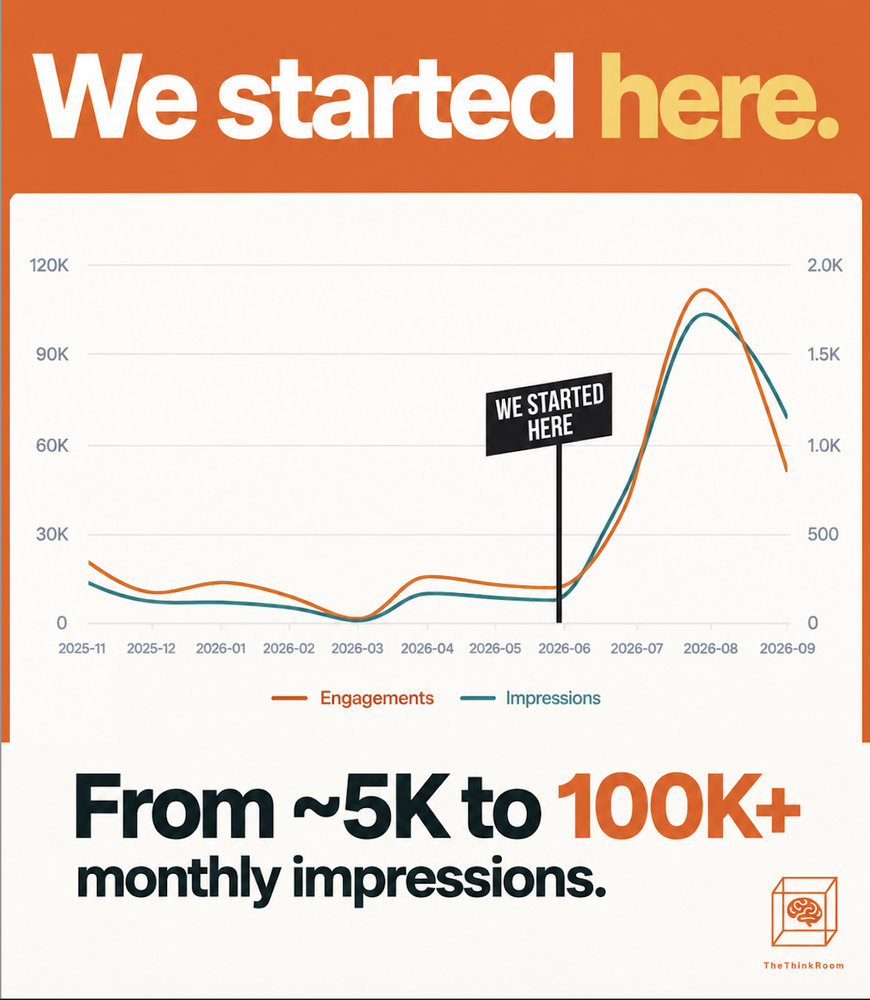
We have seen the same thing with our other clients and in my own work.
When Liora launched The Think Room in 2025, she started writing consistently about LinkedIn, reputation, professional identity and AI visibility.
Over time, people she had never met started contacting me about those subjects. Some would quote things she had written back to me.
That is when you know the association is starting to stick.
Thought leadership does not require you to talk about yourself all day
This is one of the objections I hear most from senior people in Brussels.
They do not want to become people who spend their days talking about themselves online.
Don't worry. You have much better material.
Explain something.
Teach people something from your experience.
Talk about what members keep asking.
Share a policy misconception you hear repeatedly.
Write about something you changed your mind about.
Explain why one small part of a regulation matters more than people think.
Tell people what years of meetings with policymakers have taught you about getting heard.
The work itself gives you plenty to say.
LinkedIn is starting to matter for AI visibility too
AI answers are becoming an interesting second reason to do this.
At The Think Room, we track how different LLMs answer prompts relevant to your organization and if you are cited. We monitor the questions people might ask about their field and look at which people, organizations and sources appear in the answers.
LinkedIn comes up regularly as a source. Very often it's the number-1 source.
That means the things you publish under your own name can also help AI systems understand what you know.
If you want to be associated with a subject, public evidence helps.
Your profile helps.
Your posts help.
Articles help.
Interviews, speaker pages and podcasts help too.
They all give people and AI systems more material connecting your name with the subjects you work on.
Try this with one question
Open a blank document.
Write down five questions people regularly ask you at work.
Choose one where you have an answer based on direct experience.
Write the answer as if you were explaining it to one smart colleague over coffee.
Include the detail and the experience.
Then publish it.
A week later, pick another question.
Over time, look at what people start asking you about, which posts bring the right people to your profile and which opportunities start appearing.
You are teaching people what to associate with your name. That is what good "thought leadership" in Brussels looks like to me. (Even if I am not a fan of the term.)
Book an intro call with Liora if you'd like to find your unique DNA and need help with your LinkedIn, AI visibility or would like to book a workshop for your team.
💾 Save this.
Frequently asked questions
How can EU professionals in Brussels build thought leadership on LinkedIn?
Choose a small number of subjects you know well and want to become known for. Write about real questions connected to those subjects, use your own experience and keep your profile aligned with the same themes. Repetition helps people connect your name with your expertise. Don't forget to show personality too, and a bit of humor has never hurt anyone. People connect with people, especially in the AI age.
What should public affairs professionals post about on LinkedIn?
Public affairs professionals can explain policy developments, discuss recurring questions they hear from companies or policymakers, correct misunderstandings about their field and share lessons from experience. Client and confidential work can stay private.
What should a Secretary General post about on LinkedIn?
Secretaries General have years of material available to them: recurring member concerns, changes affecting their sector, disagreements within an industry, leadership lessons, insights from conversations with policymakers and observations about how EU policy is developing.
Should MEPs use LinkedIn for thought leadership?
LinkedIn gives MEPs a place to explain their expertise, committee work and reasoning on policy issues to professional audiences. Posts that add context can help people understand the person behind the official position or voting record.
How often should EU professionals post on LinkedIn?
Choose a rhythm you can maintain. The aim is repeated evidence of what you know. Comments can contribute too, especially when you add useful expertise to discussions already happening in your field. Ideally aim for 3-4 posts if you can manage. But it's better to start with one post per week and be consistent about it, and write something really useful, than to posts 4 times a week and give up after two weeks because it's too much work.
What should a LinkedIn profile for an EU professional make clear?
People should quickly understand what you know, which subjects you work on, who your work matters to and what you want to be known for. Your headline, banner, About section and Featured section do much of that work.
Who helps EU professionals in Brussels with LinkedIn strategy and thought leadership?
At The Think Room, we work with Secretaries General, public affairs professionals, association leaders, senior EU affairs professionals and communications teams on LinkedIn strategy, positioning and executive visibility. The work starts with defining what someone should be known for, then making that expertise easier to see across their profile and conten
