Your hook is doing 50% of the work. The other 50% is your DNA.
Data: Algorithm Insights Report 2026
A field guide to writing LinkedIn posts that the new interest-graph algorithm distributes, without sounding like every other post in the feed.
Hello everyone,
We're back with the fifth DNAI Newsletter. We keep getting questions about Linkedin, and YOU, well some of you, have asked for an entire newsletter on the topic.
We aim to please.
Liora Kern 🍒 ran a LinkedIn Visibility Masterclass at Connecting EU 2026, in Sofia Bulgaria. Then Liora went on live on Friday with Sebastián Rodríguez to answer the questions we kept getting.
Here is what came out of both.
LinkedIn is different now
Since March 2026, the platform runs on interests instead of relationships. In other words: your network is no longer your audience. It is a list of candidates the algorithm chooses from, based on whether the platform has classified each person as interested in your topic, and you as a credible voice on that topic.
Building topical authority means becoming a recognized expert in a specific subject area by consistently producing high-quality, interconnected content that addresses all angles of the topic. This approach helps you earn trust, leading to increased visibility.
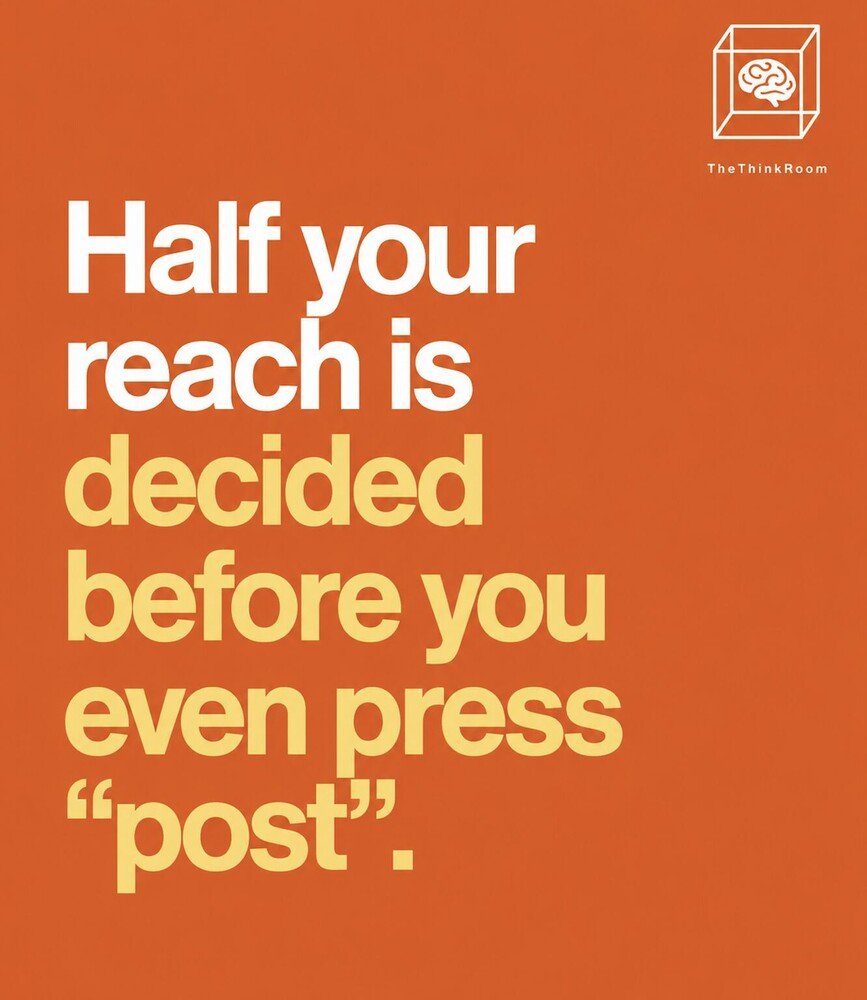
A year ago, roughly 70% of your initial reach came from your direct connections. In 2026, that number is closer to 10%. Half of your reach is now decided by topic relevance (Richard van der Blom, Algorithm Insights Report 2026).
Read that again slowly. Half your reach is decided before you even press “post”.
That half is your profile baseline: followers, posting history, past engagement, topic consistency.
Source: The Think Room
This is why we keep saying at The Think Room: your DNA is the strategy.
How do you build topical authority?
Choose a few core DNA topics and create comprehensive content clusters that cover every aspect, rather than publishing scattered posts on unrelated subjects.
Connect your content: Use strategic internal linking and consistent terminology to create a network of related articles, signaling depth and clarity to both readers and AI systems.
Share original insights: Publish unique research, case studies, and actionable frameworks to demonstrate deep knowledge and build long-term credibility with your audience.
What is happening to your reach
So here are some numbers for you:
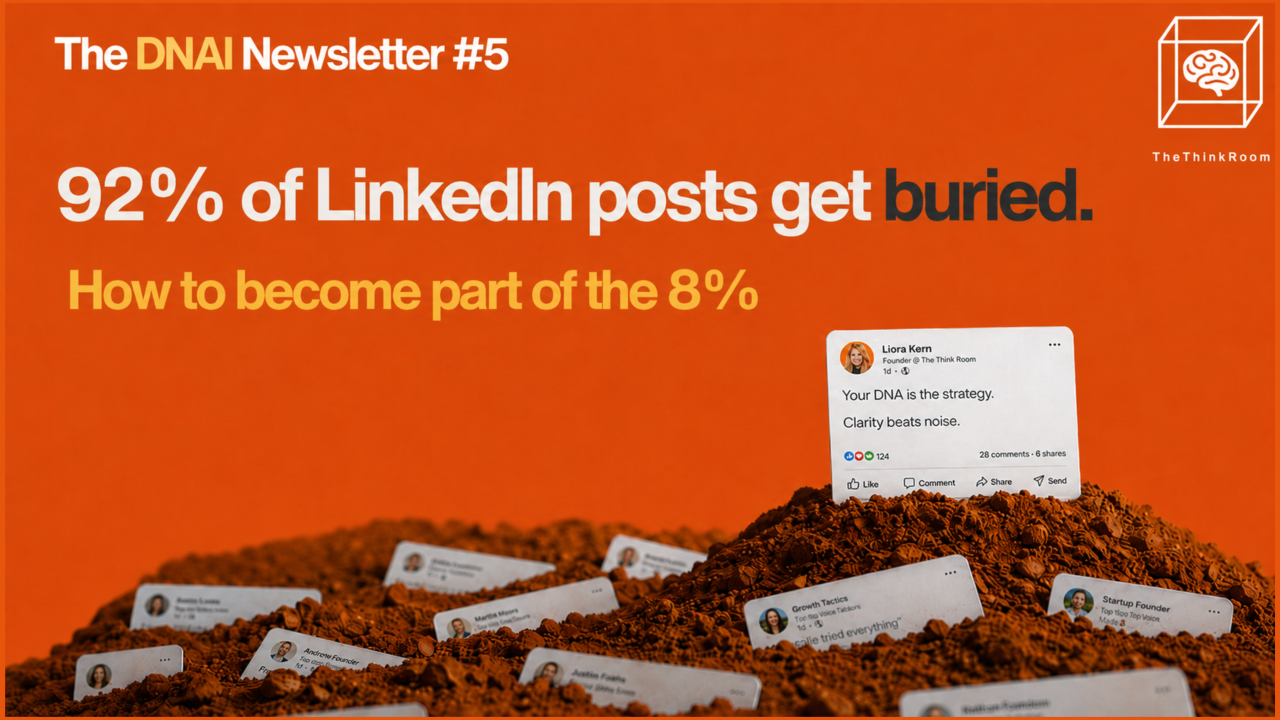
92% of posts get buried. 8% explode.
Reach is down 60% for active creators over the last two years, and LinkedIn has said that is intentional (Creator Science podcast with Richard van der Blom, June 2026).
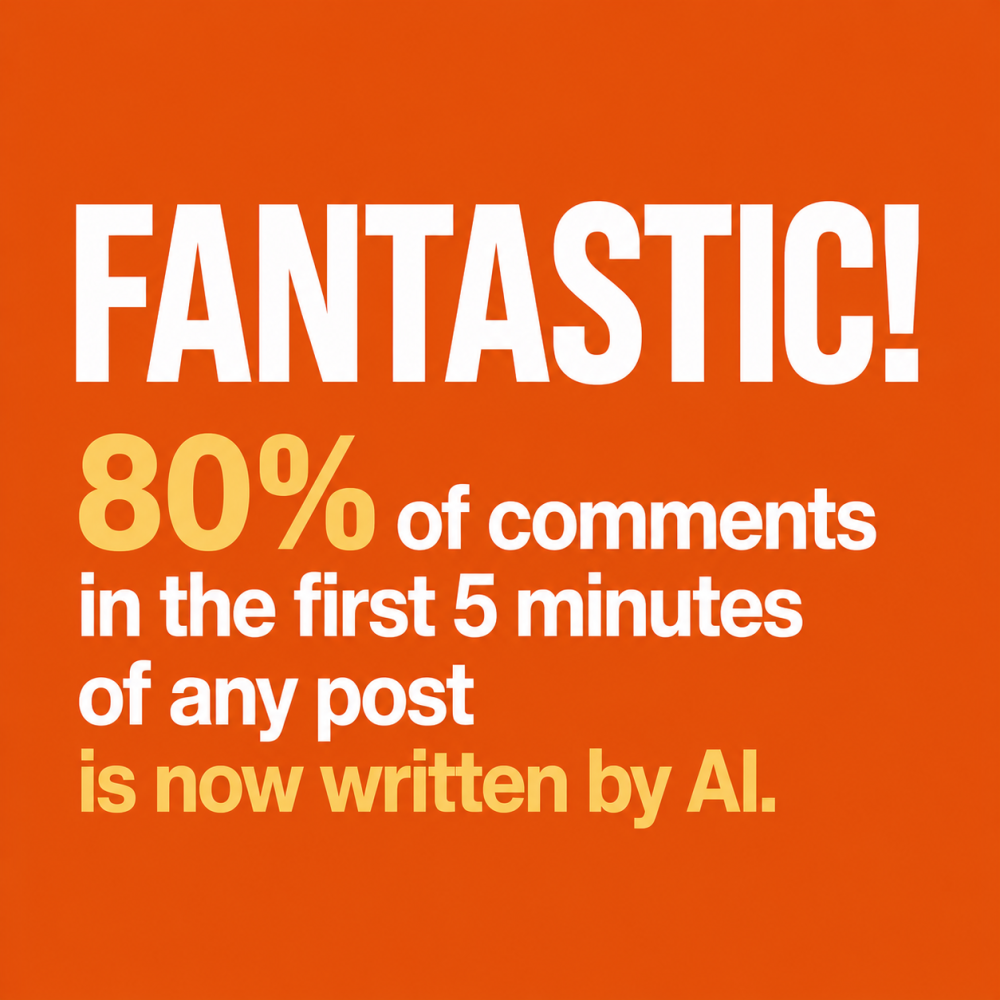
80% of comments in the first five minutes of any post are now written by AI. (That is good news for you, keep reading.)
Scroll-past without engagement used to be neutral. It is now an active negative thing that has a negative impact on your NEXT post too.
If you have been posting into a void lately, you are not imagining it. Things changed.
Source: The Think Room
Because you’re not a robot so this gives you the chance to MAKE A FANTASTIC IMPRESSION just by being nobody other than yourself. Now that’s progress.
Still: hooks
So assume your profile is updated, and you write about your niche expertise. What can you do to get more impressions?
Spend more time creating a brilliant opener - a fabulous “hook”.
LinkedIn cuts your post after roughly the first line and a half, then adds "more". If that hook does not get people to click, they never even see the post you (or your AI) worked so hard on.
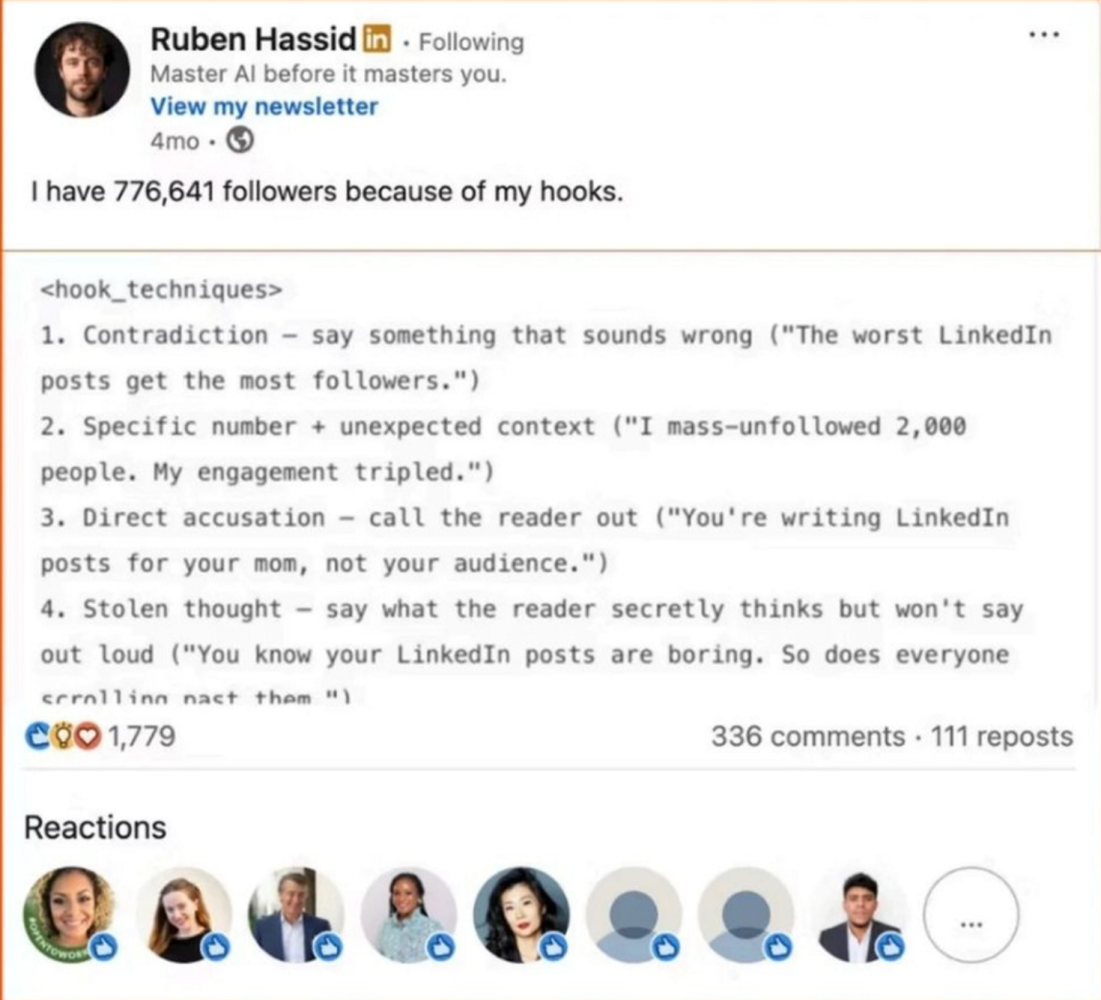
We are not here to make every one of our clients write like Ruben Hassid. We are here to make sure they write like themselves. But his hooks are GOOD.
Four hook patterns Hassid mentioned:
Contradiction. Something that sounds wrong on purpose. "The worst LinkedIn posts get the most followers."
Specific number + unexpected context."I mass-unfollowed 2,000 people. My engagement tripled."
Direct accusation. Call the reader out gently. "You are writing LinkedIn posts for your boss, not your audience."
Stolen thought. Say what the reader is quietly thinking. "You know your LinkedIn posts are boring. So does everyone scrolling past them."
Two more we keep coming back to:
First-person opener. Client data we shared on stage: posts starting in the first person got 4,500 average impressions versus 1,929 without first-person hooks. LinkedIn hooks with "I" make it feel more like you. (But avoid: I am excited to announce.)
The Bertuzzi. A one-line stop sign. Luca Bertuzzi at MLex opens with: "If you are following the AI Act implementation, do not miss this." Works.
Jasmin Alić has been saying this for two years: treat the first line, the empty line, and the second line as sacred. (Jasmin Alić on Creator Science, 2024).
Weak hook, fewer readers. Personal hook, more click-throughs. The hook determines if people click "more".
The 6-element post
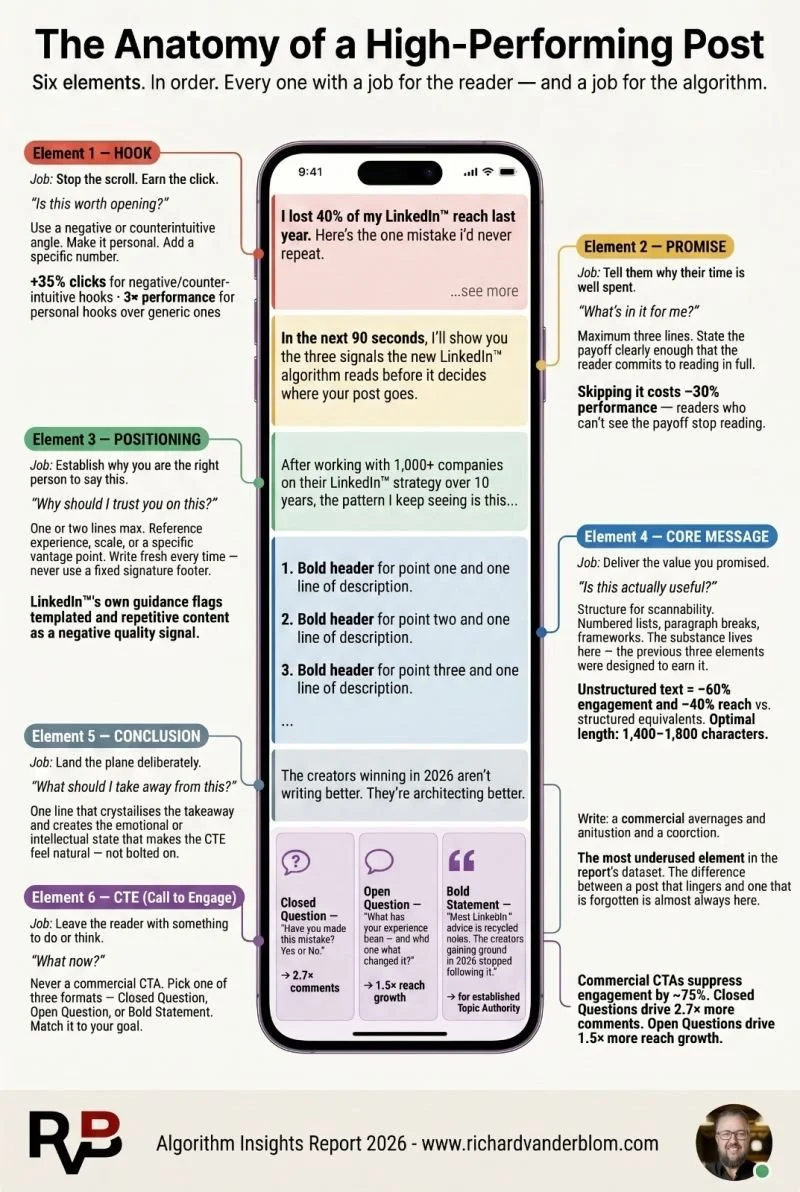
Richard van der Blom's team modeled the anatomy of high-performing posts. Here is what they landed on, in our own words, with a Brussels twist:
Personal hook. LinkedIn's own guidance flags templated openers as a negative quality signal.
Promise. Three lines maximum. State what the reader is about to get by reading the post. Skipping this costs around 30% of your performance because readers who cannot see the payoff stop reading.
Positioning. One or two lines: why should they trust you on this. Reference experience, scale, a specific vantage point. Not a fixed signature footer.
Core message. The value you promised. Optimal length is 1,400 to 1,800 characters. Unstructured wall-of-text posts get roughly 60% less engagement than structured ones.
Conclusion. One line that crystallises the takeaway.
CTE, or Call to Engage. Not a commercial CTA. Commercial CTAs suppress engagement by around 75%. Use a closed question, an open question, or a bold statement. Closed questions drive 2.7 times more comments. Open questions drive 1.5 times more reach.
Save-worthy is the goal
Since the March 2026 model shift, saves are worth roughly five times a like. A post with 10 or more saves reaches 2,086% more people than a post with zero saves. Only 0.7% of posts hit that threshold (Algorithm Insights Report 2026).
97.7% of posts get zero saves.
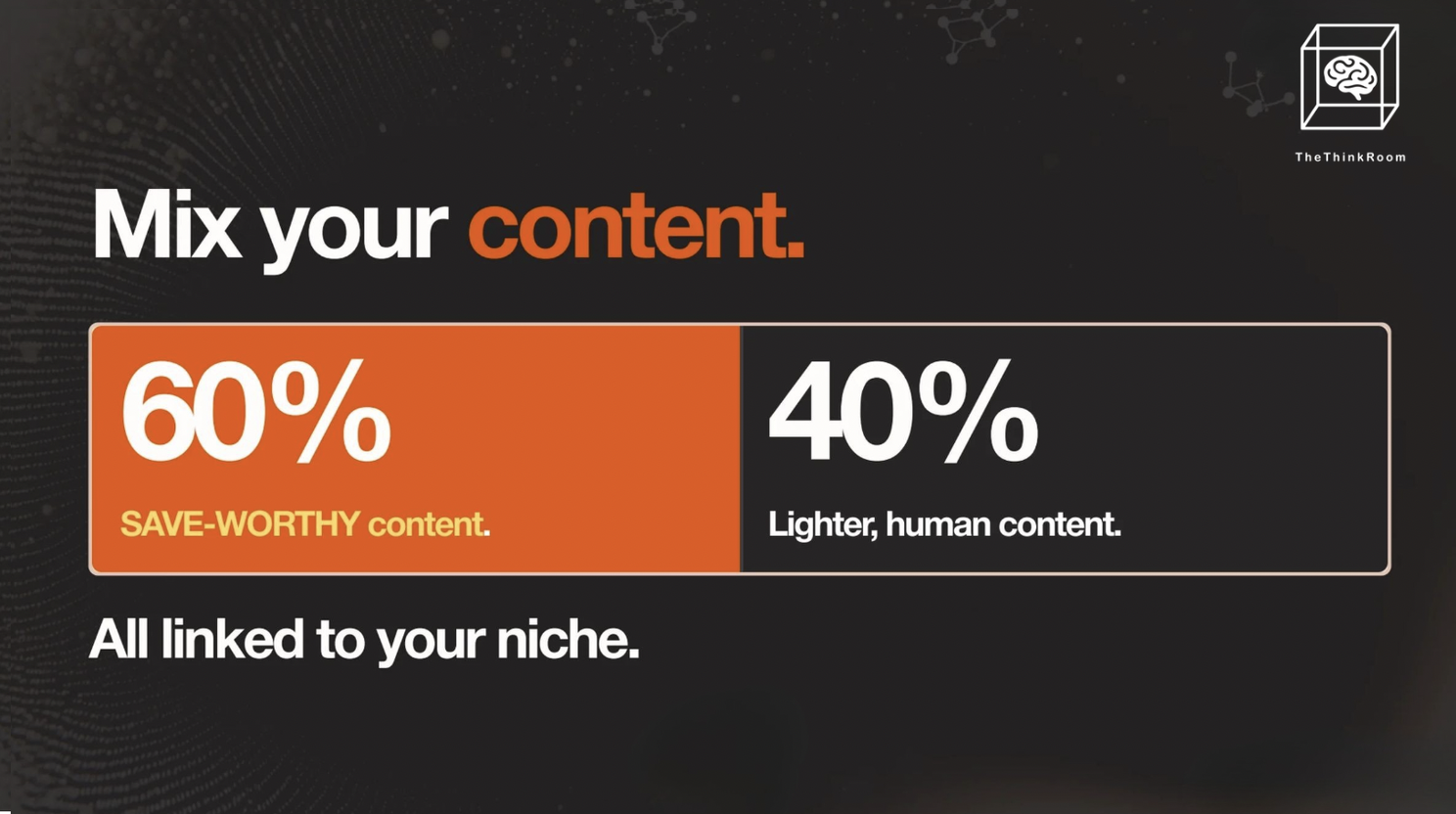
We have said this before and we will keep saying it: fun posts get likes. Save-worthy posts get results. Our content mix at The Think Room, and the one we use with clients: 60% save-worthy (frameworks, step-by-steps, checklists, decisions), 40% lighter (opinions, stories, human moments). Everything ties back to the same niche.
Source: The Think Room
If you cannot describe the post to a colleague in one sentence starting with "you know that thing about...", it is probably not save-worthy yet.
Comments are still the fastest way to grow
This has not changed in five years, and it will probably not change next year either.
Join conversations early.
Comment around your niche, not everywhere.
Build each comment around one idea.
Pick a side and explain it.
Skip the "great post" comments. LinkedIn now devalues them.
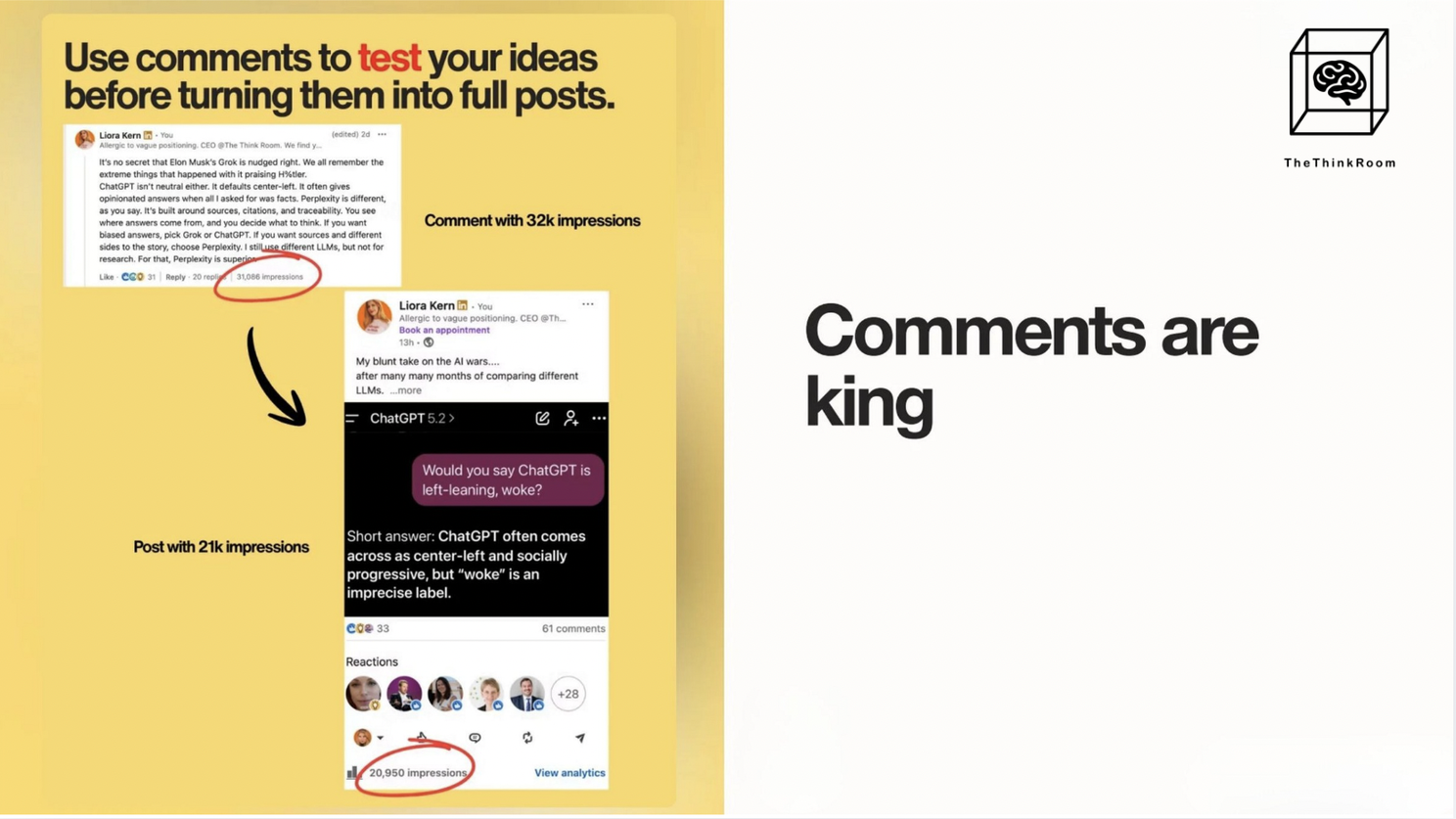
Comments are also the easiest place to test an idea before turning it into a post. If your comment gets 40,000 impressions, 200 reactions and 40 replies, that is your next post writing itself.
Source: The Think Room
Your DNA is doing 50% of the work. Are you letting it?
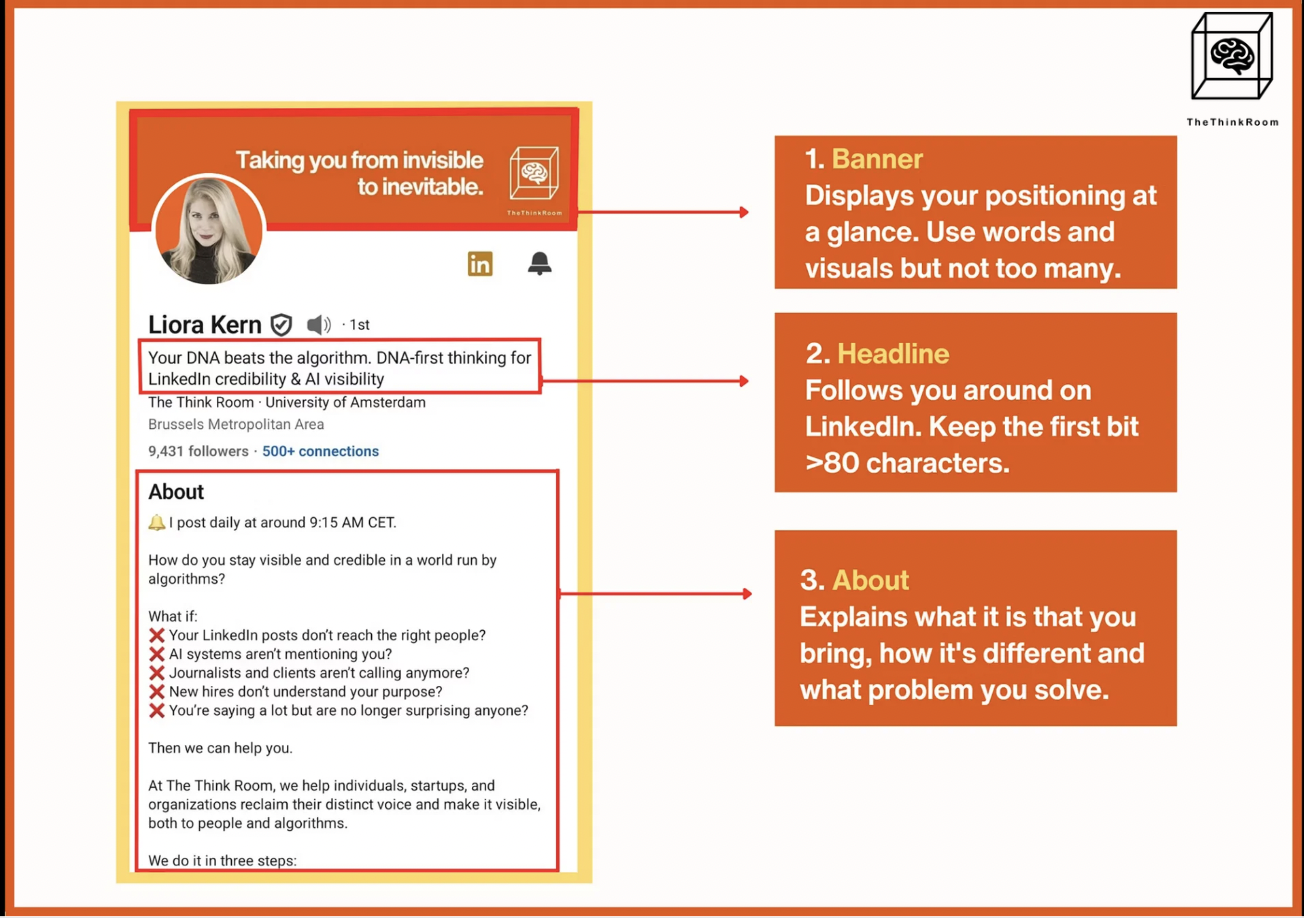
If half of your reach is your profile baseline, then your profile is not decoration. It is infrastructure.
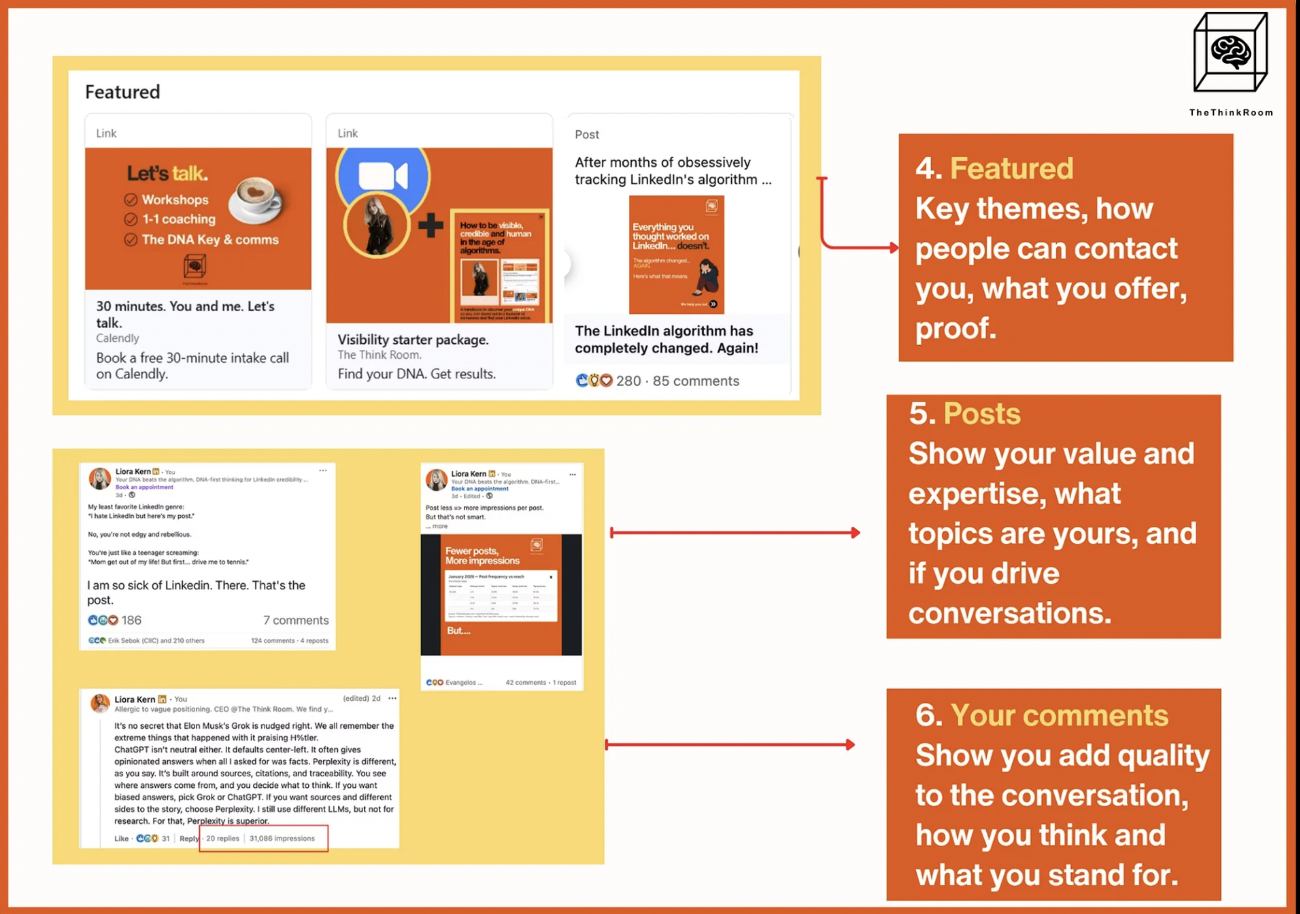
Six elements to audit this week, in this order:
Banner. Benefit you deliver + proof. Not a stock photo of a lightbulb.
Headline. The first 80 characters matter the most as they follow you around everywhere on LinkedIn. Whom you help, outcome, credibility marker.
About. What people can expect from you on LinkedIn. Not a summary of your CV.
Featured. Three items minimum. Your best save-worthy post. Your best case study. A way to get in touch. A post you're proud of and one that got lots of engagement.
Posts. If someone read your last five, would they know what you stand for?
Comments. Yes, your comments are on your profile now. They count.
Source: Liora Kern
Source: Liora Kern
Liora went from 3,485 followers to over 10,500 in a few months using this exact sequence. Impressions went up 563%, to almost 3 million. Same person. Same expertise. One niche, one voice, one rhythm. See the Brussels-specific write-up we published in Newsletter #2 for the full breakdown.
The AI question
AI slop is now detectable at the model level. Under the March 2026 ranking, LinkedIn's LLM reads your post looking for original perspective. Posts that generate reactions without adding perspective get their reach reduced.
Our rule at The Think Room, and the one Liora runs on her own profile: ask your AI to draft 20 hook ideas. Pick the one that sounds like you. Rewrite it in your own voice.
Justin Welsh has been saying a version of this since 2021: the best personal brand is living a life worth talking about. Nothing about that changed with AI. It just got harder to fake.
A rhythm you can keep
Optimal frequency in 2026, per van der Blom's data: 2-4 posts per week. Down from the old 5 to 6. Daily posting now correlates with roughly 45% less reach on average. (Liora still posts around 7 times a week, she says she has too much to say.)
Our take: three posts, one comment sprint per day, one review of your analytics every Friday. That is the whole week. If you cannot keep three, do two. What kills reach faster than posting less is posting inconsistently.
Your task this week
Five things. In this order.
Choose your niche. Be specific. If your headline needs a colon and a slash to explain it, it is too broad.
Align your entire profile around it. Banner, headline, about, featured, last five posts, comments.
Post three times this week with your own voice. First-person hooks. One save-worthy, one lighter, one opinion.
Focus on building topical authority: share original frameworks, consistent and original terminology.
Comment substantially on 10 posts a day, around your niche. Two of those become next week's post ideas.
Open your analytics on Friday. Look for patterns. Do more of what worked. Rerun what did not work with a different hook.
That is it. That is the whole system. It is not new. It is not a hack. It is what has been working quietly for the 8% of posts that get distributed, while the other 92% get buried.
Coming up
Friday we go live, 11.30 am CEST. Bring your worst-performing post and we will rewrite the hook live. Reply to this newsletter and we review yours.
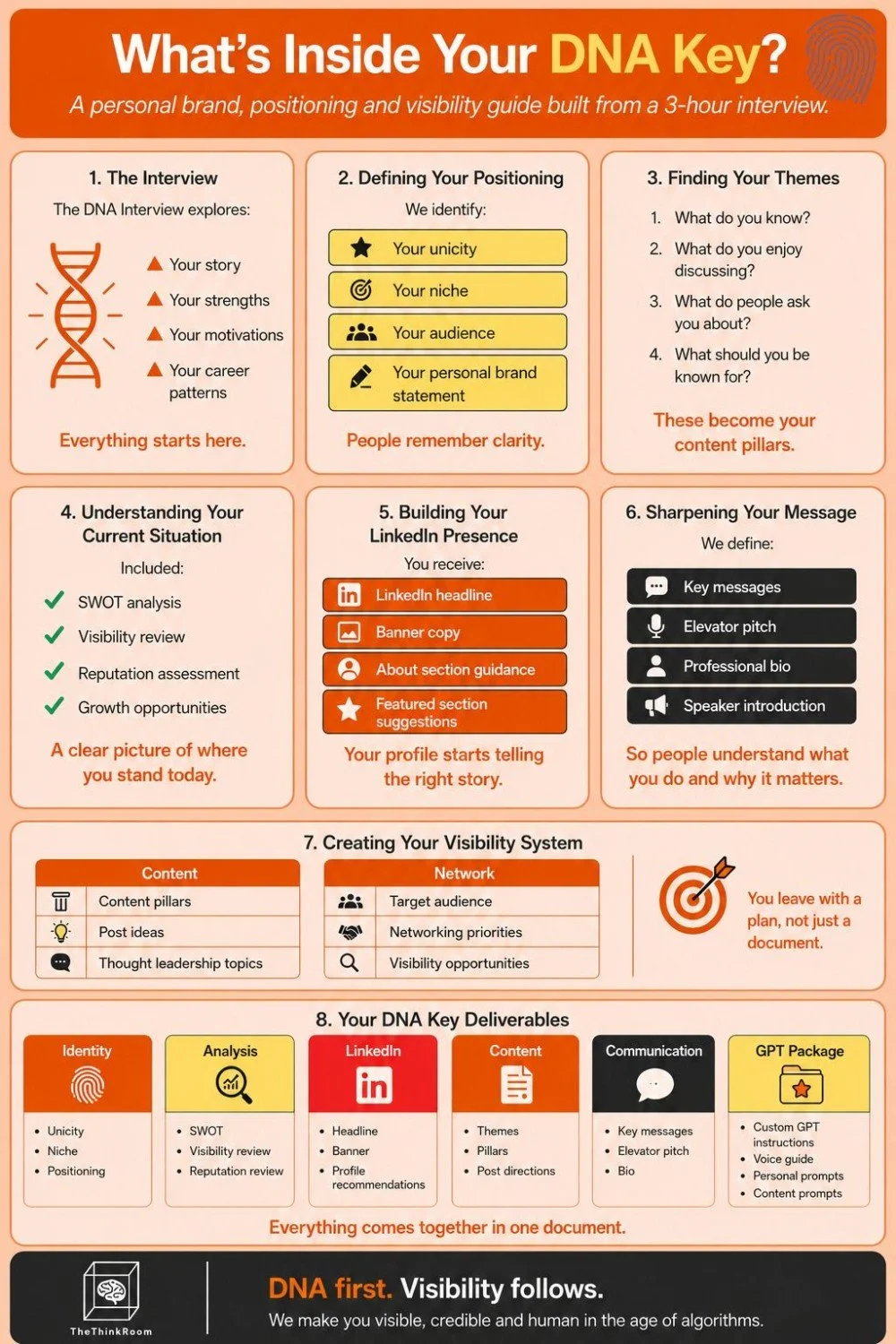
The DNA Key interviews with Liora Kern 🍒 are taking place again from August. First come, first served.
Source: The Think Room
If you made it to the end, send us a sign of life in the comments. A word. A cursed emoji. A one-line disagreement. Anything.
Thank you for reading, or scrolling.
The Think Room Team
We make you visible, credible and human in the age of algorithms.
P.S. If you know one communicator who needs some help with LinkedIn, forward this. It is why we write it.
P.P.S. Watch Liora Kern and Sebastián Rodríguez every Friday at 11:30 CEST. Or catch the replay on The Think Room page.
