AI-free ways to never run out of ideas again
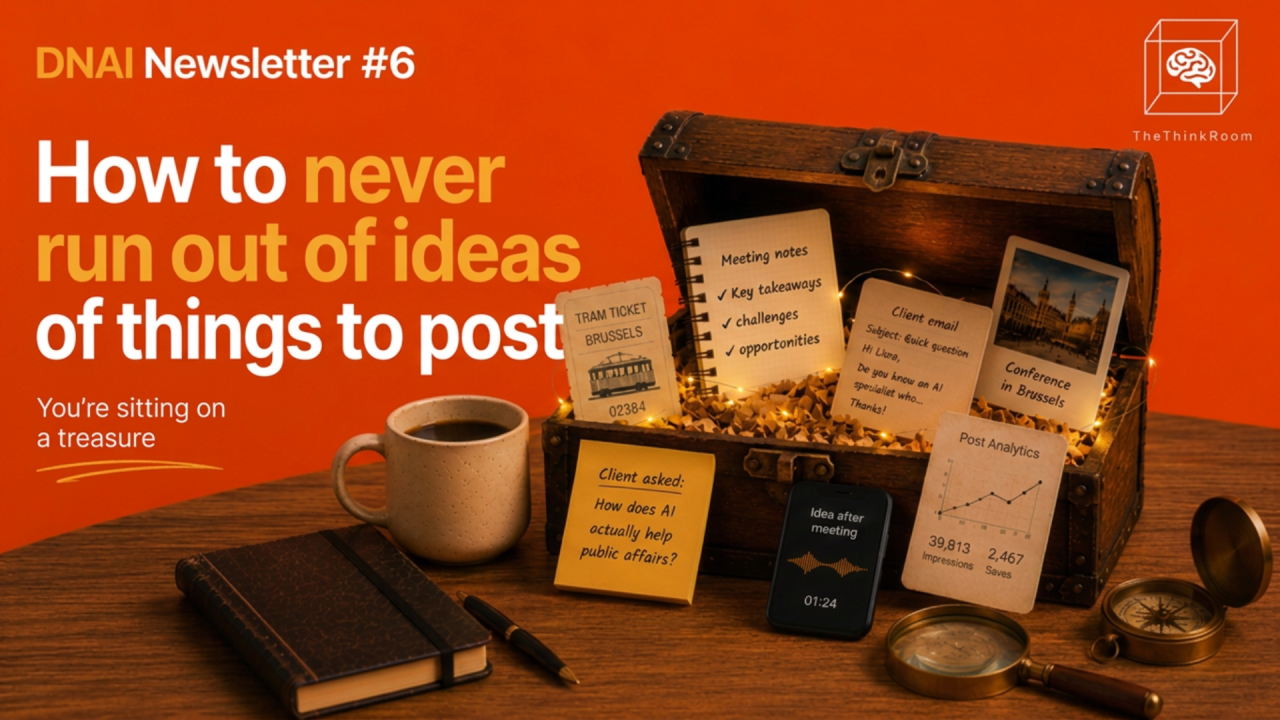
Get your shuffle, we're getting you ready for fall with some treasure hunting - in your own life
A weekly dispatch from The Think Room.
Hello everyone,
Every week someone tells us the same thing: "I know I should post more. LinkedIn is an important channel. I just don't know what to write."
This week we'd like to help you with that.
The first step, as always, is to define your DNA, and establish your niche. That already will make it so much easier. But then you still need to produce content, and that can be tricky.
In the infographic below we give you 50 ideas on how to go about it, without using AI.
And in this very newsletter we go a bit deeper into the most important ones - with examples.
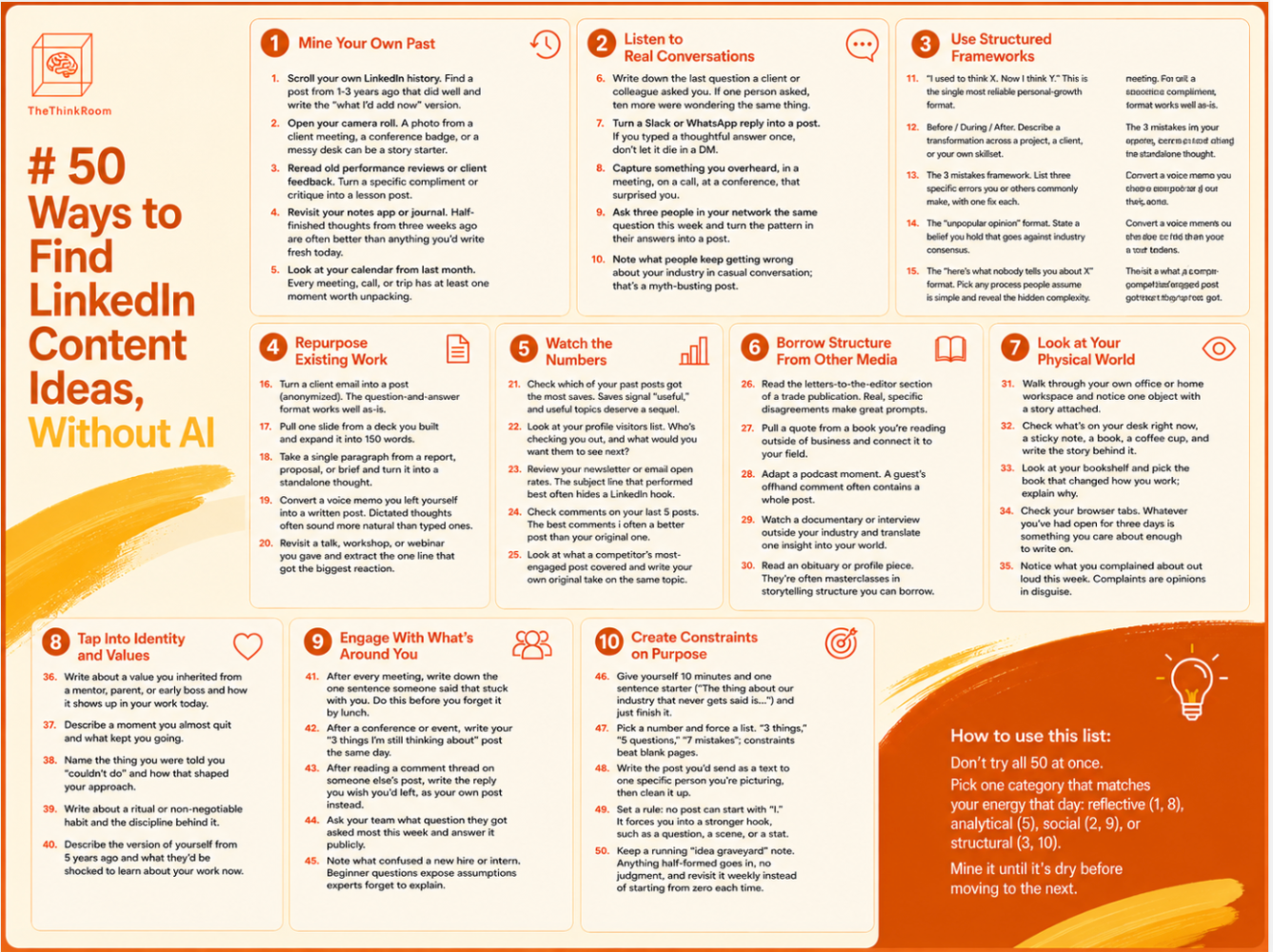
Source: The Think Room
1. Dive into your own past
Before you write anything new, go back. Scroll your analytics (365 days) and find posts that did well. Update it to the version you'd write today. Or simply repost it with a different image or a different hook.
As Gary Vee has been saying for ages: Document, don't create.
Open your camera roll: a conference badge, a Brussels tram ticket, a photo can all be the beginning of a post.
Reread an old performance review and turn one specific line into a lesson.
Liora took a four-hour workshop she runs for clients and reduced it to four steps in a single post: find a niche and own it, align everything around it, make the content useful but fun, and repost your best performers after a minimum of six weeks with a new hook. "It's just the door to your house," she wrote about picking a niche, in her post on turning a workshop into an infographic.
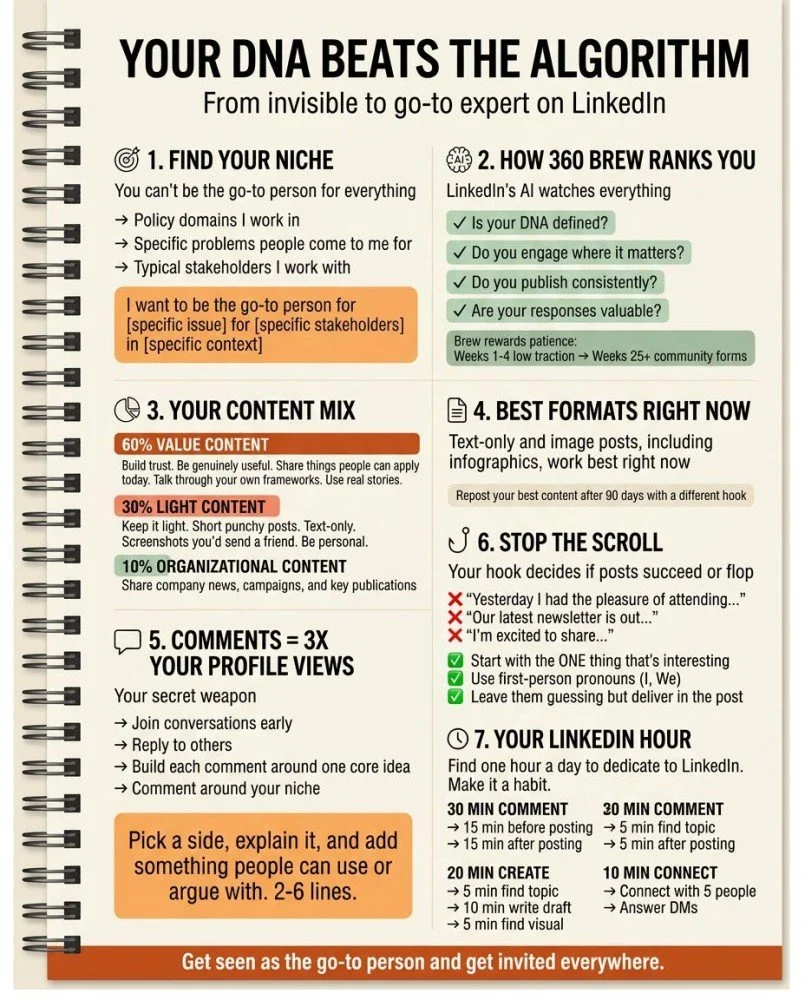
Source: The Think Room
Review posts work the same way. Take this example: "January 2025: almost invisible on LinkedIn. December 2025: this platform made my business go through the roof," she wrote, then listed what actually happened: 5,505 new followers, 1.4 million impressions in six months, weekly meetings booked through her profile, in her Happy Holidays recap.
2. Listen to real conversations
Very important: Write about what you know. Answer questions on LinkedIn you get asked in real life. Write down the last question a client or colleague asked you and answer it in public.
Write down the sentence someone said to you today before you forget it by lunch. Ask your team what question they got asked most this week.
Liora kept getting feedback from clients that her AI workshops were made specifically for communicators, and realized many people didn't understand there are so many different "AI specialists" and not all of them are what you need. "The real question is do you know someone who understands how AI transforms communication and public affairs," as she put it in in a LinkedIn post devoted to that subject.
3. Choose a proven format
"I used to think X, now I think Y."
Before and after.
4, 5, 9 mistakes people make in your field.
Methodologies, models and frameworks, the systems you use to do your job. A great format: Carousels and infographics.
How I... (not how to, as that reads as something AI could have written.) Yes we know this banner reads "how to" but we never said we were perfect.
Take a look at the top performing formats by the master of animated infographics Vincent Pierri:
Source: Vincent Pierri, LinkedIn
4. Repurpose your existing work
“A client email, a slide from a deck, a paragraph from a briefing document. Anonymize it, clean it up, post it. It already worked for you. See how it does on LinkedIn.”
And why not run an entire genre on this? Liora's Helpful PostAlert posts are a curated index of her own past posts, in this case on AI and visibility, and another one about LinkedIn visibility, dropped into one place for people who are too busy to keep track of it all.
Source: Liora Kern's Linkedin
5. Follow the numbers
Your data is telling you what to write next, if you don't forget to look. Check saves and sends, likes barely tell you anything. And make sure to check out which posts broke out of your own bubble, as those are the ones LinkedIn apparently likes enough to show to a larger group of people.
“Repost a strong performer after six to twelve weeks with a new hook or a new image. Liora once reposted the same carousel twice changed only the hook and caption, and watched it go from 21,977 impressions to 39,813. "Only 5-10% of your followers see your posts," she wrote. "So if one of your posts does well and it's not time-sensitive... repost it."
If you have your own research, no matter how micro, that is content that works well on LinkedIn. Liora once pulled 26 of her own posts and manually tracked impressions, reactions, comments, saves, sends, followers and reposts because the algorithm looked random to her. "Some posts with tons of reactions would get no more than 4k impressions... others with fewer reactions somehow exploded to 25k," she wrote in her 10 tips post. This spreadsheet was very helpful, as, like we said before, patterns are more important than impressions of one singular post.
And keep answering questions? Isn't it better to post less so you get more reach per post? Show the real math instead: "If you post less, each individual post may perform better, but my daily posts got 96,818 impressions over seven days, reaching 56,799 people, with my worst post at 1,243 and my best at 44,855." she wrote in are you obsessing about impressions per post. Posting less often means missing out on the volume that builds reach over time.
6. Let the world inspire you
Life is so much more than LinkedIn. What are you reading/doing/watching/talking about? That's content. Did we say already that EVERYTHING IS CONTENT?
A trade magazine's letters-to-the-editor page, a line or a page from a book, a documentary scene. Use them as a starting point for your posts. Connect it to your niche.
Something that works very well, is to turn something that caught your eye on LinkedIn or another platform and add your own take to it, like so:
This post got 80k impressions.
You can also write a post about how to write such posts (are you starting to see what we're doing here?).
Source: Liora's LinkedIn
The World Economic Forum's Future of Jobs Report 2025 became one of Liora's better-performing posts once she connected it to LinkedIn behavior directly: analytical thinking stays the top skill, but resilience, agility, leadership and creative thinking are climbing fast, "skills that can't be automated," as she wrote in In the core skills of 2030 aren't what you think.
Source: World Economic Forum
7. Your physical world already has the story
“The sticky note on your desk, your Japanese stationary, your coffee mug. The three browser tabs you haven't closed in days. Name the object, then explain what it says about how you work or think.”
Take this post by Nik Pearson. He wrote about his addiction to Japanese stationary.
Brussels itself is a character in Liora's feed for exactly this reason as well. "Maybe it's because I just returned to Brussels and the weather is crap," she opens her post on the things she hates about the Brussels Bubble, before listing the manels and the pace of everything. The positive mirror post did just as well: "184 nationalities, 40% foreign residents," she wrote in 9 things to love about working in the EU Bubble.
And then she wrote a post about comparing the two posts: LinkedIn loves it when I hate things.
The post about the posts (source: Liora Kern)
8. Your personal story
People follow you for what you bring to the table, and your personality is what gets them to stay. A value you inherited from a mentor, the moment you almost quit, the thing you were told you couldn't do.
Liora arrived in Brussels fifteen years ago, seven months pregnant, with zero connections and broken French. "I nearly skipped my first Brussels job at ZN because it asked for 'fluent French,'" she wrote in How I made it in the Brussels Bubble.
Fifteen years later she runs The Think Room. (By the way: She reposted it with a new image last week, but in this case it didn't perform as well as the first time.)
In the AI age, personal stories perform better than ever before
Not every identity post has to be light, sometimes you have real things to share.
As an example: Liora traveled to Malta to meet 56 leaders from the Middle East, Europe and the Americas working on free and multi-faith societies, and received the "Live What You Believe Certificate of Global Leadership." She was most impressed, she writes in that post, with Iranian women and men working, at real personal risk, for a free and democratic Iran.
9. Add constraints
As Ioana Matei writes in her analysis of a year of posting on LinkedIn, some of the best posts start with a number: "About 15 posts of everything I published went “viral”. Nearly all of them opened with a number (10 questions, 6 months, 5 years, 2025 etc)," Ioana writes.
Source: Ioana Matei, LinkedIn
Three things, five questions, seven mistakes.
You can also give yourself exactly 5/10/15 minutes to write a post (without AI). Just write from the heart. Unpolished perform better anyway.
Menachem Rabinowitz 🐘 explains how to do that.
Source: Menachem Rabinowitz, LinkedIn
Lists still work well too, as long as they are personal and not something AI could have created. "List everything you hate. I'll go first," Liora wrote, in her list post.
Our content-mix rule works the same way: two-thirds of your posting time on trust-building content that's genuinely useful and get you real-life results, one-third on lighter, punchier posts that are just fun to read and grow your visibility, as she. explains in How to make LinkedIn work for you in 2026. A ratio is a constraint too
How to use this
Print the infographic with 50 ideas and put it on my desk.
Don't worry, you don't need to try them all at once.
“Pick one category that matches your energy today: reflective if you're tired, analytical if you're annoyed at your own metrics, social if you just left a good meeting, structural if you need a rule to hide behind. Then move to the next one next week.”
Keep a note in which you put all your post ideas, so you don't have to start from zero every time.
Made it this far? Write INSPIRATION in the comments. Or let us know what you'll post about next.
We appreciate you!
The Think Room Team
We make you visible, credible and human in the age of algorithms.
PS: hit the bell on our page and put it on "always" so you don't rely on an algorithm.
