Networking season is coming to Brussels. A survival guide.
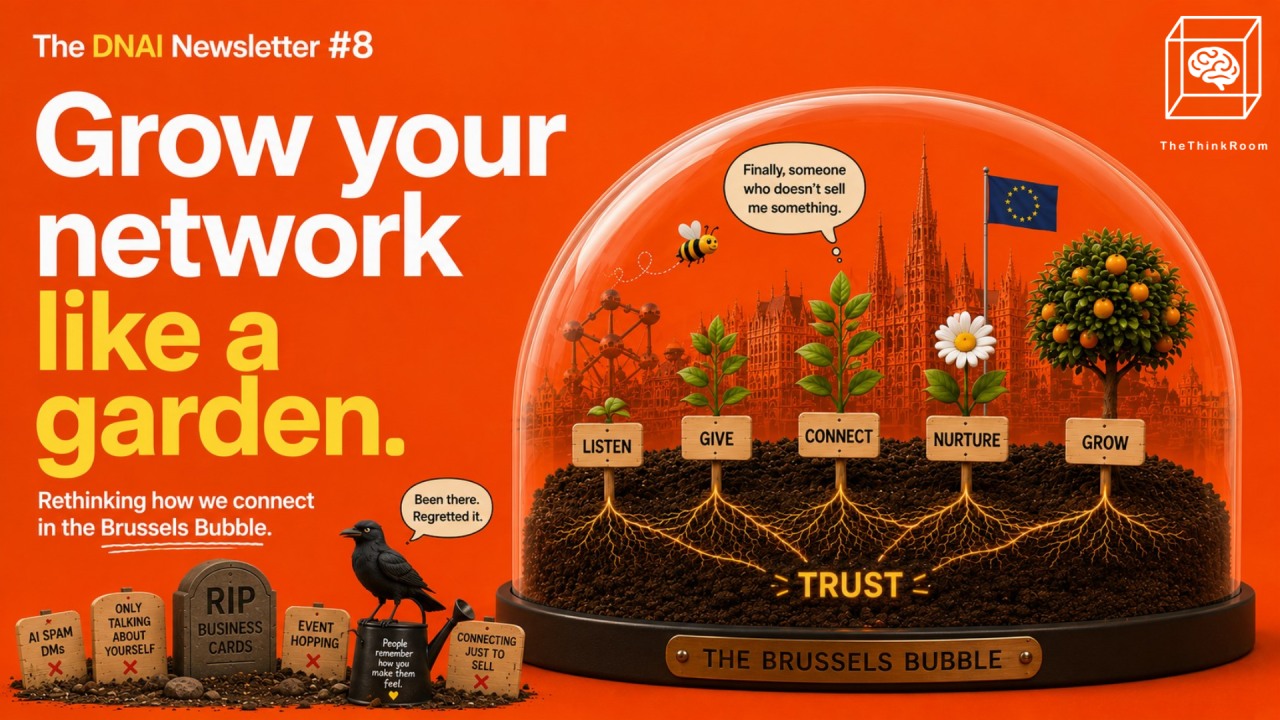
Hello everyone,
It might feel like the summer will never end, but we're two weeks away from September, and you know what that means: months of events and networking are right in front of us.
So: Let’s talk about networking.
Because it's not as easy as it looks. You may need, or desperately want, a new job. You may need clients. You may want to become a musician and want to find people to give you gigs. You may want to lobby.
In any case, you need to attend events, and meet people.
In this newsletter we talk about the do's and don'ts. In the real world, and also on LinkedIn.
Source: Supermeme.ai
If you have been going to events, handing out business cards, giving your elevator pitch, and hearing absolutely nothing back, it's not because people hate you. You're just doing it wrong.
Here is the plan to fix it today.
The give-first mindset
Do you walk into a room with a perfectly rehearsed corporate monologue, find your “targets”, and try to get something from them?
Then that’s not networking. It’s definitely not networking in 2026. We’d call it hunting.
Networking in 2026, especially the specific way of networking that we champion at The Think Room, is generous. It gives without expecting to receive. It is much more about listening and less about talking over everyone else.
If you are at an event just to get something out of it, your mindset is fundamentally flawed.
Every single opportunity to meet people is just a chance to make friends, or a way for you to help people solve their problems. Naturally, your skills will shine through as you assist them. But your primary purpose is to get to know them and see what makes them tick.
Where to start: joining existing communities
If you are new to a specific field or a new city, the absolute easiest way to start networking is by plugging into existing communities. Fortunately, the EU Bubble is full of them.
People move fluidly here. Someone may be in aviation policy today, and fertilizers tomorrow. Building cross-sector experience is vital. You need to network with people outside of your current field.
Aimée Duprat-Macabies has a great post about communities for you to join if you’re a comms professional in Brussels:
Source: Aimée Duprat-Macabies' Linkedin
Policy comms:
📍 european campaign playbook led by Sebastián Rodríguez
📍 Policy Comms LinkedIn group led by Gianmaria Sisti
Communication professionals:
📍 Social Capital led by Margaux Demeyer and Filip Simonovski
For creatives:
📍 The POP Collective led by Emma Kersalé and Gökşen Çalışkan
📍 Contentors led by Yasser Machat at the European Commission, bridging the gap between EU institutions and digital influencers.
These groups represent a new wave of professionals. They might have studied design, communications, or digital media, meaning the traditional EU Bubble isn't their natural habitat. Connect with them.
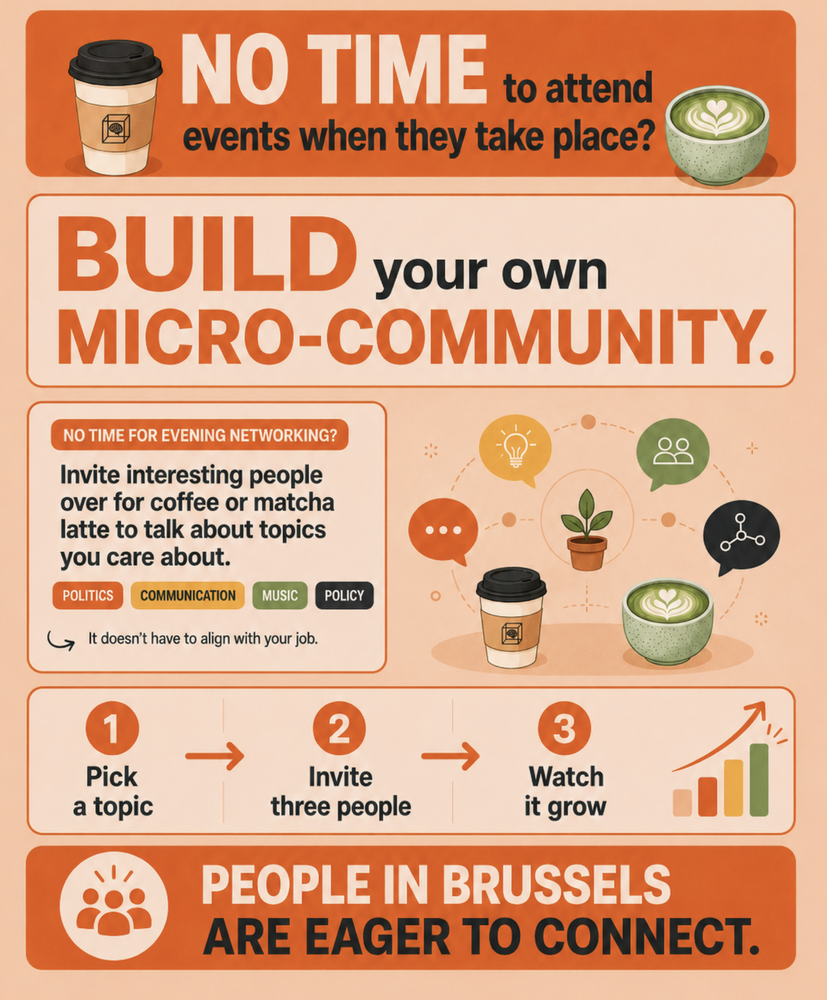
No time? Build a micro-community.
What if you simply don't have the time for evening networking?
When Liora first came to Brussels, she was seven months pregnant with her second child. She didn't have the time or energy to attend after-work events, panels, and cocktail hours. But she was brand new to the city and desperately wanted to meet people.
Her solution? She built her own micro-community.
She started inviting interesting people over for coffee (or matcha, whatever does it for your crowd), politics, communication, identity. It didn't even have to align with her day job.
What she discovered is that people in big cities are eager to connect and are happy to meet. Small groups turned into bigger groups. Today, that informal community has grown into a cross-sector circle of friends who regularly gather at her house.
“If you cannot fit into the existing networking schedule, create your own. Pick a topic, invite three people, and watch it grow.”
Did you forget your business cards?
Let's talk about the actual event. You meet someone great; you had a fantastic conversation. Now what?
“Stop fumbling for business cards. People lose them, wash them in their jeans, or throw them away. Instead, turn your phone's lock screen wallpaper into your LinkedIn QR code.”
Liora lives what she preaches and does this on her own phone.
When someone asks to connect, you just tap your screen. They scan it. Done.
Here is how to find it:
Open the LinkedIn mobile app.
Tap the search bar at the top.
Click the tiny QR code icon on the right-hand side.
Take a screenshot of the code.
Set it as your lock screen (or save it to a highly accessible photo album if you prefer to keep a picture of your kids on your lock screen).
Source: Liora Kern
4 rules
Follow these four steps:
Listen first: ask good questions. Be interested in the person standing in front of you. Prepare a little bit beforehand if you know who will be on the guest list.
Pitch yourself in one sentence: It’s good if you’re able to say who you are in one sentence, but do not give a monologue.
Be human: share something funny about yourself (what we call your unique DNA). Make sure you don't sound like you're talking like you’re in a job interview.
Build a relationship: talk about tennis, your Japanese stationery addiction, or the terrible Brussels weather. Find the human overlap.
Jimena González Hernando has a post about the tension between visibility, performance culture and authenticity. She says networking is part of the Brussels ecosystem, but that does not mean you need to attend everything. Use your energy wisely.
Source: Jimena González Hernando's Linkedin
The 20-second pitch
So we want you to relax, to listen, to engage. But people are bound to ask you: "So what is it that you do?" And then you need to avoid, at all costs, to start a monologue that is long and boring (to everyone but you). You should be able to explain what you do in 20 seconds. That means that you have 20 seconds to make a first impression when it is your turn to speak.
“If someone asks what you do, and you launch into a chronological history of your career, they are already thinking about what they're going to eat for dinner. You lost them.”
Source: Liora Kern
Keep it super short. Focus on what gives you energy, not the daily tasks you execute. Make it a little bit vague, so if they’re interested, it gives them the opportunity to ask: "Huh? Tell me more."
Here is Liora's pitch: "I help you stay visible, credible, and human in the age of algorithms."
Source: Liora Kern
It's a hook. When they ask "but how?", she layers in the DNA: "By finding your unique DNA.” And when they ask why? “So you stand out in a tsunami of sameness." Or: So LinkedIn becomes easy and you finally get traction.
Contrast this with a standard, boring EU Bubble introduction: "I'm a biotech researcher with experience in data visualization," that stops the conversation cold.
Try this instead: "I help biotech teams explain incredibly complex data with clear visual messages."
Instantly, the other person knows the outcome and can ask, "Do you only help biotech teams, or can you help me too?" If you want the full explanation, you can find it here.
Where do you work?
If you work in a large organization, keep this in mind:
If you work for a massive institution, saying "I work for the European Commission in DG Connect" doesn't help anyone understand your value. Are you a policy expert? A data visualizer? An HR manager?
When someone asks what you do, keep the answer short, but don’t make yourself smaller in the process.
“I’m in HR” is short, but it tells us very little. “I’m the HR Director at X” takes roughly the same amount of time and immediately gives us context. (By the way, research has found that even when men and women have equivalent experience, men tend to describe their job and their work using more senior, leadership-oriented language, while women describe more of what they actually do. So especially if you're a woman, be careful not to fall in that trap.)
Have one clear line for your organization as well. Try saying: "We are the think tank that ensures Europe doesn't miss the AI opportunity."
Align your personal outcome with your organization's outcome. Rehearse this line. Test it on your colleagues. See if people react positively when you use it in conversation.
And if you're “in-between” jobs, make sure to prepare how to answer that question as well.
Offline to online: DMs and groups
You made the connection. Now you're officially connected on LinkedIn. How do you nurture it?
⛔ Skip the LinkedIn groups. LinkedIn groups are largely dead spaces. If you are building a community, move them to WhatsApp or bespoke DM chats, where engagement is significantly higher and more personal.
⛔B eware the DMs. Direct messages are a minefield. We at The Think Room do not do cold outreach or hard selling via DM. But we do respond if you reach out to us, of course.
BY the way, if you are using DMs to say, "I saw the glowing recommendation from Anna saying that you do X, Y, Z" (which is obviously scraped by an AI agent), you are going to get ignored. Liora gets ten of these exact same AI-generated spam messages a week.
If you want a meeting, send an email. Don't fake a casual chat just to suddenly pivot into a sales pitch.
Comments are your secret weapon
The real networking on LinkedIn happens in the comments section. If you want to connect, engage with people's content publicly and build a relationship.
Your profile makes it clear what you bring to the table. Your comments are where you show your personality, have fun, and build relationships without wanting anything in return.
Liora recently replied to a Gary Vee post (where he swore about the algorithm) with: "Yes, train your feed. I am training my feed not to see any cursing. It is still a work in progress."
Source: Liora's Linkedin
It was a joke. Some people didn't get her humor and argued with her. But that single comment generated 15,000 impressions and brought in over 170 new followers overnight.
Debates and humor in the comments section drive mass visibility, and more importantly allow you to build your reputation and real-life relationships. YOUR NETWORK.
When you comment on posts outside your immediate 1st-degree network, you break out of your bubble. The algorithm rewards it.
Create save-worthy content
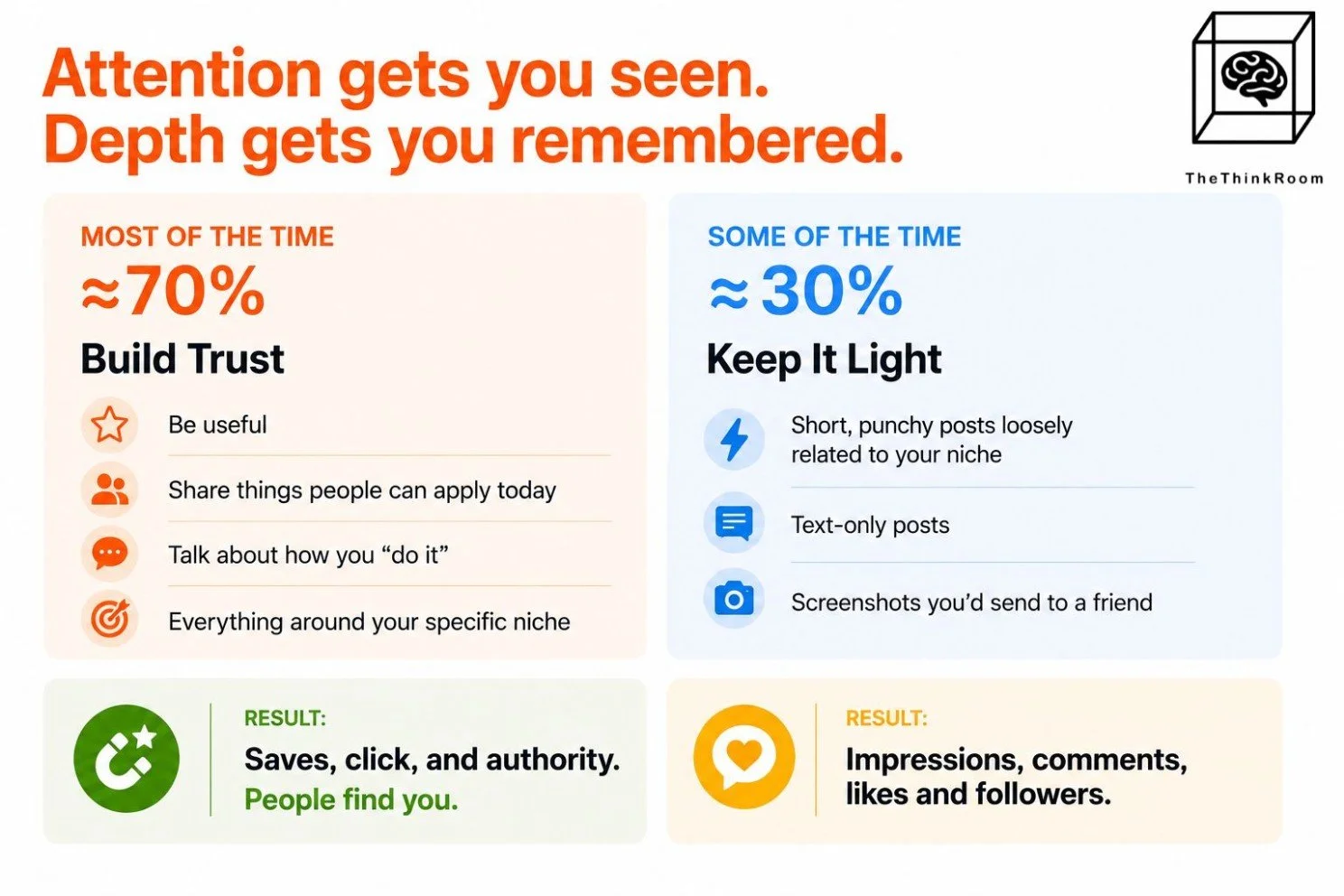
We've said this before: Likes are polite. Saves are strategic.
Liora's content has been saved over 6,000 times in the last 365 days alone.
When you create highly useful, actionable content based on the actual questions you get asked in real life networking, people save it. They come back to it. You stay top of mind.
When they finally need a consultant, a freelancer, or a new hire in your niche, they think of you. You don't have to pitch them in their DMs because your content already did the positioning.
Source: The Think Room
Need a new job?
Liora regularly helps professionals after being made redundant (the parting company usually pays for an outplacement package that includes mentoring, LinkedIn support, help with networking and applying for jobs, presentation skills and emotional support). Often, what actually helps them land a new role is her network.
If she believes in a professional, she can call a connection and say, "I have this person, and they would be amazing for your organization." They still have to pass the interviews, but the network gets them in the door.
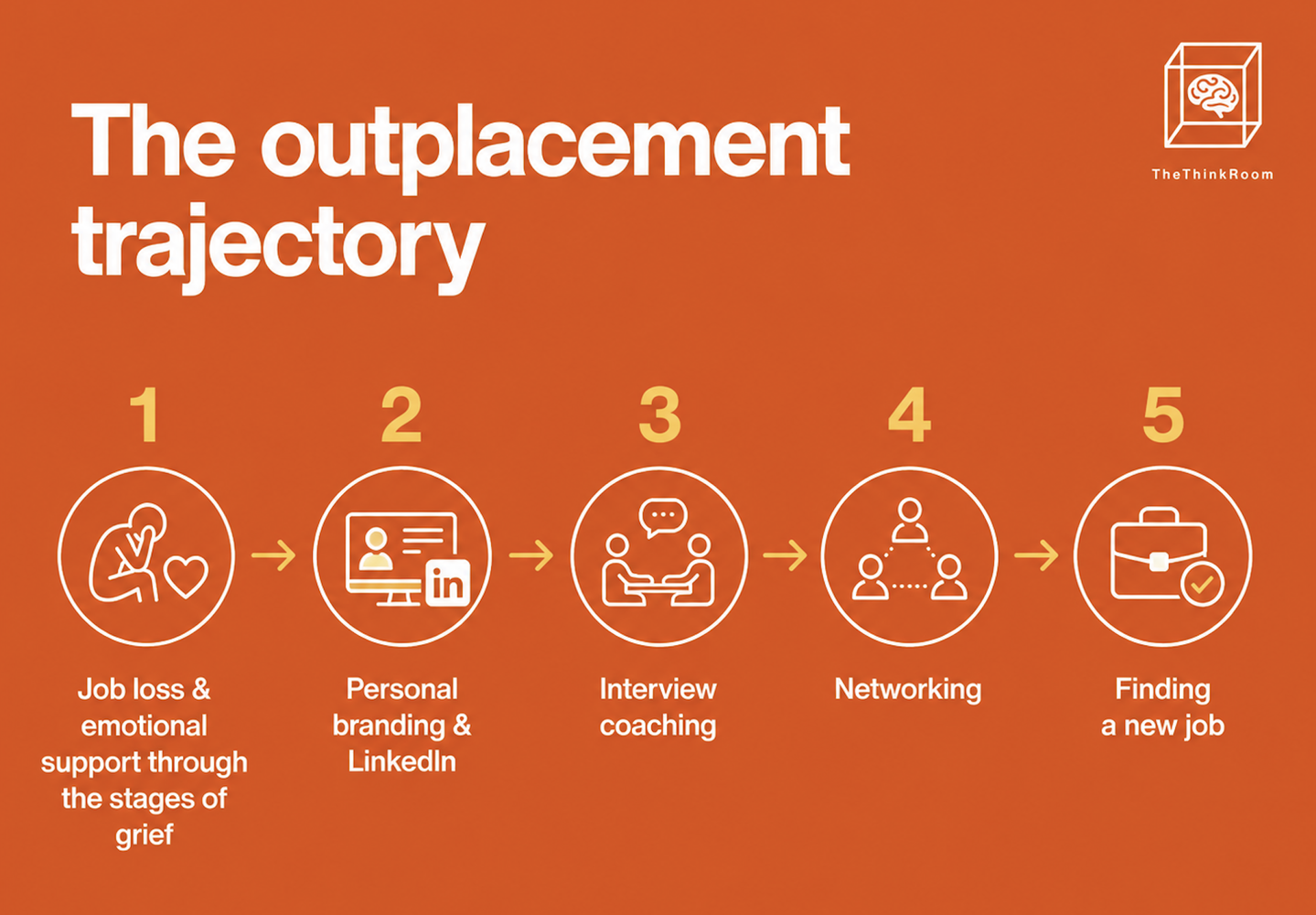
Lost your job? We're sorry :-( Your company may pay for an outplacement program. Choose your own.
Networking for introverts
Flavia Scotton is an introvert who likes building meaningful one-on-one connections with time and patience. She always considered networking events to be her own personal nightmare but with time, Flavia has discovered joy and meaning in the Brussels-mingling.
Flavia shares her own five tips for networking in the Brussels bubble.
Automating the mechanics, not the soul
Can you automate networking? Yes, but only the administrative parts.
You cannot automate the outreach. Do not write AI-generated CVs. Do not use LLMs to respond to thoughtful posts.
But you can automate the mechanics. Sebastián Rodríguez uses an automation tool so that whenever he gets an email notification about a new LinkedIn connection, an agent drops that person's name and details into a Notion database. Every month or two, he reviews the list to ensure he has followed up with the meaningful connections.
Automate the tracking. Humanize the talking.
The two cardinal sins of networking
Let's end with two things you should absolutely avoid.
⛔ The preemptive business card: do not walk up to someone and hand them your card before you have even exchanged a single word. It reeks of desperation and shows you are only there to achieve a goal, not to connect.
⛔ The open bar: do not drink alcohol heavily at networking events. If you must, stick to one or two glasses of something light. Nobody wants to have a professional conversation with someone smelling of stale beer and wine.
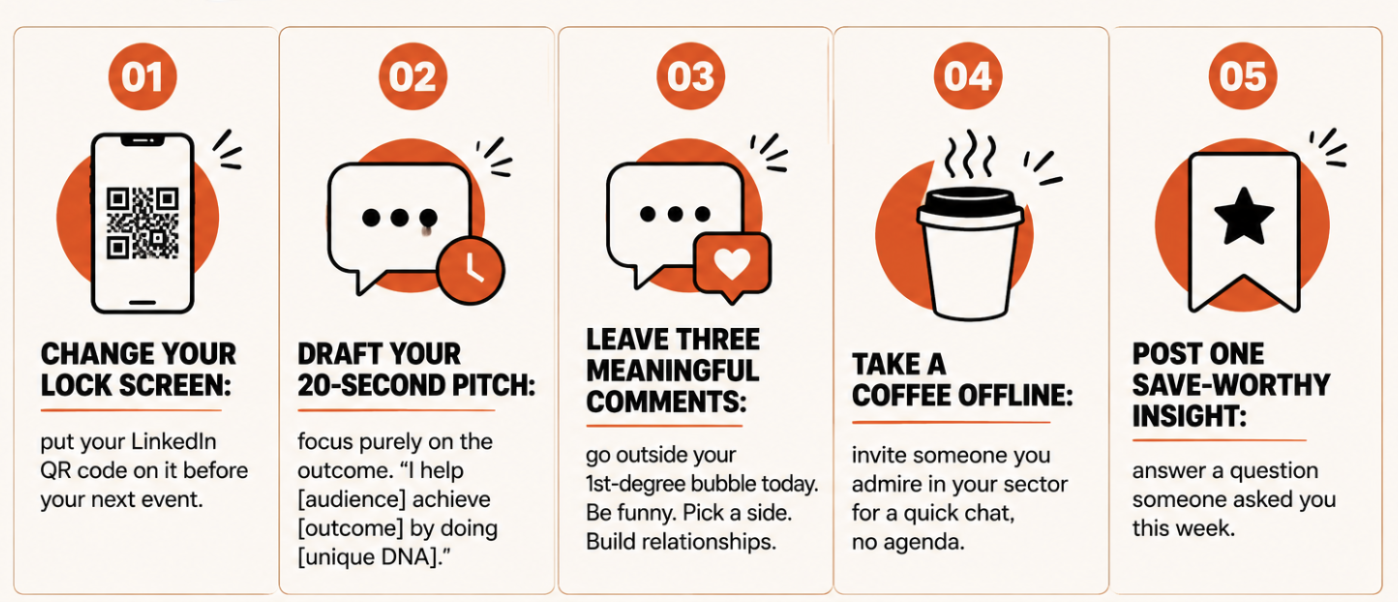
Your tasks this week
Change your lock screen: put your LinkedIn QR code on it before your next event.
Draft and practice your 20-second pitch: focus purely on the outcome. "I help [audience] achieve [outcome] by doing [unique DNA]."
Leave three meaningful comments: go outside your 1st-degree Bubble today. Be funny, add something, build relationships.
Take a coffee offline: invite someone you admire in your sector for a quick chat, no agenda.
Post one save-worthy insight: turn a question people keep asking you into a LinkedIn post
And with that we thank you for reading… or scrolling.
The Think Room team
P.S. If you know someone who needs some help with networking, forward this newsletter to them.
