
The short version: Your colleagues know things your audience would love to understand. They answer difficult questions, solve problems, challenge assumptions and explain complicated subjects every day.
And then you ask them to write a LinkedIn post, or better yet, an article. But they don't have time. They don't know where to start. Or they send you 800 words that read like a policy briefing.
There is a better way to get their expertise into your communications.
Interview them.
Today, we're sharing a practical method for interviewing subject-matter experts, finding publishable ideas in their answers and turning those ideas into content people want to read.
You can use it with a CEO, a policy director, a researcher, an engineer or anyone else whose knowledge deserves a wider audience.
1. Stop asking busy colleagues to write
One of the most common problems in corporate and association communications is getting colleagues to contribute.
The communications team needs content. The experts have the knowledge. Somehow, everyone ends up frustrated.
A policy director may be perfectly capable of explaining the consequences of a proposed EU regulation in a meeting. Ask that same person to write a LinkedIn article, and the document may sit untouched for weeks.
Writing for an external audience requires a different set of skills. You need to decide what matters, remove unnecessary detail and find a way to make someone care.
That is part of the communications team's job.
Eve Chen makes this point in her September 2026 Content Marketing Institute article, How to Get Great Content Without Asking Your SMEs to Write.

Chen's recommendation is to prepare interviews around specific questions and capture the expert's natural explanations. She also warns against producing dozens of weak pieces from a single interview simply because that's so easy these days.
2. The interview: ask questions that reveal expertise
A good interview requires preparation, curiosity and the willingness to abandon your question list when someone says something interesting.
Start by reviewing the person's recent work. Look at their presentations, public comments, reports, internal briefings and recurring conversations with clients or members.
Then prepare questions that invite them to explain what they know, and reveal a bit of their DNA in the process...
Questions we would ask:
About their expertise
What question have you answered repeatedly in the past month?
What do people outside your profession constantly misunderstand?
What can you explain in five minutes that takes newcomers months to understand?
Which part of your work has become more complicated recently?
About their judgment
Tell me about a recent decision where reasonable people disagreed.
What advice do you give that others in your field might challenge?
Have you changed your mind about something important?
What do people tend to overlook when making this decision?
About their experience
Can you walk me through a recent case?
What happened that you didn't expect?
What would you do differently?
What did you learn that might help someone facing the same situation?
And then, always: "Can you give me an example?"
Ask what happened, who was involved, what the alternatives were and why they made that choice.
If you don't understand the answer, don't be shy and ask them to explain it again. Your readers may have exactly the same difficulty.
Stop staring at your questionnaire. Really listen to what the person in front of you is saying.
Linda Pophal, SHRM-SCP, SPHR explores this in The Art of the Interview: How to Get Better Stories from Subject Matter Experts. Her approach draws on journalism: prepare carefully, listen for the unexpected and follow the answer rather than mechanically completing a questionnaire.
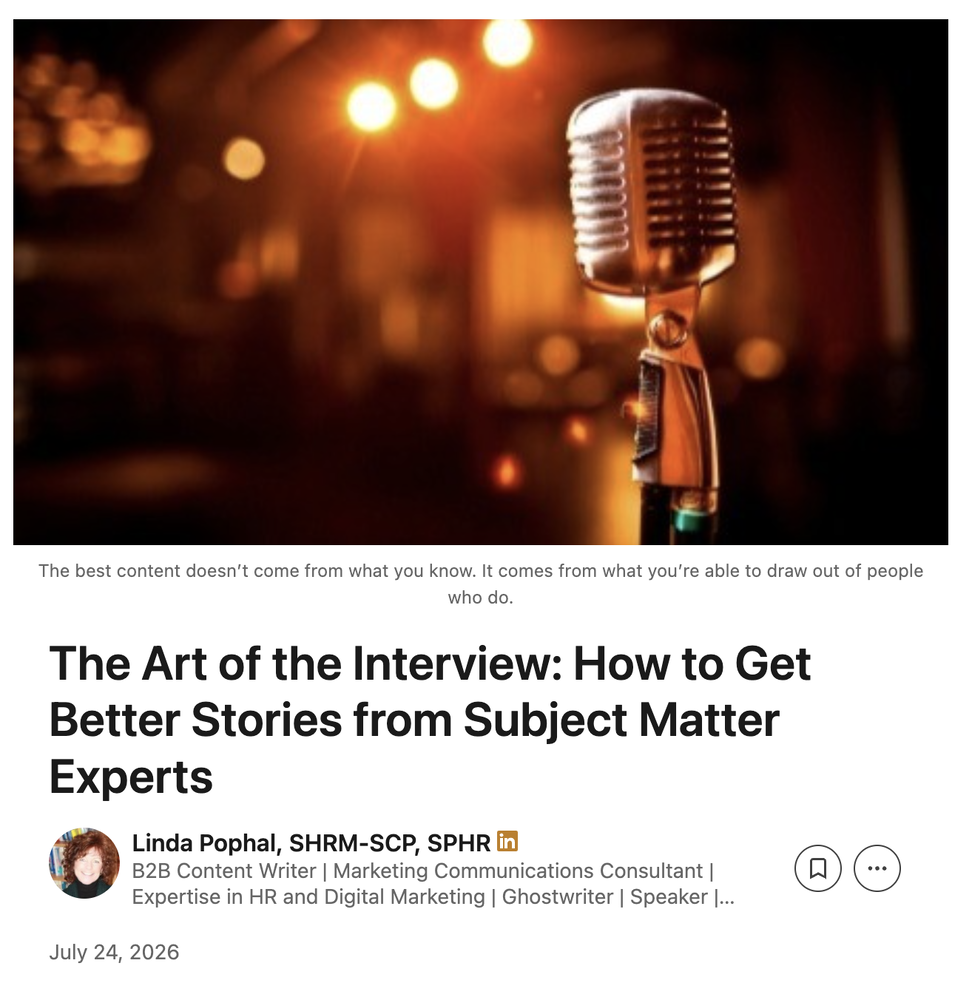
A good read.
3. What to listen for during the interview
The most interesting content rarely announces itself as a content idea.
It might be a remark about a common misconception, a story about something that went wrong or an explanation that makes a complicated subject understandable.
We listen especially carefully when an expert:
Says: People always assume...
Describes something they have stopped doing.
Explains why two apparently similar situations require different decisions.
Mentions an unexpected result.
Gives a specific example that contradicts a common belief.
Explains a concept using language you haven't heard before.
Time for follow-up questions.
Ask to record the conversation. You will want the exact explanation later, especially when the expert uses a phrase that captures their thinking particularly well.
And keep track of which material can be published. Policy teams, corporate affairs departments and associations regularly handle confidential negotiations, internal positions and information that requires approval.
4. One interview, ten possible LinkedIn posts
Let's make this concrete. Suppose you're interviewing the policy director of a European industry association about the implementation of a new EU regulation.
You ask what members are finding difficult, where misunderstandings occur and what the association has learned from its work.
The interview could produce the following editorial ideas:
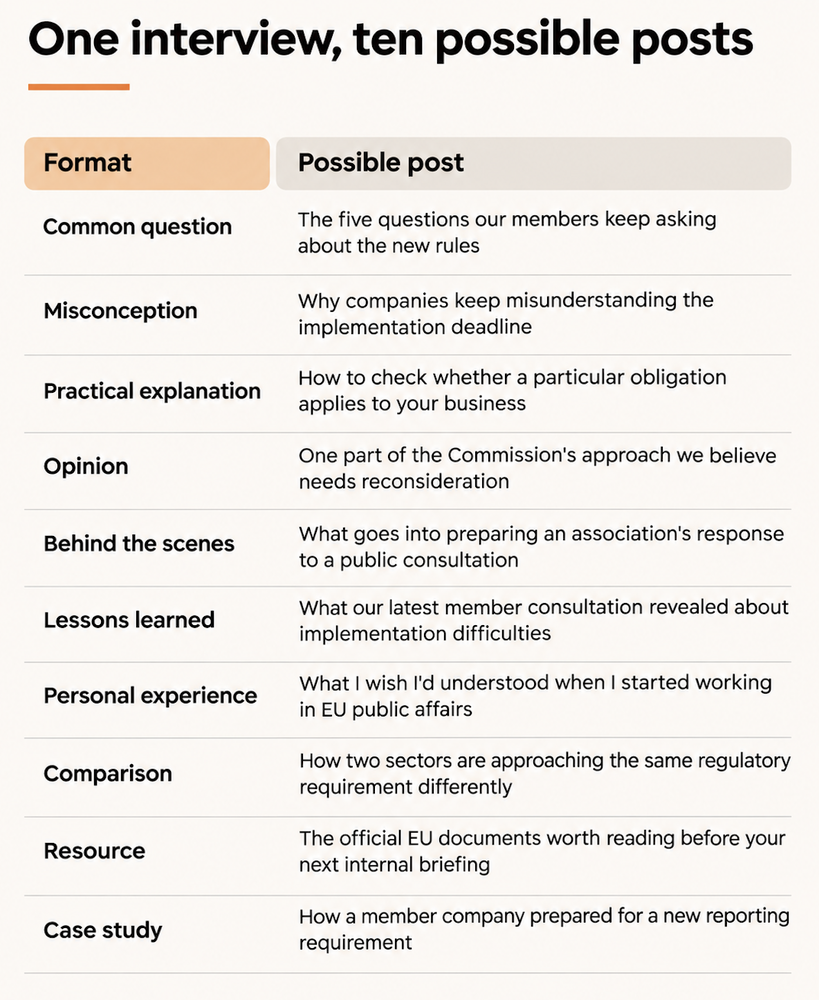
One interview, so many different pieces of content
You now have an editorial menu. Some ideas may deserve a LinkedIn post. Others could become an article, an infographic, a short video or an FAQ for members.
Choose the ones that answer a real audience question and can be supported by the source material.
The number ten is a way to explore possibilities. You might publish only four. Or 40, who knows how fruitful that conversation was.
5. Give each piece of content a purpose
Before drafting, we would ask four questions.
Who needs this information? A policy specialist, a CEO and a small business owner may all be interested in the same regulation. Their questions will differ.
What will the reader understand or be able to do afterward? "An update on our activities" is an internal description that won't get engagement. "What manufacturers need to prepare before January" gives your audience a reason to click.
What does this expert contribute? Look for an observation, explanation, experience or decision that gives the piece its particular value.
What evidence supports it? Use a report, official document, attributable quotation, verified example or published data. We don't need to tell you that a confident but inaccurate explanation can damage credibility.
Andy Crestodina, co-founder of Orbit Media Studios, illustrates the editorial work behind publishing in this LinkedIn post about creating content. He covers research, expert contributions, examples, editing and distribution.
6. Make the approval process easier
You've interviewed the expert, found the ideas and written a draft.
Now comes the part that can derail the whole exercise: approval.
Sending a 1,500-word article to an already busy director with "Please review" in the subject line is rarely the fastest approach.
Be specific about what needs checking. Ask the expert to verify the technical explanation, confirm the interpretation of the evidence and flag anything confidential or misleading.
Let the communications team handle readability, formatting and the opening.
Tess Van Ee makes a useful suggestion in this LinkedIn post about expert approvals: offer a short discussion or read-through instead of expecting every expert to edit a document line by line.
We would also suggest to agree on the approval process BEFORE the interview, especially when publishing on behalf of an organization.
7. Where AI can help
AI can save time once you have source material.
Give it the interview transcript and ask it to identify recurring questions, unexpected observations, potential article subjects and passages that need verification.
You can also use it to compare possible formats or prepare a draft for editorial review.
But check the output against the transcript. AI can make a tentative opinion sound like an official position, remove qualifications that matter or combine two separate observations into a claim the expert never made.
For communications teams handling policy, legal or commercially sensitive material, use an approved tool and follow your organization's data-handling rules.
Here's a prompt you can adapt.
Useful prompt
Analyze the following interview transcript with a subject-matter expert. Identify up to 10 possible content ideas for LinkedIn, articles, videos, or member communications.For each idea, provide:The intended audience
The specific question or problem it addresses
The expert's original observation or explanation
The most suitable content format
The exact supporting passage from the transcript
Any claims requiring verification or approval
Prioritize ideas based on specificity, usefulness and relevance to the intended audience. Preserve the expert's meaning and terminology. Do not invent facts, examples, quotations or opinions.Distinguish personal observations from official organizational positions.If the transcript doesn't contain enough material for 10 worthwhile ideas, return fewer.Do not write the finished posts yet.Transcript: [Insert approved transcript]Once you've selected the strongest ideas, you can prepare the actual content with the expert's voice, your organization's editorial standards and the relevant sources.
8. Keep an expertise library
Most communications teams have an editorial calendar. Fewer have an organized record of the knowledge sitting inside their organization.
Start keeping track of the questions, explanations and examples collected during interviews. This makes future interviews easier. You can see what you've already covered, where you need fresh evidence and which questions deserve further input.
It also helps new communications colleagues understand the expertise available across the organization.
Try this with one colleague this week
Choose someone who regularly explains complicated subjects to other people.
Ask for 30 minutes and prepare five questions based on their work. Record the conversation with permission.
Afterward, identify the three observations that would be most useful to your intended audience.
Draft one piece of content and ask the expert to check it, or if they find it easier, talk them through it and discuss it together. The turn this piece into 5 smaller posts or visuals.
You may find that the colleague who never has time to write has plenty to say this way.
Let us know if this works!
The Think Room team
We help people and organizations become visible, credible, and human in the age of algorithms.
