
Rentrée rules: what changed on LinkedIn and in AI compliance this summer

A field guide for Brussels professionals catching up after August.
Hello everyone,
Most of the EU Bubble is back bubbling, the kids have started school, and event planners are going nuts.
A good week, then, to catch up on what moved over the summer while most people were too busy to notice.
A few things changed over the summer:
GDPR conversations picked up a new urgency because of AI tools.
LinkedIn built a button that lets your own audience call out your posts as AI slop, but that button doesn’t do what you think it does.
And big consulting firms are facing tougher times while smaller, and transparent ones are proving that trust is everything.
The GDPR questions we are hearing about AI
Lately, our clients keep asking us to cover “GDPR” in the AI workshops. That shows us that AI is becoming a tool like the others, and that, after a year of pretty much everyone plugging personal data into whatever AI tool was fastest and cheapest, people are ready to take a step back and think about things strategically.
The familiar question
The GDPR question is fairly familiar: What data are you sharing, which company is processing it, why, and where does it go?
The obligation is the same one it's always been: tell people which tools handle their data, for what purpose, and disclose it if that tool processes data outside the EU. None of that stops anyone from using Large Language Models. It means being straight about where the data goes.
Then the AI Act deadline arrived
There was another deadline this summer: Article 50 of the EU AI Act started applying on 2 August 2026. The rules introduce transparency duties for providers and deployers of certain AI systems. The White & Case EU AI Act Handbook, Chapter 11 explains how these obligations apply under Article 50.
For communications teams, the relevant cases include deepfakes, emotion recognition and biometric categorization, and AI-generated or manipulated text on matters of public interest where there has been no human review or editorial control. The European Commission’s guidelines on transparency obligations set out how these requirements apply.
Breaches of Article 50 can carry fines of up to €15 million or 3% of worldwide annual turnover.
For most communications and consulting teams, the rules apply to specific uses of AI rather than every piece of AI-assisted content. Human editorial review matters, particularly when AI-generated text covers a matter of public interest.
What about self-hosting?
A self-hosted, open-source large language model running on infrastructure inside the EU can remove one complication that comes with some commercial AI tools: cross-border data transfers. Under Articles 44 to 50 of the GDPR, personal data transferred outside the EEA must meet specific conditions, which can include an adequacy decision or safeguards such as Standard Contractual Clauses.
This LinkedIn post on self-hosted LLMs and GDPR by Dejan Deklich explains why keeping the infrastructure self-hosted within the EU can make that part of compliance simpler.
Source: Dejan Deklich's Linkedin
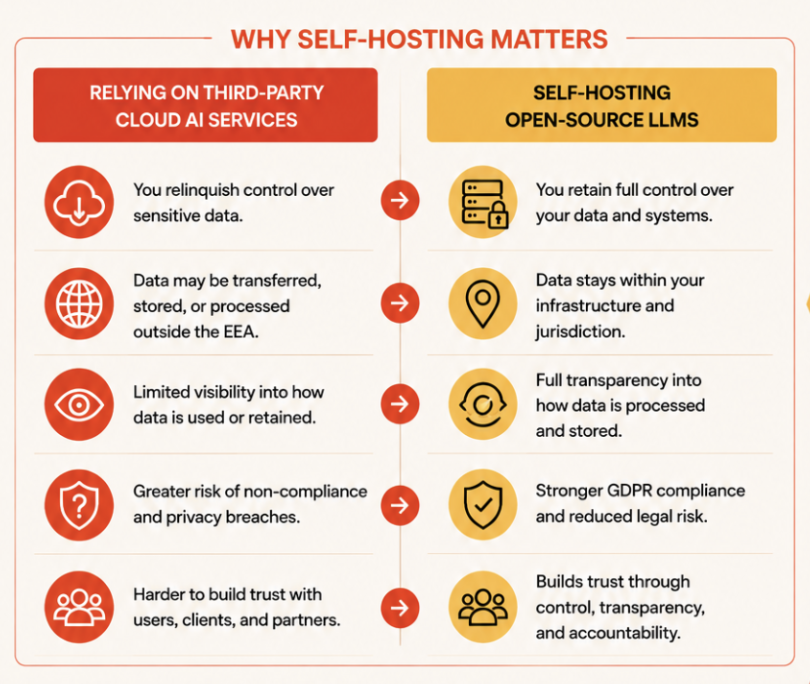
Self-hosting also gives full control over data retention and deletion, and it produces the kind of audit trail regulators ask for when personal data feeds an automated process, as Simfero's breakdown of self-hosted open-LLMs for GDPR compliance explains.
Source: SIMFERO
For everyone else
It's not a shortcut, though.
Self-hosting doesn’t remove every GDPR obligation. If the AI processes sensitive categories of personal data, the relevant GDPR requirements still apply. Then there’s the practical side: running one yourself properly requires infrastructure and technical expertise that many small agencies simply don’t have in-house, as Limina AI’s piece on the challenges of self-hosting explains.
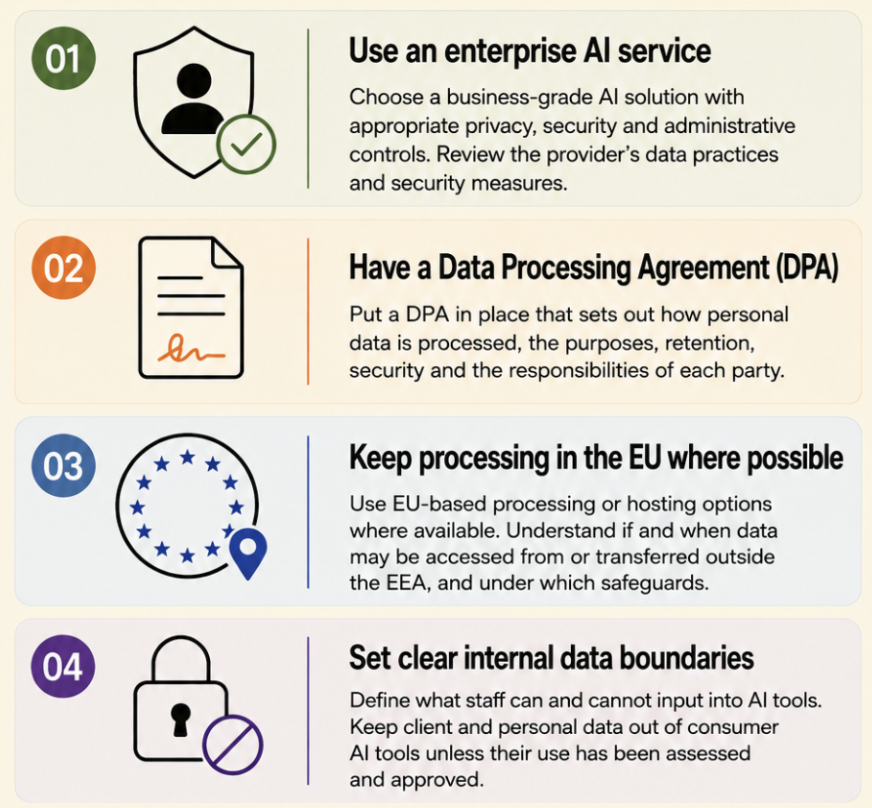
For most organisations, though, "doing this properly" is much less complicated: have a data processing agreement with the AI provider, choose EU-based hosting where it is available, and do not put real client data into consumer AI tools. That is broadly the approach set out in DPO Consulting’s guide to GDPR and AI compliance and Parloa’s overview of AI privacy rules.
Source: The Think Room visual based on info by DPO and Parloa
The workable middle ground
Use a paid, enterprise-tier tool with a signed data processing agreement for anything client-related, and keep desk research in a separate, less sensitive zone.
At The Think Room, the DNA Key research now comes with a choice for clients: automated web research, or a slower manual version at a higher cost, because people should know how their information gets handled before the work starts.
What stays consistent everywhere
Spain enforces GDPR more strictly than Germany does, which surprises people who assume the rules read the same everywhere. They don't, in practice.
What stays the same:
Disclose the tools and the transfers. Decide deliberately which steps in a process really need AI versus which ones just default to it.
Alright, so LinkedIn.
The AI slop button is live, and it's not what you thought
LinkedIn's Chief Product Officer, Hari Srinivasan, confirmed in late July that a "Seems like AI slop" option is now available with every post, as TechCrunch reported.
Flag a post, and it feeds LinkedIn's classifiers, which trim that content's reach in feeds outside the poster's own network, a mechanism this LinkedIn Pulse breakdown of the five rules for AI posts in 2026 walks through in detail.
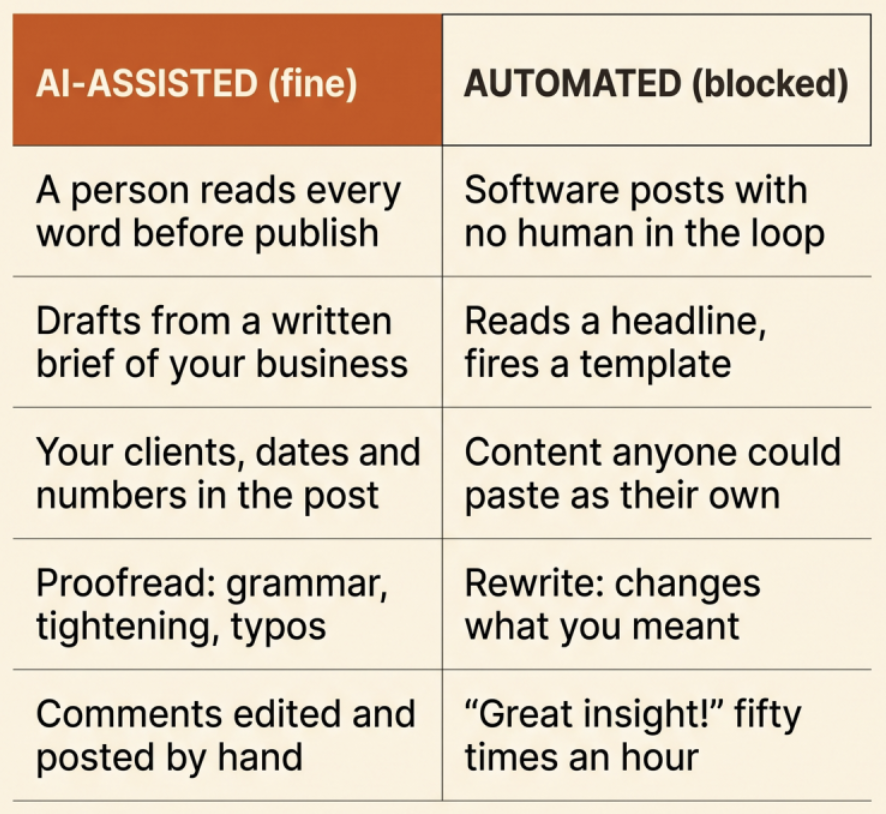
Srinivasan: "AI in the loop is fine. AI as the author is not." LinkedIn's own help page on best practices for content created with the help of AI defines the target as content that "feels generic, repetitive, recycled, or designed primarily to game attention rather than add to a meaningful conversation." So the tool isn't hunting for AI use, plenty of posts get help from AI at some stage. It's hunting for posts with nothing behind them.
Source: Neeraj Shah's Linkedin
Flagged posts don’t get removed. Their reach may drop in much the same way as when someone clicks “not interested,” according to Startups.co.uk’s explainer on what happens when a post gets tagged.
There’s a private nudge for the person who posted it too. A note can appear in their analytics when people read the content as overly AI-generated or inauthentic. Nobody else sees it, as Mashable covered here.
And people have learned the tells:
🥱 Using three times the words you need to make one point.
🦜 Explaining it again after everyone understood it the first time.
🤯 Formatting every thought into tidy, even-length bullets.
One useful test before publishing anything: could a stranger have written this exact post with the same prompt? If yes, it's missing a name, a story, date, a real number, something only you would know.
A different approach is X’s Community Notes. Contributors can add context to potentially misleading posts, but notes do not appear through a simple majority vote. The system looks for agreement among contributors who have disagreed in their previous ratings, an attempt to prevent one group from determining what appears.
The system has drawn criticism, much of it tied to wider debates about X and content moderation. But the idea behind it is worth thinking about: people with different rating histories have to find some common ground, rather than one central team making the call. X determines those different perspectives from how contributors have rated previous notes, rather than their political affiliation, demographics, follows or posts (X Community Notes: Diversity of perspectives).
That makes it an interesting model for moderation, as Liora Kern 🍒 has seen through occasionally contributing to Community Notes on X.
The conversation consulting firms are about to have
The coming months bring contract renewals. And this year, more clients are asking themselves (or you):
Is this senior invoice covering work that could have come out of an AI subscription?
What clients may start questioning
That's not a knock on large consulting firms, plenty of what they do still needs judgment and scale no AI tool replicates.
But when a deliverable is a logo, a generic visual, or speaking points that read like they came straight out of a prompt, and the bill reflects senior hourly rates, that chink is going to come up in renewal conversations this quarter.
One counterargument holds for some clients: they don't want to know how the work gets made, as long as the KPIs are hit and the invoice is fair. Fair enough.
For anyone running a team, the work looks more like this: a fifty-page research report or a full brand document still needs a week of senior review and creative judgment, no matter who or what produced the first draft.
AI may make that first draft faster, but it doesn't necessarily reduce the senior work that comes after.
Make the disclosure a selling point
The stronger move, for any consultant or agency: say plainly what's AI-assisted and what isn't, and treat that disclosure as a selling point rather than a confession.
Something like: this part uses a visibility tool that scans placements at a scale no person could manage by hand, and that scale is exactly why it's worth paying for. Clients who hear that upfront tend to trust the relationship more, not less. Finding out mid-project, by accident, does far more damage than the disclosure ever would.
The opportunity
There’s also an opportunity here for smaller firms and independent consultants. They can use AI openly, keep costs lower and still produce work to a high standard.
For clients, that can mean paying for the expertise and work involved, rather than the costs that come with running a much larger firm.
Turning your own LinkedIn data into decisions
One habit worth adopting this month: pull a full LinkedIn performance export, add what the platform doesn't give you by default (likes, saves, shares, comments per post, tracked manually in a spreadsheet), and hand the whole thing to an LLM with one instruction: find what's working, what needs to be improved and what to drop.
The findings tend to be specific. One dataset showed posts published before 9:00am consistently outperforming a longtime habit of posting at 9:45am, across every instance tested. That kind of pattern is close to invisible without pulling the numbers together, and it's the kind of task AI does very well: finding structure across a pile of historical data,.
One thing to avoid entirely: AI-written comments. LinkedIn already suppresses them, and the slop button adds a second layer of penalty on top.

Source: Supermeme.ai
Format notes: video keeps climbing, but a mix still matters
Video is rising fast. For quite a while only posts promoted by LinkedIn were performing well, but now unpromoted accounts are seeing real video traction too.
Anyone comfortable speaking on camera should treat an unscripted, easygoing selfie video as a format worth testing.
No format needs to be avoided across the board, unless it's already working unusually well for someone specific, the way Henneke Duistermaat who posts hand-drawn cartoons with every update stands out precisely because she never breaks the pattern.
Source: Henneke Duistermaat's Linkedin
Outside that kind of signature niche, mixing formats (video, carousel, plain text) and tracking what performs by day and purpose beats locking yourself into one lane.
Authenticity and reach aren't opposites.
Inauthentic content can spike once, but it rarely repeats, because a reader who clicks through, meets the person, and finds a mismatch between the post and the human doesn't come back.
The test: does the person sound the same in real life as they do on LinkedIn? If not, no amount of optimization fixes that gap.
What to do this month
Disclose the tools you use, and for which parts of the work
Keep client data and desk research in separate files
Write posts that could only have come from you
Expect the renewal conversation this quarter, and get ahead of it
Please subscribe and turn on our bell, so you don't miss our updates.
Many thanks for reading, or scrolling through,
The Think Room Team
We make you visible, credible and human in the age of algorithms
